
Official statement
Other statements from this video 8 ▾
- □ Is latency really killing your conversions and SEO performance?
- □ Is mobile performance really the game-changer for your Google rankings?
- □ Is running Lighthouse multiple times really the only way to get reliable performance diagnostics?
- □ Are animated GIFs really tanking your SEO and Core Web Vitals?
- □ Is image lazy loading really essential for your SEO performance?
- □ Are your JavaScript bundles really dragging down your Core Web Vitals?
- □ Should you really be analyzing your JavaScript bundles with webpack to boost SEO performance?
- □ Why does performance optimization take so much time in SEO?
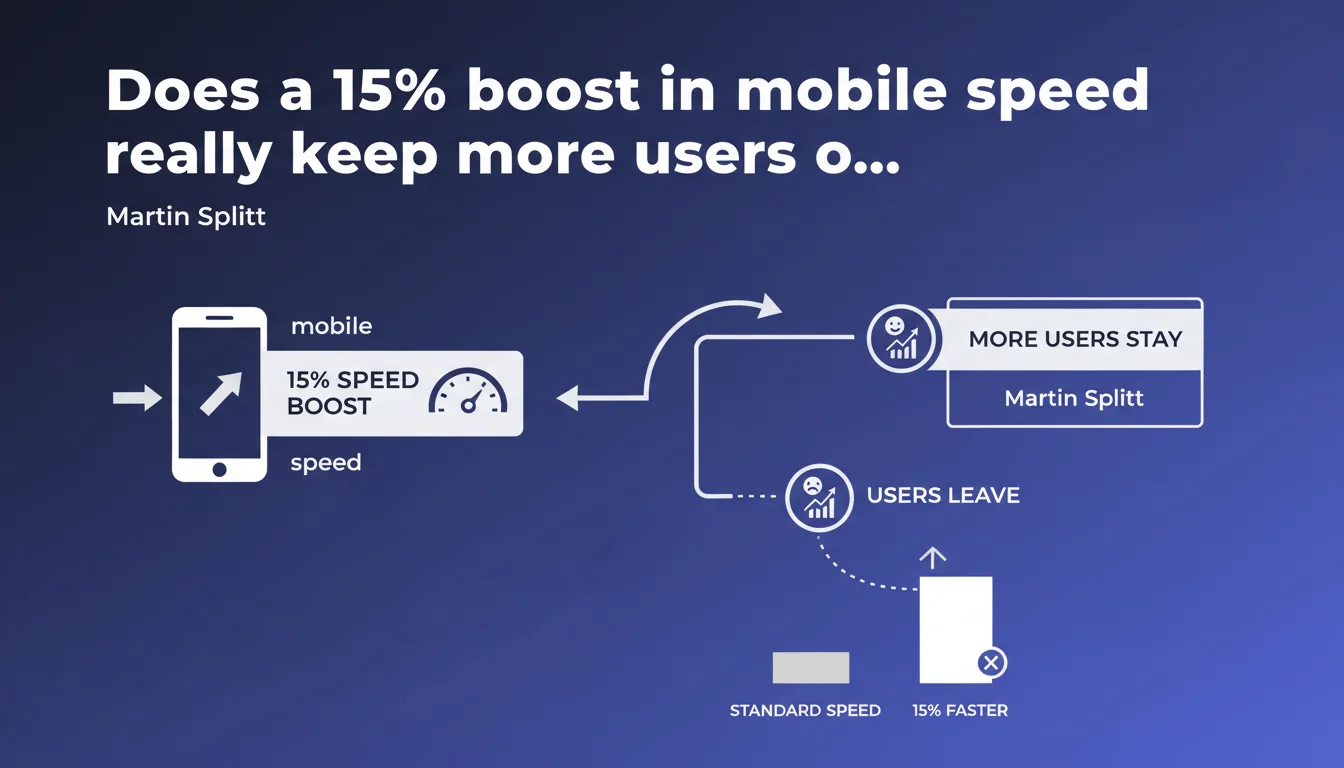
Martin Splitt confirms that reducing mobile load time by 15% generates measurable increases in product page retention. Google establishes a direct and quantifiable link between technical performance and user engagement. The takeaway: mobile speed is no longer just a 'best practice'—it's a business lever.
What you need to understand
Why is Google specifically focusing on product pages?
Product pages are the most scrutinized when it comes to bounce rate and conversion. A user landing on a product listing has strong commercial intent: they want to decide, and fast. If the page is slow to load, they bounce — and Google knows this.
By targeting this specific page type in his messaging, Splitt sends a clear signal: performance directly impacts business metrics, not just Core Web Vitals. And that's where it matters to Google, because a poor user experience degrades SERP perception.
What does this 'measurable increase' actually mean in numbers?
Google remains vague on the magnitude. 'Measurable' doesn't mean 'massive.' We're talking about maybe a few percentage points of extra retention, but on a high-traffic e-commerce site, that can represent thousands of saved sessions each month.
The ambiguity is intentional: Google never gives precise ranges to prevent mechanical optimization toward a specific threshold. But the message is clear: every millisecond counts, especially on mobile where user patience is even shorter.
Why exactly 15%?
This figure is no accident. It corresponds to realistic optimization effort: dropping from 3.5 seconds to 3 seconds of load time, or from 2 seconds to 1.7 seconds. It's achievable without a complete overhaul.
Google isn't talking about cutting load time in half — that would be unrealistic for most sites. Instead, it sets an accessible target that allows you to measure impact without requiring months of development work.
- Mobile performance impacts user retention directly, not just rankings
- Product pages are particularly sensitive to load time due to their commercial function
- A 15% improvement is a realistic and measurable target
- Google intentionally avoids giving conversion figures to prevent mechanical optimization
SEO Expert opinion
Does this statement actually change anything on the ground?
Not really. Teams working on large e-commerce sites already know that mobile speed is critical. What's new is that Google is publicly endorsing the link between technical performance and retention — which can help convince decision-makers who are hesitant to invest in optimization.
But let's be honest: if you've already implemented lazy loading, optimized your images, and reduced render-blocking JavaScript, you're not learning anything here. It's a public validation, not a revelation.
Do you really need to hit exactly 15% improvement?
No. This figure is an example, not a magic threshold. What matters is tracking your own data: analyze the correlation between load time and bounce rate on your product pages. [Verify] in your specific context — a luxury site doesn't have the same expectations as a price comparison tool.
And remember: not all sites react the same way. A B2B site with qualified traffic and a long decision cycle can tolerate more latency than a pure-play mobile player where users are comparing three competitors simultaneously.
Can you really isolate the impact of speed?
That's the weak point of this statement. Splitt talks about a 'measurable increase' but doesn't explain the measurement method. Was this data isolated in a rigorous A/B test? Or is it a correlation observed across a large sample?
The reality is that mobile speed is often correlated with other factors: a fast site is typically better coded, better maintained, with more polished UX. It's hard to say whether speed alone is what keeps the user, or the entire experience as a whole.
Practical impact and recommendations
What should you prioritize measuring on your product pages?
Start by cross-referencing your performance data with business metrics. Use Search Console to identify your slowest product pages, then compare their bounce rates and conversion rates in Google Analytics (or GA4).
Focus on Largest Contentful Paint (LCP) on mobile — it's the metric that best reflects how users perceive speed. If your LCP exceeds 2.5 seconds on mobile, you have immediate room for improvement.
Which optimizations deliver results fastest?
Image compression remains the quickest lever to pull. Convert your product visuals to WebP or AVIF, enable lazy loading on below-the-fold images. You can easily gain 10-20% in load time.
Next, reduce render-blocking JavaScript: defer non-critical scripts, eliminate unused libraries. A Lighthouse audit will give you a precise list of quick wins.
- Audit your product pages with PageSpeed Insights and identify those with LCP > 2.5s
- Cross-reference CrUX data (Chrome User Experience Report) with your actual bounce rates
- Convert your product images to next-gen formats (WebP, AVIF)
- Enable lazy loading on all images not visible in the initial viewport
- Reduce JavaScript bloat: remove unused libraries, defer non-critical scripts
- Set up a CDN if you haven't already — network latency weighs heavily on mobile
- Test before/after impact by monitoring session duration and bounce rate on your target pages
❓ Frequently Asked Questions
15% d'amélioration de vitesse, c'est mesuré comment ?
Est-ce que cette amélioration impacte directement le ranking Google ?
Faut-il prioriser mobile ou desktop pour ces optimisations ?
Quel outil utiliser pour mesurer l'impact réel sur la rétention ?
Un site avec beaucoup de médias peut-il atteindre 15% d'amélioration facilement ?
🎥 From the same video 8
Other SEO insights extracted from this same Google Search Central video · published on 29/12/2022
🎥 Watch the full video on YouTube →
💬 Comments (0)
Be the first to comment.