
Official statement
What you need to understand
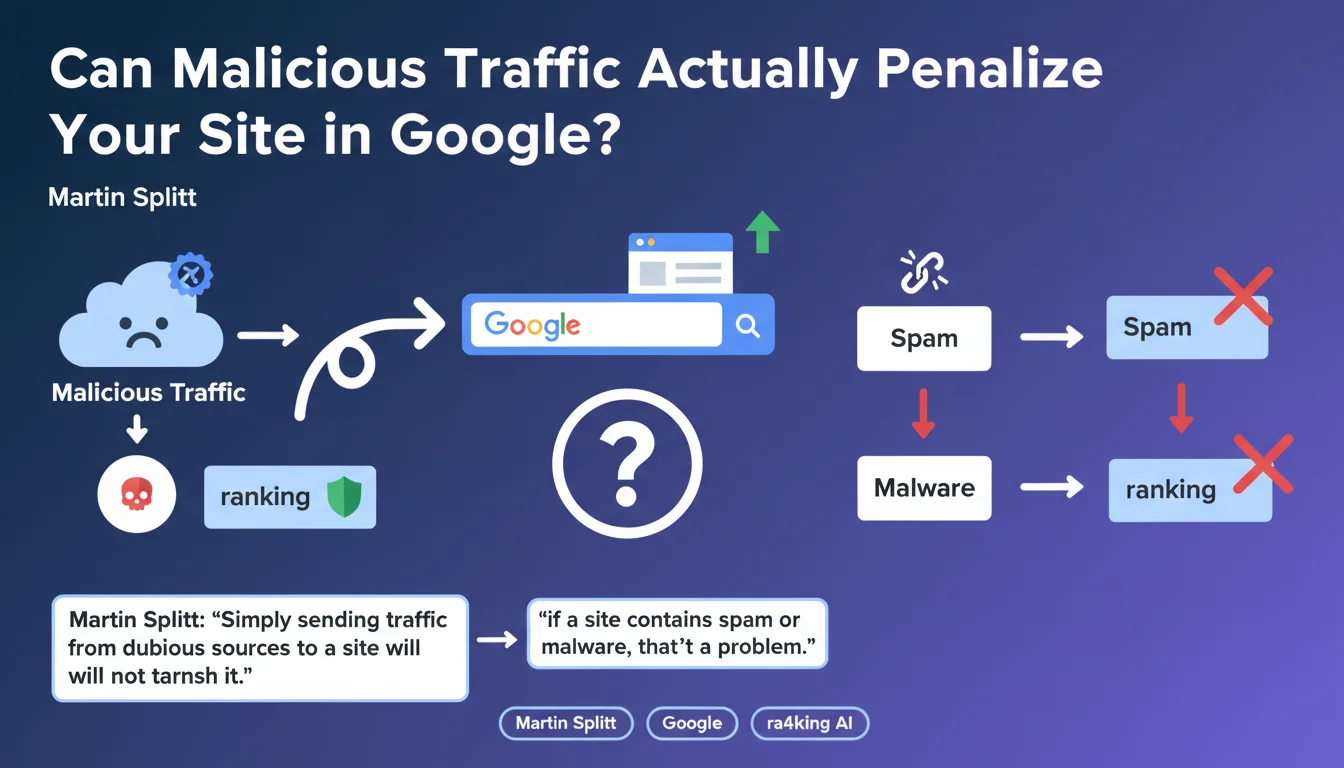
Google officially confirms that a site cannot be penalized by external traffic attacks. Concretely, if a competitor or malicious actor decides to massively send suspicious, fraudulent, or bot-generated traffic to your site, this will not affect your ranking in search results.
This statement puts an end to a persistent fear in the SEO community: that of negative SEO through artificial traffic. Google's algorithms are sophisticated enough to identify and ignore these external manipulation attempts.
However, Martin Splitt makes a crucial distinction: if your site actually hosts spam or malware, that's problematic. The distinction is important between suffering an external attack and having a genuinely compromised site.
- External malicious traffic does not impact your SEO
- Google differentiates between external attacks and compromised content
- An infected site or one containing spam remains penalizable
- Your site's security remains your responsibility
SEO Expert opinion
This position from Google is consistent with what we've been observing in the field for several years. Supposed cases of negative SEO through traffic often turn out to be misleading correlations, where other factors actually explain the ranking drops.
An important nuance: if malicious traffic causes chronic server overload, catastrophic loading times, or repeated 503 errors, then yes, indirectly this can harm SEO. It's not the traffic itself that penalizes, but the degradation of user experience it causes.
Furthermore, certain types of more sophisticated attacks, such as massive content scraping or link injection attempts, require active monitoring. Google makes the distinction, but your infrastructure must hold up.
Practical impact and recommendations
- Don't panic if you notice a suspicious traffic spike in Analytics: your Google ranking is not threatened by this fact alone
- Monitor your site's technical health: response times, availability, server error rates that can be affected by massive traffic
- Strengthen security: CMS updates, web application firewall (WAF), SSL certificate, because a compromised site will be penalized
- Regularly audit your content to detect any spam injection, malicious links, or compromised pages
- Use Google Search Console to monitor security alerts and indexing issues
- Implement a performance monitoring system to quickly identify degradations related to DDoS attacks
- Configure filtering rules at the server or CDN level to block obviously malicious traffic and preserve your resources
- Document suspicious traffic incidents to identify patterns and anticipate future attacks
Implementing a comprehensive SEO security strategy requires advanced technical expertise, combining sophisticated monitoring, log analysis, and infrastructure optimization. These aspects touch on technical SEO, cybersecurity, and data analysis simultaneously—areas where support from a specialized SEO agency can prove particularly valuable to ensure optimal protection without compromising your performance.
💬 Comments (0)
Be the first to comment.