
Official statement
Other statements from this video 4 ▾
- □ Le choix du CMS a-t-il vraiment un impact sur votre classement Google ?
- □ Google juge-t-il vos pages sur leur méthode de création ou uniquement sur leur qualité finale ?
- □ Le CMS influence-t-il vraiment les performances SEO de votre site ?
- □ Les CMS sont-ils vraiment prêts pour le SEO dès l'installation ?
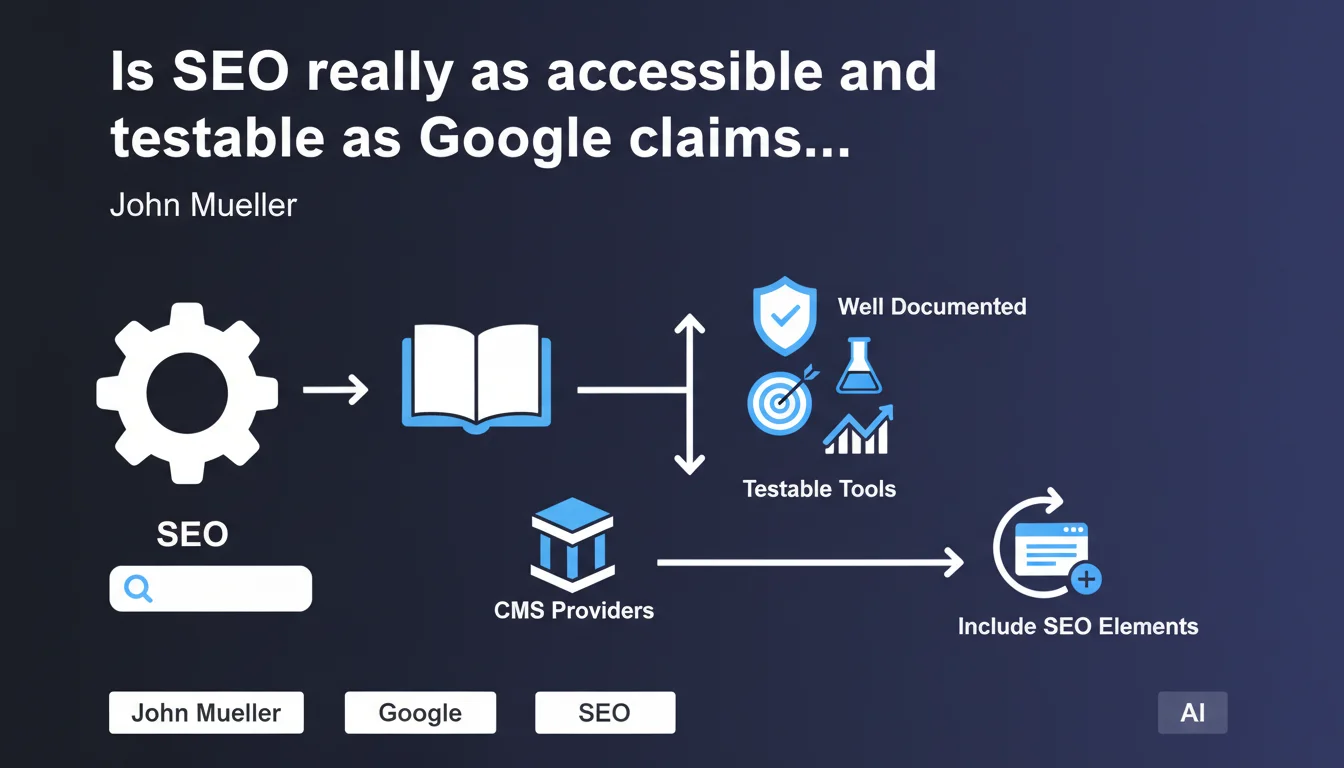
Mueller argues that SEO holds no mysteries: it is well documented and testable, which theoretically allows any CMS to integrate best practices. Behind this straightforward statement lies a more nuanced reality — between official documentation and real-world practices, the gap often remains considerable.
What you need to understand
What does "well documented" mean when Google says it?
When Mueller talks about documentation, he's referring to official resources: Search Central, guidelines, public statements during Google Search Central Office Hours. The idea: any developer or CMS editor can access the information needed to create a SEO-compatible system.
The subtext is clear. Google is responding to a recurring criticism that organic search would be a black box reserved for insiders. This statement aims to demystify SEO and push platforms to take responsibility.
What does "testable" mean?
Tools abound: Search Console, Lighthouse, PageSpeed Insights, mobile-friendliness test, structured data validator. These tools allow you to verify indexability, performance, and mobile compatibility.
The promise: anyone can audit their site without relying on an external consultant. This is technically true for basic technical aspects — crawlability, loading time, Schema markup.
Why this statement now?
It fits into a logic of holding platforms accountable. Google has long been accused of favoring certain CMS platforms or not providing clear enough guidance. Here, Mueller passes the ball back: if your CMS is poor at SEO, it's not a Google documentation problem.
- Technical SEO relies on public standards (HTML, HTTP, Schema.org)
- Google provides free diagnostic and validation tools
- CMS editors have no excuse for ignoring the fundamentals
- The "magic" often mentioned mostly hides a lack of understanding of the basics
SEO Expert opinion
Does this simplistic vision match the reality on the ground?
Let's be honest: yes for technical fundamentals, no for everything else. A CMS can indeed integrate canonical tags, generate correct XML sitemaps, optimize crawl budget. These aspects are documented and testable.
But reducing SEO to that is to ignore the real complexity of modern search optimization. Official documentation says nothing — or almost nothing — about the respective weight of ranking signals, penalty thresholds, toxic link patterns, Google's real expectations regarding content.
Which aspects remain completely opaque despite the "documentation"?
Take the example of quality content. Google repeats that you need to create useful content for the user. Great. But what minimum length? What text-to-image ratio? What optimal publishing frequency? How is "usefulness" measured algorithmically? [Fact-check needed] because Google will never tell.
Same thing for backlinks. The documentation says "get natural quality links." Perfect. But how many? From which domains? With what acquisition velocity to avoid alerts? These crucial questions have no official answer — you test, you observe, you deduce.
Does "testability" have limits?
Absolutely. Google tools test technical compliance, not actual performance in the SERPs. Search Console tells you if your page is indexable, not if it will rank. Lighthouse measures loading time, not semantic relevance.
And that's where it pinches. The real test is ranking in live conditions — and no Google tool predicts that with reliability. You're forced to go through third-party platforms (SEMrush, Ahrefs) and especially through empirical experimentation.
Practical impact and recommendations
What should you concretely do with this information?
First, master the documented fundamentals. Make sure your CMS properly handles meta tags, robots.txt, sitemap, 301 redirects, Schema markup. These aspects are indeed well documented and non-negotiable.
Then, definitely don't stop there. Use free Google tools as a diagnostic basis, but supplement with third-party tools for backlink analysis, rank tracking, competitive semantic analysis.
What mistakes should you avoid after this statement?
Don't fall into the trap of believing that following official documentation is enough. A technically perfect site according to Google can very well never rank if it lacks authority, semantic relevance, engagement signals.
Also avoid underestimating complexity. Yes, SEO is testable — but testing intelligently requires experience, structured hypotheses, rigorous methodology. It's not because it's "documented" that it's simple.
How to verify that your site applies best practices?
- Audit your site with Search Console, Lighthouse and PageSpeed Insights — fix critical errors
- Verify that your CMS automatically generates essential tags (title, meta description, canonical, hreflang if needed)
- Test the indexability of your strategic pages with the URL inspection tool
- Validate your Schema markup with the structured data validator
- Measure your Core Web Vitals in real conditions (CrUX report)
- Compare your performance with that of your direct competitors via third-party tools
- Set up rank tracking to detect fluctuations quickly
Mueller's statement is useful for reminding that the technical basics of SEO are not witchcraft. Everything is accessible, documented, testable. But it oversimplifies a far more complex reality.
Technical aspects are indeed manageable with rigor. However, everything touching on content, links, authority remains largely empirical. Official documentation will never replace field experience.
These technical and strategic optimizations represent a substantial undertaking, especially on complex sites or competitive sectors. If you feel that the scope of the task exceeds your internal resources, support from a specialized SEO agency can save you valuable time and help you avoid costly mistakes.
❓ Frequently Asked Questions
Les outils Google suffisent-ils pour auditer un site ?
Peut-on vraiment tout apprendre sur le SEO via la documentation officielle ?
Tous les CMS se valent-ils en SEO si la documentation est accessible à tous ?
Cette déclaration change-t-elle quelque chose pour les professionnels SEO ?
🎥 From the same video 4
Other SEO insights extracted from this same Google Search Central video · published on 13/07/2022
🎥 Watch the full video on YouTube →
💬 Comments (0)
Be the first to comment.