
Official statement
What you need to understand
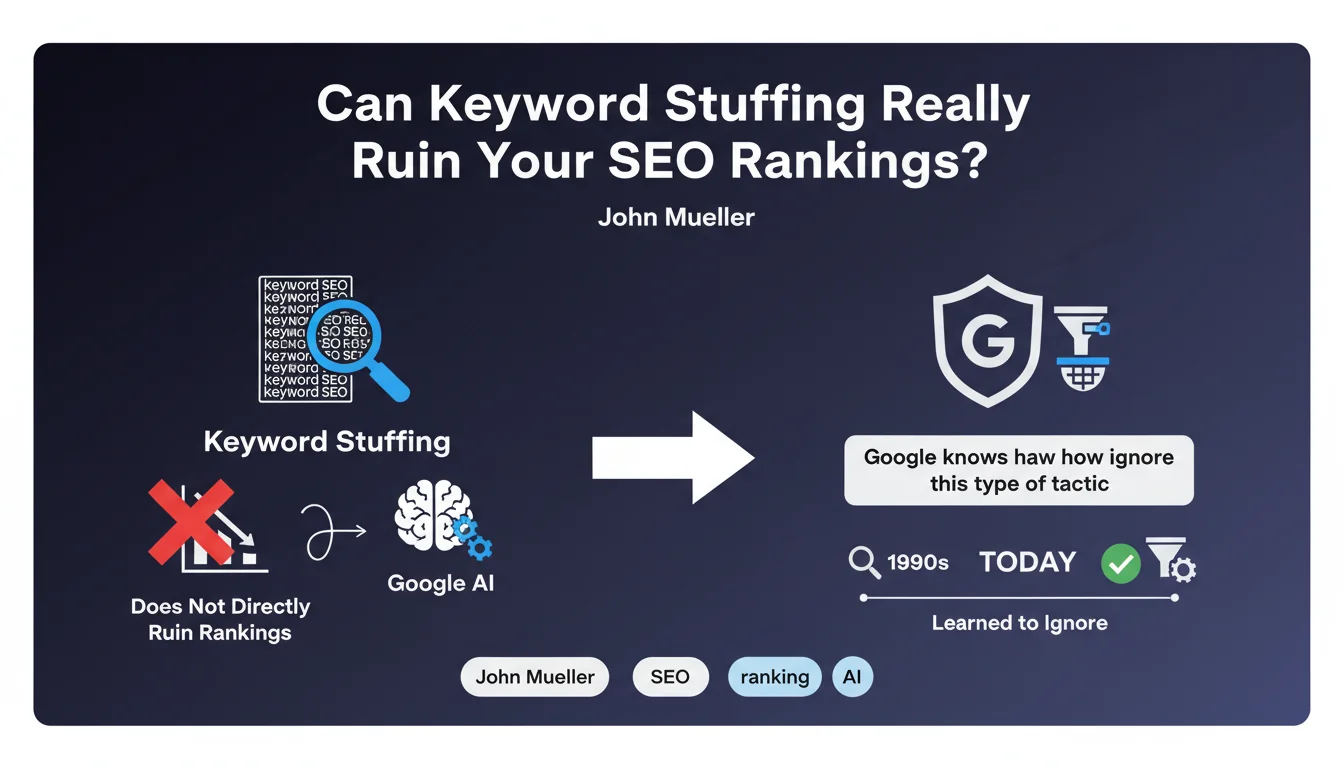
Google has officially confirmed that keyword stuffing alone does not cause deindexing or a severe penalty for your site. This practice, inherited from the 90s, consisted of massively repeating keywords to manipulate algorithms.
Today, search engines have evolved considerably. Google has sophisticated systems capable of identifying and simply ignoring keyword stuffing, without drastically penalizing the page.
This statement provides important insight into how the algorithm actually works. If your site is experiencing indexing or ranking issues, keyword stuffing is probably not the main cause.
- Keyword stuffing is ignored by Google, not necessarily penalized
- This practice doesn't justify blacklisting or complete deindexing
- SEO problems generally have deeper causes
- Google favors neutralization rather than sanction for this obsolete tactic
SEO Expert opinion
This position is consistent with the field observations we've been making for several years. In practice, sites still using keyword stuffing mainly see their content lose relevance and performance, without completely disappearing from results.
However, this statement needs to be nuanced. While isolated keyword stuffing doesn't lead to a direct penalty, it often contributes to degrading user experience and behavioral signals. Content stuffed with keywords generates a high bounce rate, low visit time, and therefore indirectly poor rankings.
Furthermore, algorithms like Helpful Content now penalize low-quality content as a whole. A text stuffed with keywords will naturally be considered unhelpful and lose visibility, even without explicit sanction.
Practical impact and recommendations
- Audit your existing content: identify pages with excessive keyword repetitions, but don't panic if you find any
- Prioritize rewriting low-performing content: focus on important pages with keyword stuffing that generate little traffic
- Adopt a natural keyword density: aim for 1-2% maximum and favor semantic variants and synonyms
- Optimize for user intent: write first to answer visitors' questions, keywords will follow naturally
- Monitor your behavioral metrics: bounce rate, time on page, and engagement are more revealing indicators
- Never use keyword stuffing in new content: this technique is completely obsolete and counterproductive
- Vary your lexical field: use named entities, co-occurrences, and vocabulary from your topic's semantic field
- Test your content's readability: if a text sounds artificially written when read, there's a problem
Implementing a modern and high-performing SEO content strategy requires in-depth expertise of the latest algorithmic developments. Between semantic analysis, technical optimization, and creating high-value content, there are many aspects to master that are constantly evolving. For businesses looking to maximize their organic visibility, working with a specialized SEO agency provides personalized strategic support and helps avoid costly mistakes in time and performance.
💬 Comments (0)
Be the first to comment.