
Official statement
What you need to understand
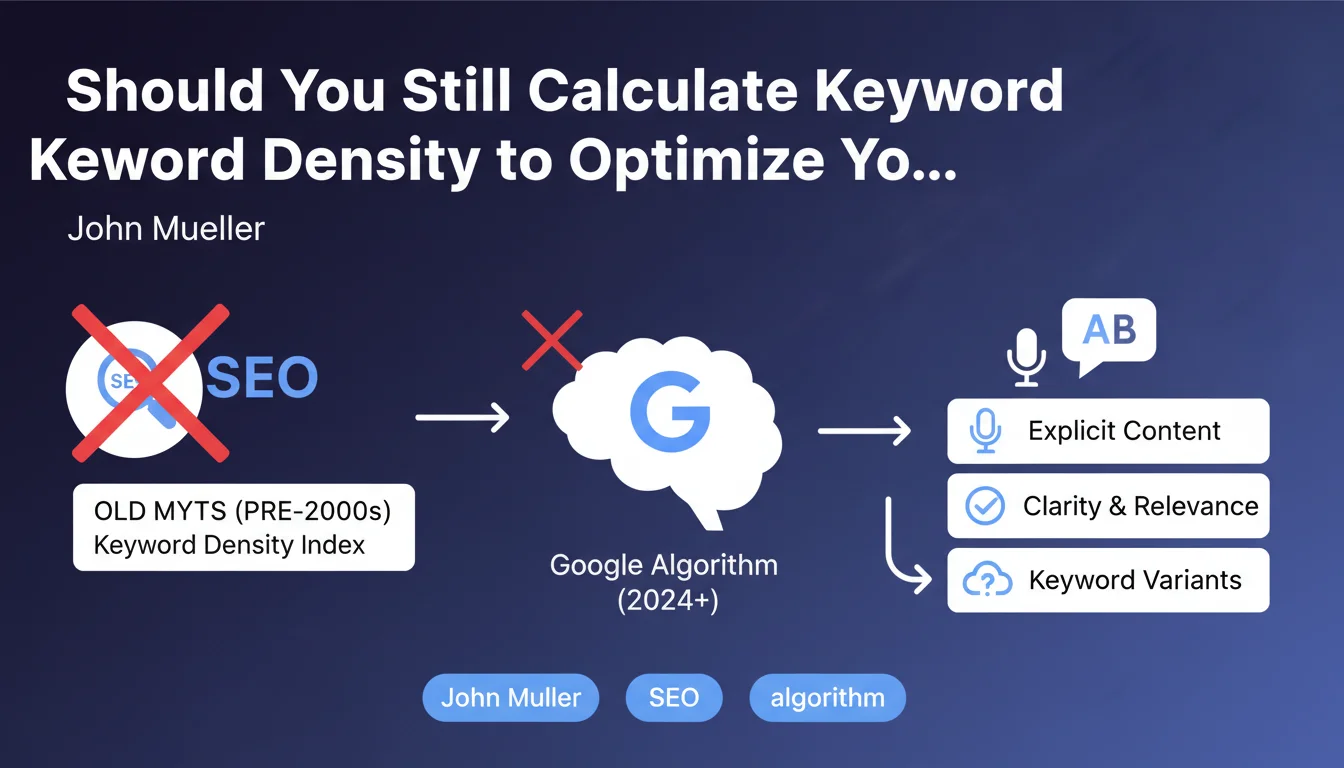
Keyword density (the percentage of occurrences of a term in a text) was once considered a major ranking factor. Some SEOs calculated the perfect ratio: 2%, 5%, 7%? This mechanical approach long dominated optimization practices.
Google confirms here that its algorithm does not calculate a density score to evaluate the relevance of a page. This metric inherited from 1990s search engines (Altavista, Inktomi) has never been part of Google's functioning.
What really matters is that the content is explicit and clear about its topic. Google favors overall semantic understanding rather than mechanical counting of repetitions.
- No magic formula: no ideal density percentage exists
- Variants unnecessary: no need to force all variations of a keyword
- Priority to explicitness: content must clearly address the topic without ambiguity
- Natural approach: write for the user, not for a mathematical ratio
SEO Expert opinion
This statement is perfectly consistent with field observations. The pages that perform today are not those with a calculated density, but those that precisely respond to search intent with natural and rich vocabulary.
However, an important nuance: while density as a metric doesn't exist, the presence of the keyword remains necessary. A page that never explicitly mentions its main topic will struggle to rank. It's about finding the balance between sufficient presence and over-optimization.
Beware of the opposite trap: completely rejecting the notion of density doesn't mean totally ignoring keywords. Google needs clear textual signals to understand your topic. The risk is falling into content that's too vague or generic.
In practice, the best-ranked pages naturally use their main keyword in strategic areas (title, H1, opening paragraphs, relevant H2s) without artificial calculation. This is the contextual approach that Google values.
Practical impact and recommendations
In summary: abandon keyword density calculation tools and focus on semantic clarity and contextual relevance of your content.
- Stop calculating keyword density in your existing or future content
- Uninstall plugins or tools that alert you about density percentages
- Write naturally by focusing on answering search intent
- Ensure clear presence of the topic in the title, introduction, and main subheadings
- Favor the semantic field: use synonyms and related terms naturally rather than mechanically repeating
- Test understanding: a reader should immediately grasp your page's topic from the first lines
- Optimize strategic areas (title tags, H1, meta description) with the main term without stuffing
- Analyze well-positioned competitors: observe their natural approach rather than their repetition ratio
This evolution toward a sophisticated semantic approach requires completely rethinking your content strategy. Modern optimization relies on fine understanding of natural language processing algorithms and user intents. To deploy an effective SEO strategy that integrates these complex dimensions, support from a specialized SEO agency can prove valuable for auditing your existing content and building a high-performing editorial line adapted to current search engine requirements.
💬 Comments (0)
Be the first to comment.