
Official statement
What you need to understand
What exactly does Google say about differentiated interstitial display?
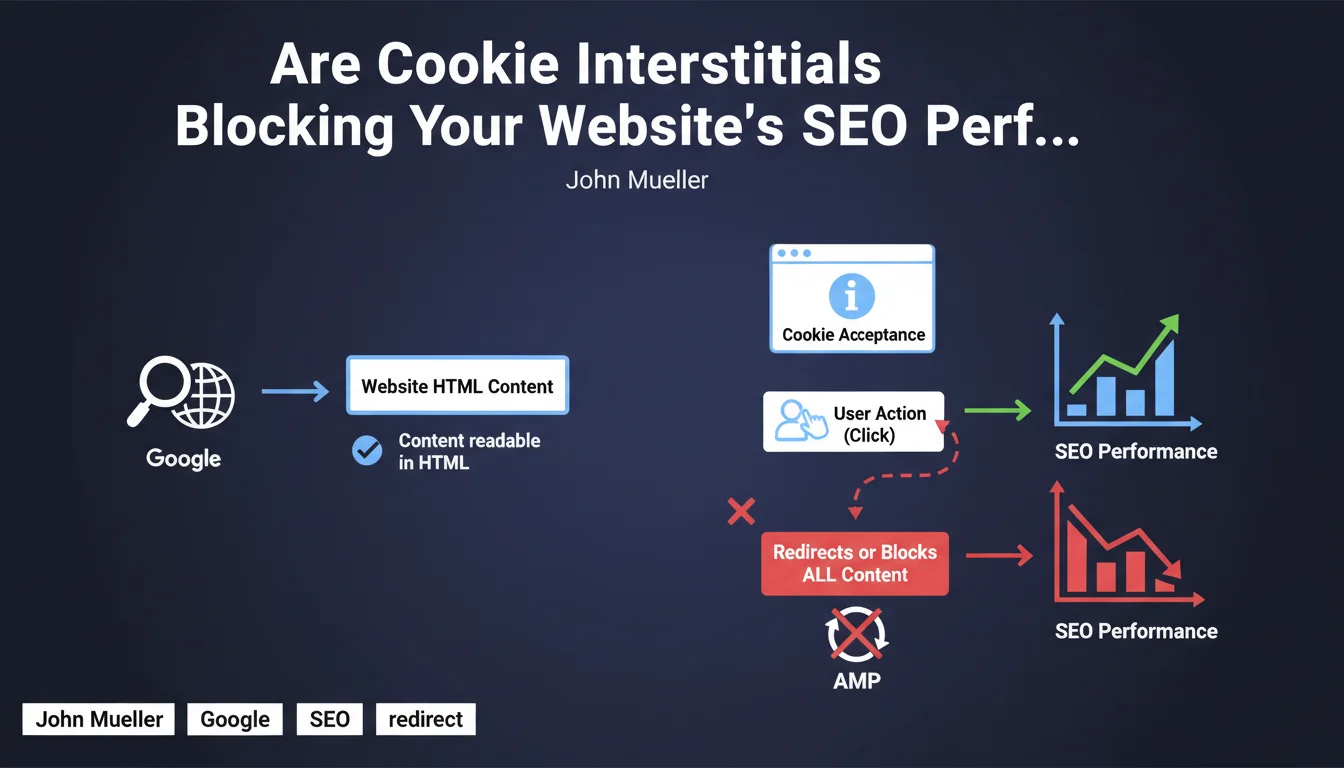
Google acknowledges that it is technically acceptable to display different interstitials depending on the traffic source. Visitors arriving directly on a mobile site may see more intrusive interstitials, while those coming from search results (and Googlebot) may benefit from a less intrusive experience.
This distinction seems to contradict traditional rules against cloaking, which consists of presenting different content to search engines and users. Yet Google considers this practice acceptable in this specific context.
Which types of interstitials does Google consider legal?
Google's algorithms are capable of recognizing legal and necessary interstitials. These include cookie management banners, GDPR warnings, or mandatory legal messages.
The essential condition: these interstitials must be displayed in front of the content page and not in place of it. The user must be able to easily access the main content after acknowledging the message.
- Accepted legal interstitials: cookies, GDPR, legal age verification, warnings required by law
- Authorized differentiation: distinct treatment of direct traffic versus organic traffic
- Critical condition: the actual content must remain accessible behind the interstitial
- Key principle: do not replace the content with the interstitial
Why does this Google position seem contradictory?
This statement creates an ambiguous gray area. Traditionally, showing something different to Googlebot and users is the very definition of cloaking, a sanctioned practice.
Here, Google seems to authorize a form of contextual cloaking based on traffic source, provided that the intention is to improve user experience from SERPs rather than to manipulate rankings. However, this nuance remains subject to interpretation.
SEO Expert opinion
Is this statement consistent with practices observed in the field?
Google's position reflects a pragmatic evolution of their approach. In reality, sites need to monetize their direct traffic differently, and Google acknowledges this economic necessity.
However, the boundary between legitimate optimization and manipulation remains blurred. I regularly observe sites penalized for similar practices, which suggests that the automatic interpretation of algorithms does not always correspond to public statements.
What are the real limits of this authorization?
Google distinguishes the intention behind the differentiation. If the objective is to comply with guidelines on intrusive interstitials for organic traffic while monetizing direct traffic, it may pass. If it's to hide content or manipulate rankings, it's cloaking.
The problem: algorithms don't read intentions, only code. An automated system can easily confuse the two situations, hence sometimes unjustified penalties or abusive practices that slip through the cracks.
In which cases does this practice become truly dangerous?
The major risk occurs when the difference between versions is too significant. A light interstitial for Googlebot and an entire page of advertising for direct traffic will likely trigger alerts.
Similarly, if the interstitial truly prevents access to the main content (forcing registration, hiding the full text), Google will consider this manipulation, regardless of traffic source. The tolerance remains limited to intensity adjustments, not changes in nature.
Practical impact and recommendations
What should you do concretely to stay within acceptable limits?
Favor a conservative and measured approach. If you differentiate your interstitials, ensure that the version for organic traffic strictly respects the guidelines: easily closable, not covering more than half the screen, not appearing immediately.
For direct traffic, even if you can be more aggressive, keep the main content quickly accessible. An interstitial that closes with one click remains within acceptable standards.
Document your implementation and ensure that the differentiation relies on clear technical criteria: HTTP referer, UTM parameters, rather than on sophisticated Googlebot detection that would resemble deliberate cloaking.
What critical mistakes should you absolutely avoid?
Never block access to indexable content behind an interstitial for Googlebot. Even if Google says it recognizes interstitials, inaccessible content remains invisible content for indexing.
Avoid overly sophisticated detection systems that specifically aim to identify Googlebot to show it something special. Instead, differentiate by traffic source (organic vs. direct) in a transparent manner.
- Never replace the main content with the interstitial
- Ensure the interstitial closes easily (visible X button)
- Limit screen coverage (maximum 50-60% on mobile)
- Differentiate by traffic source, not by bot detection
- Test regularly with Search Console (URL inspection)
- Verify that content remains crawlable with the Mobile-Friendly Test
- Document your implementation choices to justify in case of questions
- Monitor your Core Web Vitals metrics (impact on CLS notably)
How can you verify that your implementation is compliant and risk-free?
Use the URL inspection tool in Search Console to see exactly what Googlebot visualizes. Compare with what a user coming from search results sees. The gap should be minimal and justifiable.
Test with different referers and monitor your Core Web Vitals. A poorly implemented interstitial degrades CLS (Cumulative Layout Shift) and can impact your SEO independently of any manual penalty.
Analyze your bounce rates by traffic source. If organic traffic bounces significantly more than direct traffic because of overly aggressive interstitials, Google will interpret this as a signal of poor user experience.
💬 Comments (0)
Be the first to comment.