
Official statement
What you need to understand
What does geographic context mean in SEO?
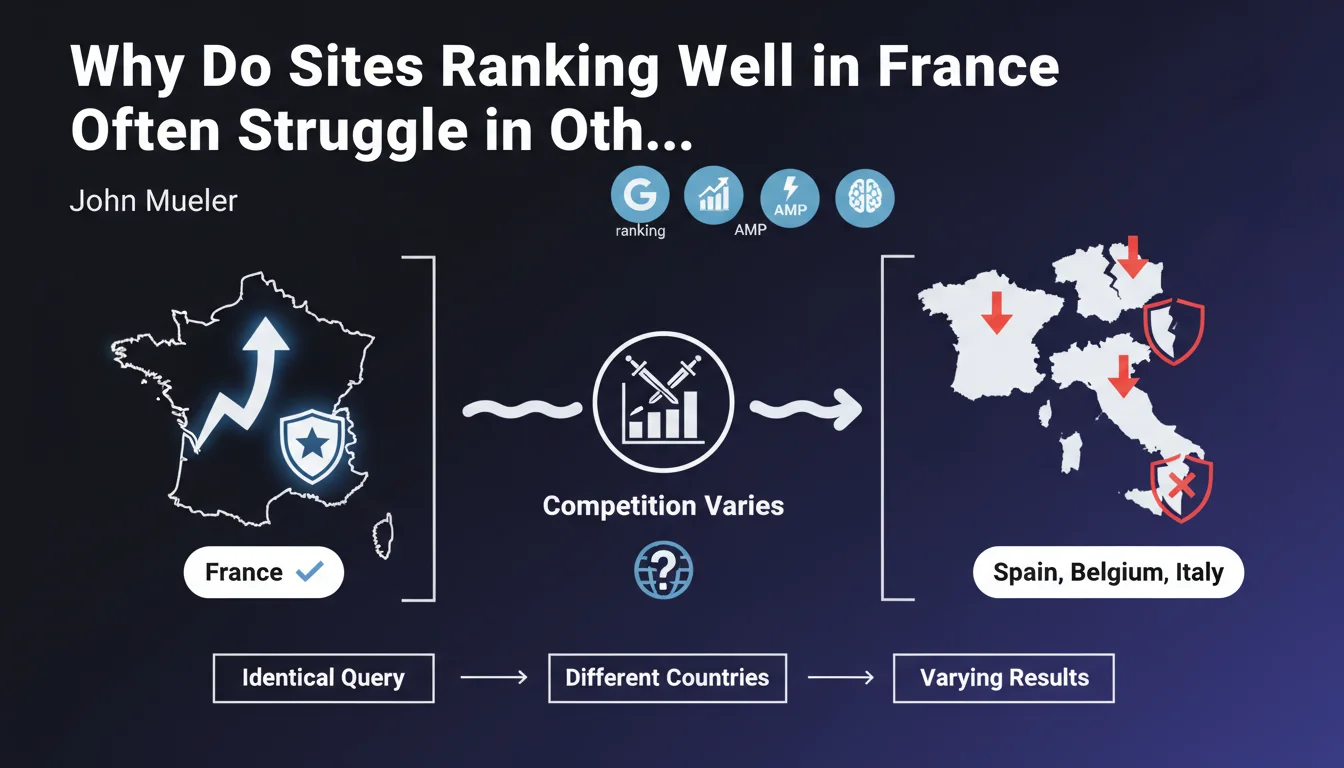
Google doesn't operate uniformly across the world. Each national version of the search engine (Google.fr, Google.es, Google.be) has its own competitive ecosystem.
A site performing well for a query in France can find itself completely invisible for the same query in Spain or Italy. This difference is explained by completely different local competitive contexts.
Why does SEO performance vary so much from one country to another?
Several factors explain these ranking differences. Local competition varies considerably across markets: a saturated sector in France may be untapped in Belgium.
Local relevance signals also play a major role. Google favors sites that demonstrate a genuine presence in each targeted country, not simply a translation.
What does it mean to optimize a site for multiple countries?
International optimization isn't limited to translating content. It requires a dedicated SEO strategy for each market: local keyword research, adapted content creation, link acquisition from national sites.
- Each national version of Google has its own ranking algorithm and its own competition
- Good positioning in one country in no way guarantees success in another
- International optimization requires a country-by-country approach, not simple translation
- Local relevance signals (backlinks, hosting, content) are determining factors
SEO Expert opinion
Does this statement match what we observe in the field?
Absolutely. After 15 years of international SEO practice, I can confirm that this reality is systematically observed. The audits we conduct show spectacular ranking differences between countries.
I've seen sites dominate their French market while being invisible in Germany or Italy. The main reason? A centralized approach that ignores the local specificities of each market.
What nuances should be added to this statement?
There are notable exceptions. Very powerful international brands benefit from a halo effect that allows them to perform in several countries simultaneously, even without extensive local optimization.
Similarly, for very specific queries or technical ones with little competition, a site can indeed position correctly in several countries. But these cases remain marginal.
In which cases doesn't this logic fully apply?
Small language markets like French-speaking Belgium or French-speaking Switzerland can sometimes be influenced by French results. Google sometimes lacks quality local content.
For brand queries, positioning generally remains stable from one country to another. If someone searches for your brand name, you'll normally appear, regardless of the Google version.
Practical impact and recommendations
How can you concretely adapt your SEO strategy for multiple countries?
Start with a local competitive analysis for each targeted market. Identify who the dominant players are, what types of content perform well, and what unexploited opportunities exist.
Implement an appropriate technical structure: country-specific subdomains (fr.example.com, es.example.com) or subdirectories (/fr/, /es/). Use hreflang tags to tell Google which version to serve to which audience.
Develop a localized content strategy, not simply translated. This means creating content that addresses the specific needs of each market, with local examples, references, and expressions.
What critical mistakes should you absolutely avoid?
Never settle for simple automatic translation. Google detects low-quality content, and users immediately reject it. Invest in native writers.
Avoid international duplicate content without hreflang tags. Google might consider your different versions as duplicated content and penalize your entire site.
Don't neglect local link building. Backlinks from French sites will only have limited impact on your ranking in Spain or Italy. Each market requires its own link acquisition strategy.
What should you check to ensure successful international optimization?
- Verify correct implementation of hreflang tags on all pages
- Analyze country-by-country positioning with Google Search Console configured for each market
- Audit translation quality and cultural adaptation of content
- Measure local backlink acquisition for each language version
- Check technical signals (loading speed, hosting) on each market
- Monitor bounce rate and engagement by country to detect relevance issues
- Conduct regular local keyword research to identify opportunities
- Track conversions and KPIs separately for each targeted market
💬 Comments (0)
Be the first to comment.