
Official statement
What you need to understand
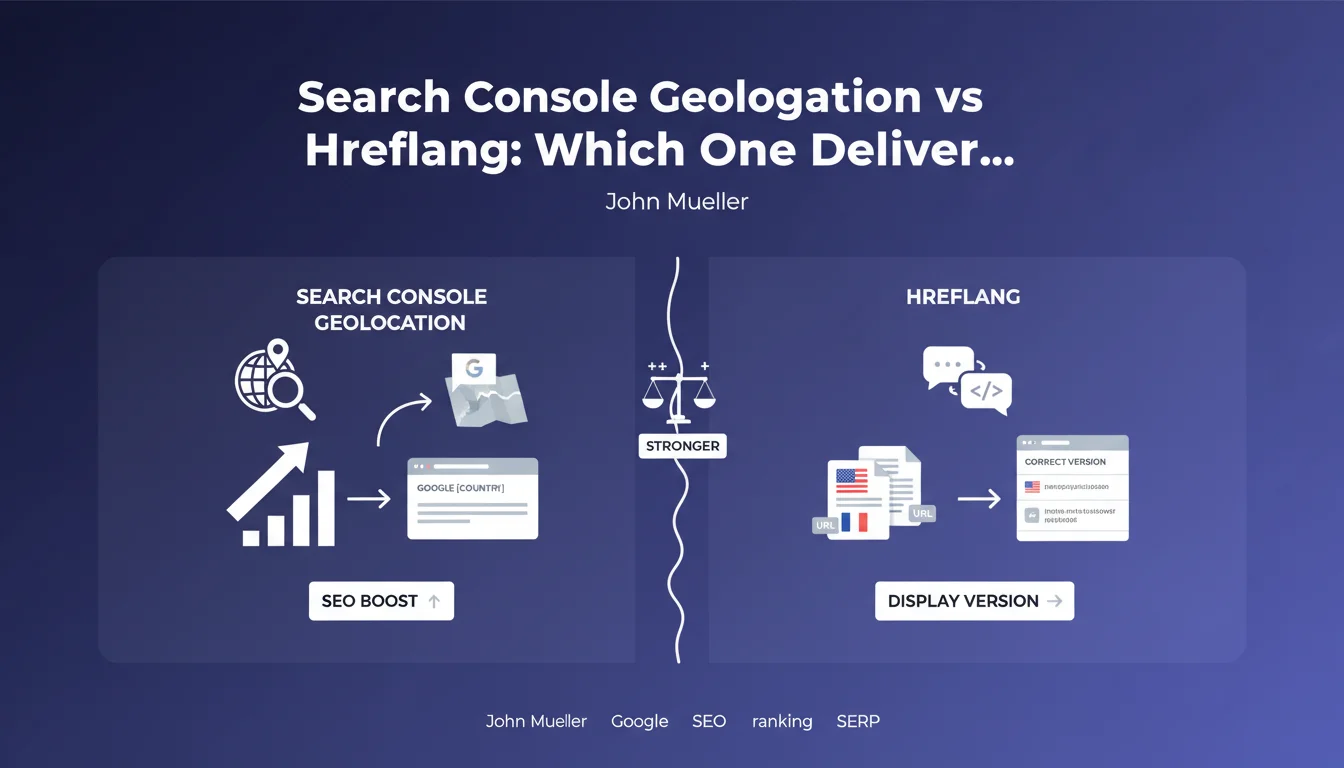
The geographic targeting parameter in Google Search Console is often misunderstood by SEO practitioners. Contrary to popular belief, setting a target country does not limit your site to that territory alone.
This configuration does not function as an exclusive filter. If you indicate "France" as your target, your site can still appear in search results in Belgium, Switzerland, Canada, or even the United States. Google considers this information as one signal among others.
The search engine actually combines multiple indicators to determine a site's geographic relevance:
- The domain name extension (.fr, .be, .com, etc.)
- The hosting server's IP address
- Mentions of physical addresses and local contact details
- Backlinks from sites in the targeted country
- The targeting parameter in Search Console
- Content language (secondary signal)
It is crucial to understand that a site must target a specific country and not a language. A common mistake is thinking that a French-language site automatically targets all French-speaking countries.
SEO Expert opinion
This statement from Google is perfectly consistent with field observations. In practice, we regularly see sites targeting France naturally appearing in Belgian or Swiss results, especially when the content precisely answers a local query.
An important nuance concerns international e-commerce sites. If you manage multiple versions of a site for different countries (example: site.fr, site.be, site.ch), the geographic targeting parameter becomes critical to avoid any cannibalization between your versions. Each version must imperatively be associated with its country in Search Console.
For local businesses, even with France targeting correctly configured, presence in other French-speaking countries can be beneficial. Don't consider this "leakage" as a problem, but as an opportunity for additional visibility, provided your offer is relevant for these markets.
Practical impact and recommendations
Following this official clarification, here are the concrete actions to implement to optimize your geolocation strategy:
- Immediately check in Search Console that the geographic targeting parameter is properly set for your site (if you're using a generic domain)
- Choose ONE single primary target country corresponding to your priority market, even if you're targeting multiple territories
- For a multi-country presence, create distinct versions of the site with subdomains (fr.site.com, be.site.com) or ccTLDs (.fr, .be) rather than a single generic version
- Properly implement hreflang tags if you manage multiple linguistic or geographic versions of the site
- Strengthen localization signals: visible physical address, local phone number, mentions in content pages
- Obtain backlinks from sites in the targeted country to reinforce geographic relevance
- Monitor performance by country in Search Console to identify unexpected opportunities in other territories
- Never rely solely on language to define geographic targeting
In summary: The geographic targeting parameter in Search Console is an important but non-exclusive signal. It must be configured systematically, while keeping in mind that your site can legitimately appear in other countries.
Implementing a coherent international architecture requires a comprehensive strategic vision: domain choices, technical structure, hreflang implementation, and coordination of localization signals. This growing complexity, particularly for multi-country sites, often justifies support from a specialized SEO agency that can orchestrate all these parameters according to your development objectives.
💬 Comments (0)
Be the first to comment.