
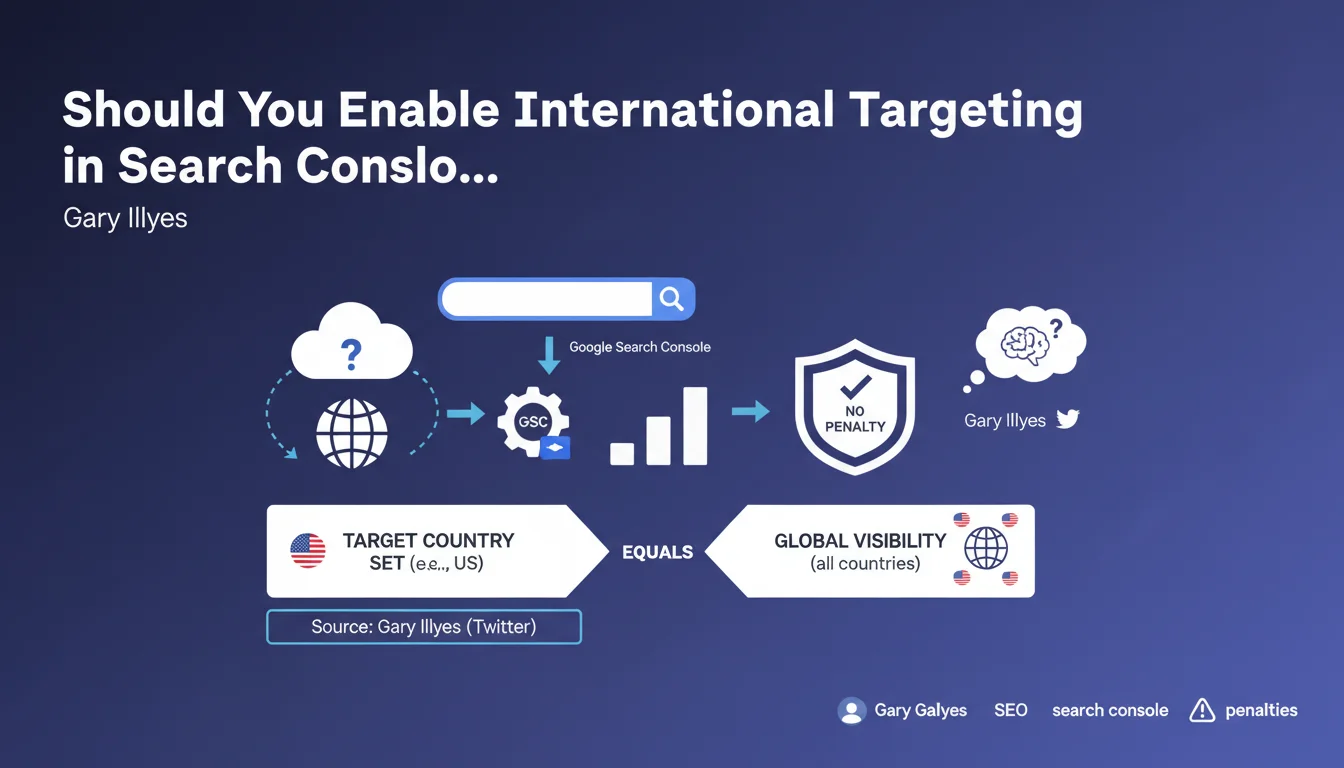
Official statement
What you need to understand
What exactly is the international targeting feature in Search Console?
Google Search Console offers a geographic targeting option that allows you to indicate the priority country for which a site wants to rank. This feature, accessible in the settings, primarily concerns generic domains (.com, .net, .org).
Unlike country-specific domains (.fr, .de, .uk) that are automatically associated with a country, generic domains can benefit from this manual indication. The theoretical objective is to help Google understand the site's primary target audience.
What does Gary Illyes' statement about the absence of penalties actually mean?
Gary Illyes claims that setting a target country does not negatively affect the site's relevance score in other countries. In other words, indicating "France" as a target would not reduce the site's visibility in the United States or Canada.
This statement may seem counterintuitive, as it raises the question of the actual usefulness of this feature. If it has no negative impact elsewhere, what advantage does it provide exactly in the targeted country?
What are the key takeaways from this statement?
- International targeting in Search Console does not penalize visibility in non-targeted countries
- This feature primarily concerns generic domains (international TLDs)
- The real impact of this option on the boost in the targeted country remains unclear in the statement
- Other SEO signals remain more decisive: content language, local backlinks, hosting, structured data
- This feature does not replace a comprehensive international strategy (hreflang, multilingual architecture)
SEO Expert opinion
Does this statement align with real-world observations from SEO professionals?
Based on my experience with multilingual and international sites, Gary Illyes' statement partially corresponds to observations. Indeed, activating geographic targeting on a .com domain does not seem to create a drastic negative filter for other countries.
However, the reality is more nuanced. While the parameter does not explicitly penalize, it still sends a geographic preference signal. In situations where Google hesitates between multiple versions of similar content, this signal can tip the scales and favor display in the targeted country at the expense of others.
What important nuances should be added to this statement?
The statement omits a crucial point: international targeting has a relative effect, not an absolute one. On a monolingual French site targeting France, the impact will be marginal because all other signals already converge toward that country. On a multilingual site with similar content, this parameter can influence traffic distribution.
Furthermore, the statement does not mention the interaction with hreflang tags. In practice, Search Console targeting must be consistent with your international architecture. An inconsistency between the two can create contradictory signals that disrupt indexing.
In which cases does this feature remain genuinely useful?
International targeting retains its value for generic domains with clear geographic anchoring but an international TLD. For example, a French e-commerce site on a .com benefits from this additional signal to reinforce its local relevance.
On the other hand, for a truly international site with multiple language versions, this option becomes problematic. It can create an artificial preference when the site should be geographically neutral at the root domain level, with subdirectories or subdomains handling specific targeting.
Practical impact and recommendations
What should you actually do with international targeting?
For a monolingual site intended for a specific national market on a generic domain, activate targeting toward the corresponding country. This configuration reinforces the consistency of your geographic signals without major risk.
For a multilingual or international site, do not activate targeting at the root domain level. Instead, use a subdirectory architecture (/fr/, /en/, /de/) or subdomains with properly configured hreflang tags to handle targeting for each version.
In all cases, prioritize strong natural signals: content in the target language, mentions of local addresses and phone numbers, backlinks from sites in the targeted country, and LocalBusiness structured data if relevant.
What critical mistakes should you avoid in your targeting strategy?
- Never set country targeting if your site offers multiple language versions at the same hierarchical level
- Do not use international targeting as a substitute for hreflang tags for a multilingual site
- Avoid inconsistencies between the country targeted in Search Console and on-page signals (language, currency, geographic mentions)
- Do not frequently change target countries, as this can create confusion in indexing
- Do not forget to verify that your hosting provider and CDN are not creating contradictory automatic geographic redirects
How can you audit and optimize your current geographic targeting?
Start by checking in Search Console whether targeting is currently active and whether it matches your strategy. Then analyze the geographic distribution of your organic traffic in Google Analytics to identify any inconsistencies.
Audit all your geolocation signals: hreflang tags, language declared in HTML, geographic mentions, backlinks, and Google Business Profile. All these elements must form a coherent whole pointing to your target market.
Test your site's display in search results from different countries using simulation tools or VPNs. Verify that the correct language version appears for each market and that hreflang tags are functioning properly.
💬 Comments (0)
Be the first to comment.