
Official statement
What you need to understand
What exactly does Google say about the position of internal links?
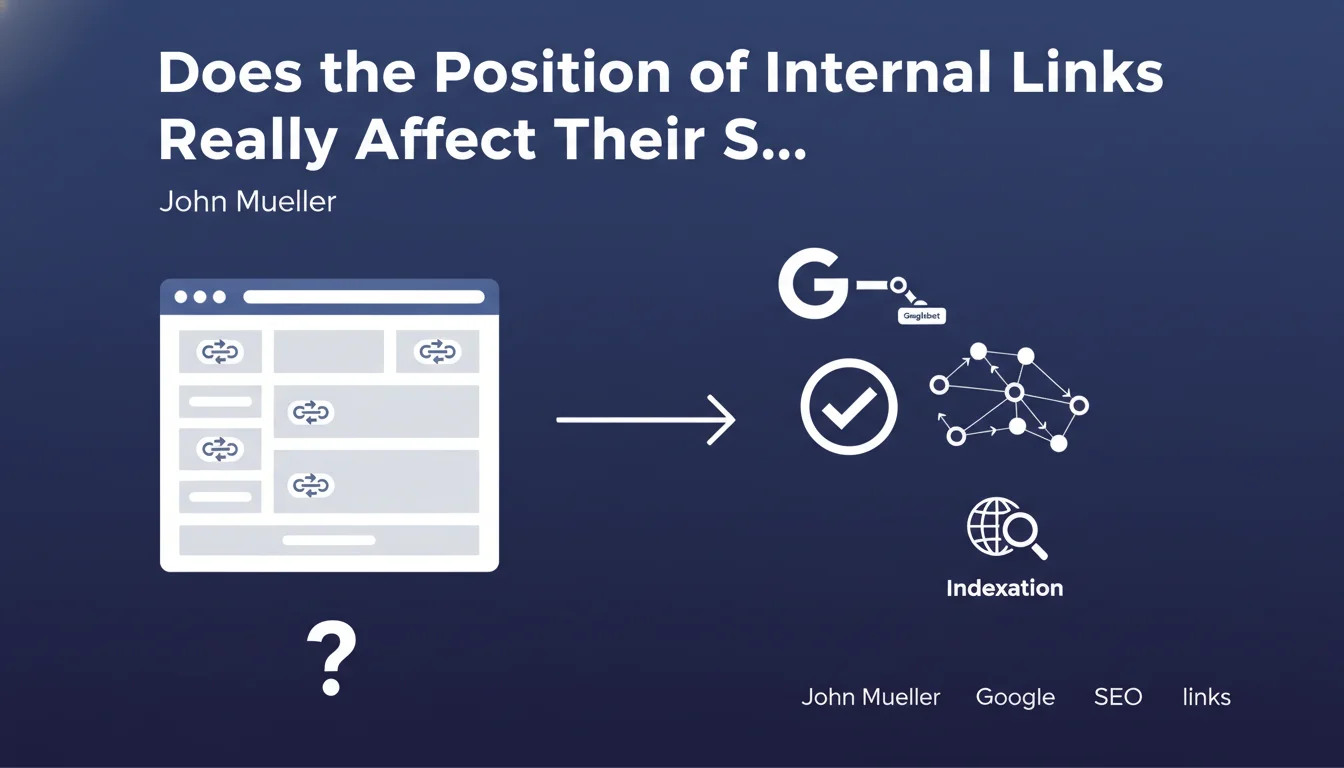
Google clearly states that all internal links on a page are detected and followed by Googlebot, regardless of their position. Whether they're placed in the header, body text, sidebar or footer, no discrimination is made at the indexation level.
This statement aims to reassure webmasters: a link in the footer will be technically followed in the same way as a link at the top of the page. The robot doesn't differentiate treatment based on the HTML location of the link.
Why is this clarification important for SEO?
Many practitioners believed that Google favored the first links encountered in the HTML code. This belief came from old practices where only the first occurrence of a link to a URL counted.
Mueller's confirmation clarifies that in terms of crawling and indexation, all links are treated equally. However, this doesn't mean they have the same weight in terms of PageRank transmission or contextual relevance.
What's the difference between link detection and link value?
It's crucial to distinguish two concepts: the technical detection of a link and its SEO value. Google does indeed follow all links, but that doesn't mean they all have the same importance in the algorithm.
- Technical detection: all internal links are crawled, regardless of their position
- Contextual value: the weight transmitted can vary according to semantic context and position
- Internal PageRank: SEO juice distribution can be influenced by factors other than just the link's presence
- Semantic relevance: a link in the main content remains more contextually relevant than a navigation link
SEO Expert opinion
Is this statement complete or deliberately simplified?
Mueller's statement is technically accurate but probably simplified. It focuses on the crawling and indexation aspect, which is indeed neutral with respect to link position.
However, it says nothing about the algorithmic weighting of these links. In reality, Google uses numerous contextual signals to evaluate a link's importance: its proximity to relevant content, its anchor text, its visibility to users, etc.
What nuances should an SEO expert bring to this statement?
A link in the main editorial content will probably have more contextual weight than a footer link, even though both are followed. The difference lies in the associated relevance signals: semantic proximity, textual environment, anchor within the reading flow.
Google patents show that the algorithm can identify page zones: navigation, main content, sidebar, footer. It would be naive to think that this zonal segmentation doesn't influence the value assigned to links.
In which cases does this rule have practical limitations?
If a page contains hundreds of links, particularly in the footer or sidebar, this can significantly dilute internal PageRank. Even though all are followed, equal distribution can harm priority pages.
Additionally, systematic footer links on all pages can be interpreted as site-wide links with less individual weight. Google can detect these patterns and adjust their influence accordingly.
Practical impact and recommendations
How can you strategically optimize internal link placement?
Prioritize contextual links within the main content body, with natural and relevant anchors. These links benefit from a rich semantic environment that reinforces their algorithmic value.
Use navigation (header, sidebar, footer) for the site's overall structure, but don't rely solely on these links to push your strategic pages. Create dedicated editorial links within your content.
- Place priority links in editorial content with strong semantic context
- Limit the number of links in footer and sidebar to avoid PageRank dilution
- Use descriptive and varied anchors rather than generic ones
- Create a thematic internal linking structure coherent between topically related pages
- Avoid systematic site-wide links except for essential navigation
- Regularly audit internal PageRank distribution with dedicated tools
What common mistakes should you absolutely avoid?
Don't overload your footers with dozens of links to all your pages. This outdated practice unnecessarily dilutes your crawl budget and internal PageRank without providing real value.
Avoid replacing editorial internal linking with simple technical navigation. Dropdown menus and footers aren't sufficient to transmit thematic relevance between related content.
Don't neglect user experience: a link that's visible and naturally clickable by visitors will always have more value than a link hidden at the bottom of the page, even though both are technically followed.
How can you check and improve your internal linking strategy?
Use tools like Screaming Frog or Ahrefs Site Audit to map your internal linking and identify orphaned or under-optimized pages. Analyze internal PageRank distribution to detect imbalances.
Create a thematic link matrix to identify linking opportunities between complementary content. Prioritize links from your high-authority pages to your strategic pages you want to boost.
💬 Comments (0)
Be the first to comment.