
Official statement
What you need to understand
What's the connection between server location and geographic targeting?
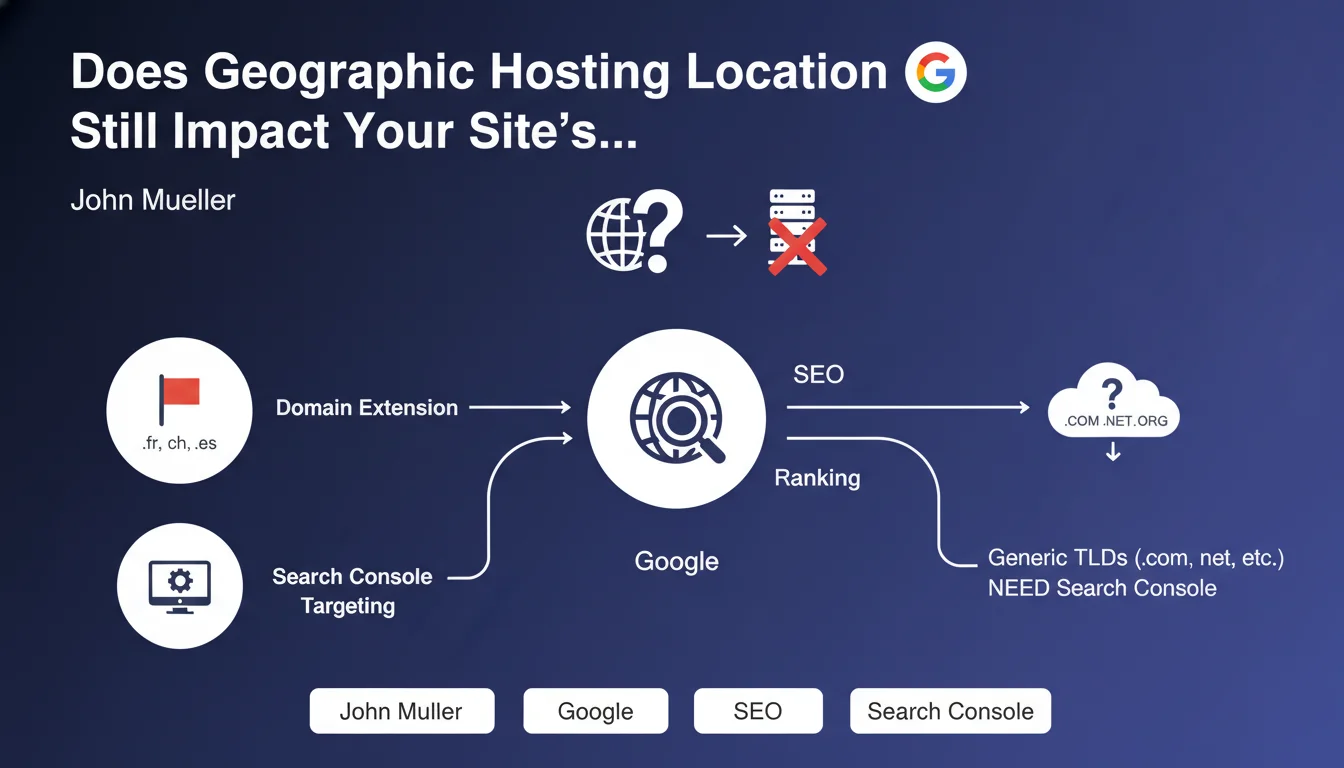
Google has officially confirmed that the physical location of the server is not a determining criterion for identifying the country targeted by a website. Contrary to popular belief, hosting your site in the United States rather than France won't fundamentally change Google's perception.
The search engine uses other much more reliable signals to determine a site's geolocation. This clarification allows webmasters not to worry excessively about the location of their technical infrastructure.
What are Google's real criteria for geographic targeting?
Google relies on a set of geographic signals to understand the market a site is targeting. The domain name extension (.fr, .de, .co.uk) constitutes the most obvious and strongest signal.
The Search Console settings also allow you to explicitly define the targeted country for generic domains (.com, .org). Hreflang tags complete this system for multilingual sites by precisely indicating which version to serve to which audience.
Why does this question keep coming up among SEO professionals?
Geographic hosting was once a more significant ranking factor, particularly for reducing latency and improving local loading times. This historical importance has created persistent confusion.
- Server location is not a decisive criterion for geographic targeting
- The domain extension remains the strongest signal (.fr, .de, etc.)
- Search Console settings allow you to explicitly define the target country
- Hreflang tags are essential for multilingual sites
- Google uses a combination of signals to determine geographic targeting
SEO Expert opinion
Is this statement consistent with field observations?
John Mueller's statement does indeed correspond to the observations of SEO practitioners for several years. Many international sites hosted on global CDNs or American servers rank perfectly in their respective local markets.
However, this official position shouldn't make us forget that technical performance remains an indirect but real ranking factor. A geographically distant server can create latencies that impact user experience and therefore SEO.
In which cases does server location remain relevant?
For single-country sites with an exclusively local audience, hosting in the targeted geographic area presents tangible advantages. Reduced latency improves Core Web Vitals, official ranking criteria since 2021.
E-commerce sites with legal constraints (GDPR, sensitive data hosting) may also need localized hosting for compliance reasons, which provides a collateral benefit in terms of performance.
What misinterpretations should you avoid?
Some SEO professionals overinvest in geographic hosting while neglecting much more important signals. Forgetting to configure targeting in Search Console or neglecting hreflang tags will have a much more negative impact.
The opposite mistake also exists: thinking that hosting has no importance is excessive. Performance remains an indirect factor that deserves attention, particularly through Core Web Vitals which include server response speed (TTFB).
Practical impact and recommendations
How do you properly configure your site's geographic targeting?
For a single-country site, ideally prioritize a local extension (.fr, .be, .ch) which constitutes the clearest signal. If you use a .com or .org, be sure to configure geographic targeting in Search Console.
For a multilingual or multi-country site, implement correct hreflang tags on all pages. Structure your site with subdomains (fr.site.com) or subdirectories (site.com/fr/) rather than separate domains when possible.
What technical checks should you perform regularly?
Regularly test your loading times from different geographic locations with tools like GTmetrix or WebPageTest. A TTFB (Time To First Byte) above 600ms indicates a potential problem.
Verify that your hreflang tags are correctly implemented via Search Console, "International Targeting" section. Hreflang errors are common and can create cannibalization problems between versions.
What should you prioritize in your hosting strategy?
Focus first on overall performance: a good CDN is better than a mediocre local server. Invest in quality hosting that guarantees high availability and fast response times.
For sites with heavy international traffic, distributed infrastructure becomes essential. Modern CDNs like Cloudflare, AWS CloudFront or Fastly offer a global presence that automatically optimizes content distribution.
- Check the domain extension used and its suitability for the target market
- Configure geographic targeting in Google Search Console for generic domains
- Implement and verify hreflang tags for multilingual sites
- Test loading times from targeted geographic areas
- Regularly measure Core Web Vitals, particularly TTFB
- Prioritize a quality CDN for international sites
- Audit technical configuration at least quarterly
- Monitor international targeting errors in Search Console
💬 Comments (0)
Be the first to comment.