
Official statement
What you need to understand
What Does Google Really Say About Content Quantity?
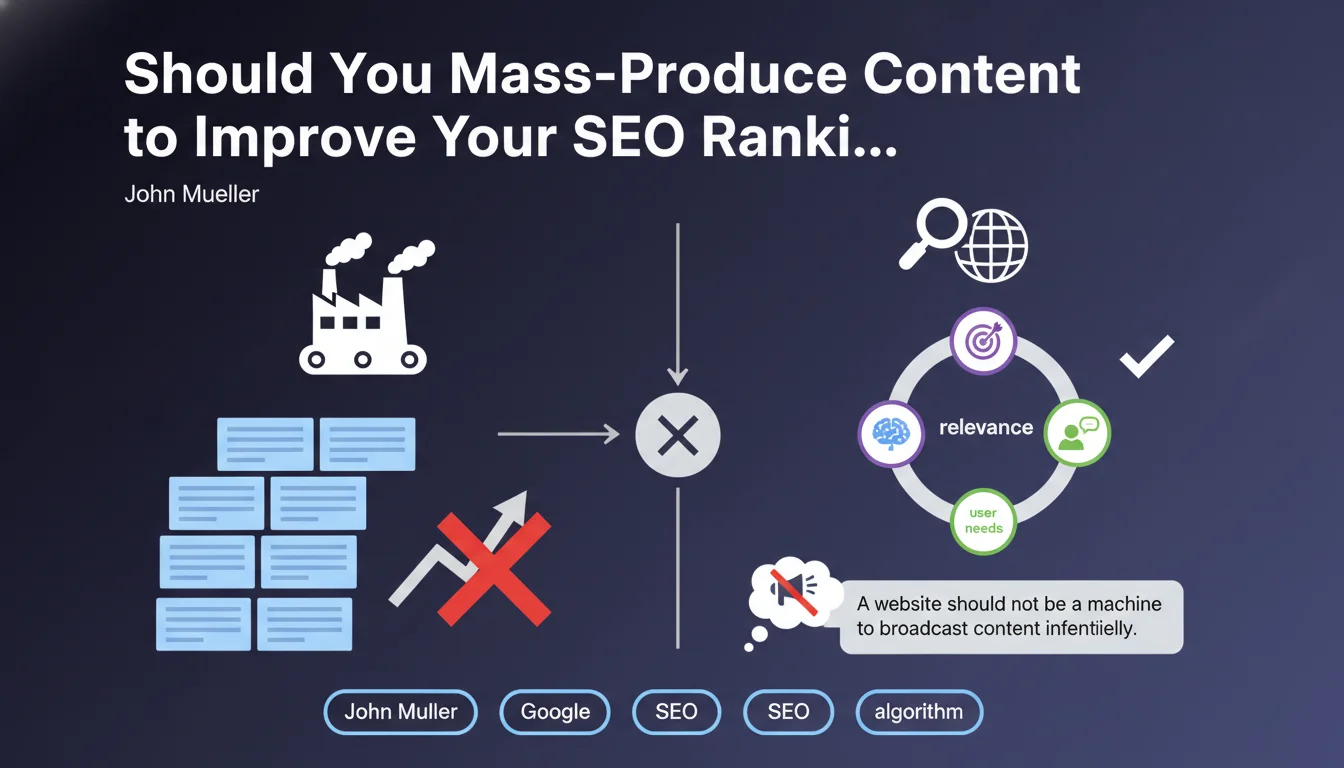
John Mueller has clarified Google's position: the volume of published content is not a direct ranking factor in the relevance algorithm. In other words, a site that publishes 10 articles per day will not automatically have an advantage over a competitor who publishes 2 per week.
This statement aims to counter a widespread but mistaken practice: that of considering a website as a "content machine" that must constantly produce. Google favors quality and relevance rather than simply proliferating articles.
Why Does This Nuance Matter for SEO Professionals?
The distinction is crucial: Google does not reward raw quantity, but rather the ability to meet users' needs. A site with 50 excellent articles will always outperform a site with 500 mediocre articles.
However, this statement does not mean you should stop publishing regularly. Publication frequency remains an important signal in certain specific contexts, particularly for news and time-sensitive topics.
What Is the QDF Algorithm and Why Is It Critical?
The Query Deserves Freshness (QDF) algorithm is a specific Google system that detects queries requiring recent results. It automatically activates for breaking news topics, ongoing events, or emerging trends.
For these particular queries, content freshness effectively becomes a relevance criterion. A site that regularly publishes on a current topic will gain visibility for these specific queries.
- Quantity alone is not a direct ranking factor
- Quality and relevance remain Google's priority criteria
- The QDF algorithm favors fresh content for news queries
- Publication frequency can become important in specific contexts
- Google discourages "content machine" sites without added value
SEO Expert opinion
Is This Statement Consistent with Real-World Observations?
After 15 years of experience, I can confirm that Mueller's position is partially true but requires important nuances. In stable sectors (plumbing, law, crafts), a site with 30 quality pages indeed outperforms a competitor with 300 superficial pages.
However, in dynamic sectors (technology, finance, digital marketing), I consistently observe that sites publishing regularly dominate the SERPs. The reason? They accumulate more signals of freshness, topical relevance, and industry authority.
What Critical Nuances Should Be Added to This Statement?
Mueller simplifies a more complex reality. Publication frequency is certainly not a direct factor, but it activates several indirect mechanisms: increased crawl budget, strengthened internal linking, expanded semantic field, improved topical authority.
Moreover, certain vertical sectors have different algorithmic expectations. Google News, Google Discover, and Featured Snippets explicitly favor recent and frequently updated content.
In Which Cases Does This Rule Not Fully Apply?
For news sites and media, publication frequency remains absolutely critical. The QDF algorithm is permanent for these sites, and Google explicitly expects continuous production of fresh content.
E-commerce sites also constitute an exception: regularly adding new products, seasonal buying guides, and comparative content sends positive signals of commercial vitality and active inventory.
Finally, niche platforms seeking to comprehensively cover a topic benefit from an intensive publication strategy, as they gradually build topical authority that is difficult for less prolific competitors to challenge.
Practical impact and recommendations
What Content Strategy Should You Actually Adopt?
Abandon the logic of volume for volume's sake. Focus on a hybrid approach: maximum quality + frequency adapted to your sector. Analyze your Top 3 competitors and identify their actual publication rhythm.
For stable sectors, prioritize 2 to 4 high-quality monthly publications (2000+ words, thorough research, technical optimization). For dynamic sectors, aim for 2 to 3 weekly publications with a mix of news content and evergreen content.
Implement an update system for your existing content. Google values the freshness of updated content as much as that of new content, with the added advantage of capitalizing on already acquired authority.
What Critical Mistakes Should You Absolutely Avoid?
Don't fall into the trap of mass-produced generic content. AI tools can facilitate production, but content without real expertise, without a unique angle, and without added value will be ignored by Google and your users.
Also avoid keyword cannibalization. Publishing 10 similar articles on the same query dilutes your authority instead of strengthening it. Map your search intents before producing.
Beware of vanity metrics. A full editorial calendar is not a relevant KPI. Instead, measure: crawl rate, average positions, organic traffic per article, and conversion rate.
How Can You Audit and Optimize Your Existing Content Strategy?
Conduct a performance audit of your existing content. Identify articles that generate traffic versus those that stagnate. Prioritize updating content positioned between 5th and 15th position: that's where ROI is maximal.
Analyze your freshness profile with Search Console. If your most visited pages date back more than a year without updates, you're probably leaving opportunities on the table, especially if your competitors are actively updating.
- Define a publication rhythm adapted to your sector, not to your current capabilities
- Prioritize 80% quality / 20% volume rather than the reverse
- Implement an update calendar for existing content (every 6-12 months)
- Map search intents before producing to avoid cannibalization
- Monitor crawl budget and adjust frequency if Google isn't visiting your new content
- Analyze content strategies of Top 3 competitors for your target queries
- Activate Google News and Discover if suitable for your sector (news, trends)
- Segment your strategy: evergreen content + news content if relevant
- Measure ROI per article: organic traffic, conversions, positions gained
- Absolutely avoid generic content mass-produced without expertise
💬 Comments (0)
Be the first to comment.