
Official statement
Other statements from this video 4 ▾
- □ Faut-il vraiment créer son propre site pour apprendre le SEO efficacement ?
- □ Peut-on tester des techniques SEO contraires aux guidelines Google sans risque ?
- □ Faut-il encourager les expérimentations SEO 'sneaky' pour former de meilleurs experts ?
- □ Faut-il vraiment poser toutes ses questions en SEO sans craindre le ridicule ?
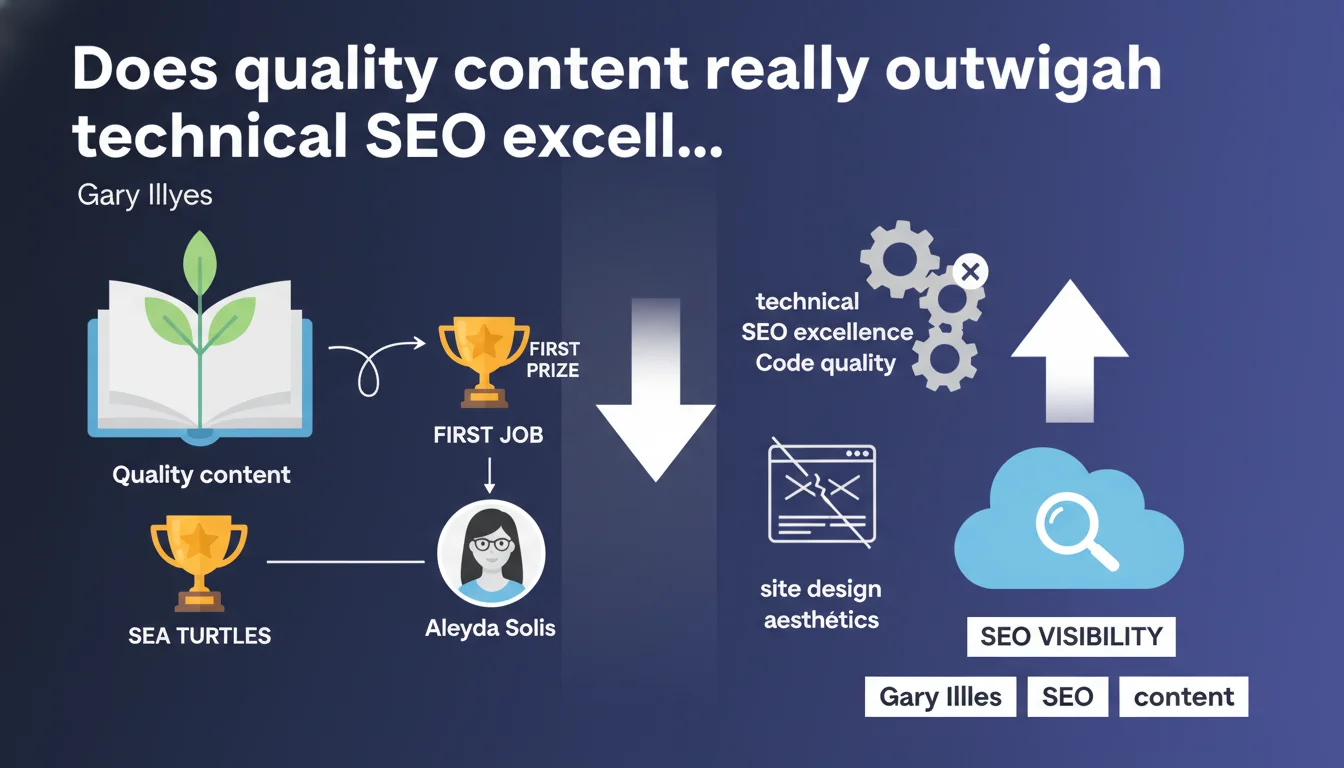
Google affirms through Gary Illyes that quality content trumps technical aspects, relying on the example of a sea turtle website that won an award and landed a job without technical excellence. Practically speaking? This statement invites reconsidering the balance between technical optimization and editorial strategy, but raises questions about real-world situations where technical issues become blocking factors.
What you need to understand
Is Google questioning the importance of technical SEO?
No. Illyes' statement doesn't say that technical SEO is useless — it simply affirms that quality content can compensate for certain technical shortcomings. The anecdote about Aleyda Solis' website illustrates a case where exceptionally relevant content about sea turtles generated enough relevance and engagement signals to prevail despite imperfect code.
This position aligns with the logic of weighted ranking factors: not all criteria are equal, and their importance varies depending on the query, competition, and context. A technically flawless site with mediocre content will lose to a technically average competitor with excellent editorial content — at least in certain niches.
In what contexts does this rule apply?
The scenario described by Illyes works mainly when competitive density is low or the topic covered is specialized enough that few actors produce in-depth content. A site about sea turtles in 2005-2010 (probable timeframe of the Solis case) didn't face the same saturation as a competing e-commerce site today.
Another variable: the minimum technical requirement level. If the site is crawlable, indexable, and Core Web Vitals aren't catastrophic, Google can focus on content. But if blocking errors exist (accidental noindex, infinite redirect chains, massive duplicate content), even the best content will remain invisible.
What are the essential takeaways?
- Quality content can compensate for certain technical weaknesses, but not all of them.
- This dynamic works better in low-competition niches or specialized topics.
- Technical SEO remains a minimum prerequisite: without proper crawlability and indexability, content will never reach search results.
- Google values engagement and user satisfaction signals — exceptional content naturally generates these signals.
SEO Expert opinion
Is this statement consistent with field observations?
Yes and no. Let's be honest: in ultra-competitive verticals (finance, healthcare, general e-commerce), brilliant content on a technically deficient site won't be enough. Google's algorithms have evolved — and the technical bar has risen considerably with Core Web Vitals, mobile-first indexing, and HTTPS prioritization.
Illyes' anecdote likely dates from an era when average web content quality was catastrophic. Today, well-documented content proliferates — making technical differentiation more decisive. A fast, well-structured site with coherent internal linking and flawless mobile experience will have a net advantage, even if content is slightly inferior.
What nuances should be added to this statement?
Google often speaks of "content quality" without precisely defining what that encompasses. [To verify]: is it only informational depth, or does it include angle originality, editorial structure, engagement generated, and naturally acquired backlinks? The algorithm doesn't "read" content like a human — it relies on algorithmic proxies (session time, bounce rate, satisfied queries, domain authority).
Another critical point: this statement can be weaponized by clients to justify abandoning technical debt. "Google said content is enough, so no need to fix our 404s, loading times, or silo architecture." False. Technical optimization remains the foundation — content is the superstructure.
In what cases does this rule not apply?
As soon as competition intensifies or E-E-A-T criteria come into play, technical excellence becomes critical again. A healthcare site with exceptional content but without HTTPS, clear legal notices, or catastrophic speed will lose to technically solid competitors — even if their content is less thorough.
Practical impact and recommendations
What should you do concretely?
Adopt a balanced and contextual approach. If your site operates in a low-competition niche with truly differentiating content, yes, prioritize editorial investment. But first ensure technical foundations are solid: crawlability, indexability, acceptable speed, logical structure.
Conversely, if you operate in a saturated sector (travel, finance, healthcare, tech), technical optimization becomes a major differentiating factor. A competitor with equivalent content but a technically flawless site will consistently outrank you.
What mistakes should you absolutely avoid?
- Never justify abandoning technical debt with this statement — it speaks of compensation, not substitution.
- Don't confuse "quality content" with "volume of content": 50 average pages don't equal 5 excellent pages.
- Avoid underestimating the importance of E-E-A-T signals, especially in YMYL verticals (healthcare, finance, legal).
- Don't neglect mobile experience and Core Web Vitals — these criteria are now minimum prerequisites, not bonuses.
How should you prioritize your SEO efforts?
First audit critical technical blockers: 5xx errors, accidental noindex, misconfigured canonicals, redirect chains. These issues nullify all editorial investment. Once these foundations are stabilized, invest heavily in content — but structured, optimized for semantic search, and generating engagement signals.
Concretely? Test your pages with Search Console, Screaming Frog, and PageSpeed Insights. Identify strategic pages, enrich them, then optimize technical performance. Alternate between technical and content — never one without the other.
❓ Frequently Asked Questions
Un contenu exceptionnel peut-il compenser un site techniquement défaillant ?
Google accorde-t-il plus d'importance au contenu qu'à la technique ?
Dois-je arrêter d'investir dans la technique SEO ?
Comment savoir si mon contenu est assez bon pour compenser des faiblesses techniques ?
Dans quels secteurs la technique SEO reste-t-elle critique ?
🎥 From the same video 4
Other SEO insights extracted from this same Google Search Central video · published on 17/02/2022
🎥 Watch the full video on YouTube →
💬 Comments (0)
Be the first to comment.