
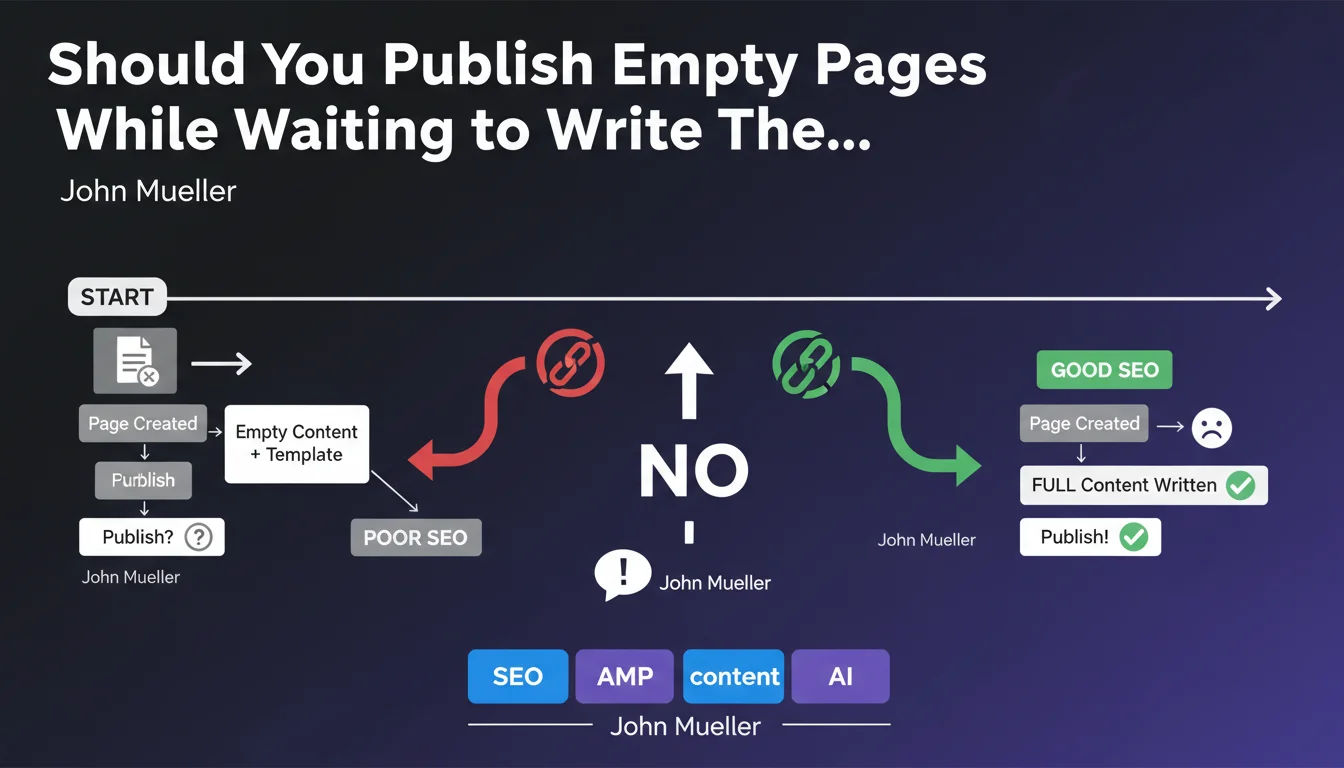
Official statement
What you need to understand
Why Are Some Publishers Tempted to Publish Empty Pages?
In technical SEO practice, some professionals consider creating pages without content to achieve early indexation. The idea is to make Google discover the site structure before the final content is even written.
This approach may seem logical in contexts of site redesigns or launching new categories. Yet it presents major risks for the quality perceived by search engines.
What Are the Consequences of an Empty Page in Google's Eyes?
Google evaluates content quality from the very first visit by its crawlers. An empty or nearly empty page will immediately receive a negative assessment that can persist over time.
The search engine may also classify these pages as Soft 404s, meaning pages that return an HTTP 200 code but contain no useful content. This classification severely damages the trust granted to your site.
- Empty pages receive an unfavorable quality score from their first indexation
- The risk of Soft 404 classification is high and penalizing
- This poor first impression can persist even after content is added
- Google always favors immediate quality over future potential
What Exactly Do We Mean by an Empty Content Page?
An empty page doesn't necessarily mean a completely blank page. It refers to a page that contains only structural elements: header, navigation menu, footer, sidebar.
Even with these elements present, if the main content area is absent or contains only a few generic words, Google will consider the page empty. The ratio between useful content and navigation elements is decisive.
SEO Expert opinion
Is This Recommendation Consistent with Field Observations?
After 15 years of experience, I confirm that this directive is perfectly consistent with reality regarding Google's behavior. I've observed numerous cases where prematurely published pages suffered lasting penalties.
The principle of early quality signals is well documented. Google retains a memory of initial assessments, and it often takes months to reverse a poor first impression, even after content enrichment.
Sites that apply a strict policy of publishing only with finalized content consistently achieve better performance in terms of indexation and ranking.
Are There Situations Where This Rule Could Be Nuanced?
In certain very specific cases, a different approach can be considered. For e-commerce sites with thousands of references, it may be acceptable to publish product pages with minimal but structured content (title, price, short description).
However, even in this context, it's preferable to have at minimum 150-200 words of unique and relevant content. A product page with only technical specifications in bullet points remains problematic.
What Are the Long-Term Risks of Such a Practice?
Beyond Soft 404 classification, publishing empty pages can affect your site's crawl budget. Google allocates limited time to crawling each site, and wasting this resource on valueless pages reduces the crawling frequency of important pages.
Even more serious, this practice can degrade the overall trust Google grants to your domain. A site that multiplies low-quality pages will see all its content penalized, even quality pages.
Practical impact and recommendations
What Should You Do Concretely Before Publishing a New Page?
The golden rule is simple: never publish a page before it contains its final and complete content. This includes the main text, optimized images, metadata, and all planned multimedia elements.
For an efficient production workflow, work on staging or preprod environments. Use the robots.txt file or meta robots tags to block indexation as long as the content isn't finalized.
- Verify that each page contains at minimum 300 words of unique content
- Ensure the main content addresses the page's search intent
- Validate that title and meta description tags are optimized and filled in
- Confirm the presence of at least one optimized image with alt attribute
- Test the content/navigation ratio to ensure it favors content
- Configure a staging environment with noindex to prepare content
- Never use HTTP 200 status for incomplete pages
How Should You Manage Pages Currently Being Written?
For pages in preparation, several technical strategies are available to you. The simplest is to not publish them at all until they're ready.
If you absolutely must make the page accessible for testing, use HTTP authentication or place it on a subdomain blocked by robots.txt. Absolutely avoid "page under construction" mentions on publicly accessible URLs.
What Mistakes Should You Absolutely Avoid in Managing Your Content?
The most frequent error consists of publishing a page with a generic placeholder like "content coming soon" or "page under construction." These pages are immediately detected as empty by Google.
Another common mistake: duplicating an existing page structure by changing only the title, while waiting to personalize the content. This creates duplicate content that harms the entire site.
💬 Comments (0)
Be the first to comment.