
Official statement
Other statements from this video 4 ▾
- □ Does quality content really outweigh technical SEO excellence?
- □ Can you test SEO techniques that violate Google's guidelines without risk?
- □ Should you encourage 'sneaky' SEO experimentation to develop better expert-level skills?
- □ Should you really ask every SEO question without fear of looking foolish?
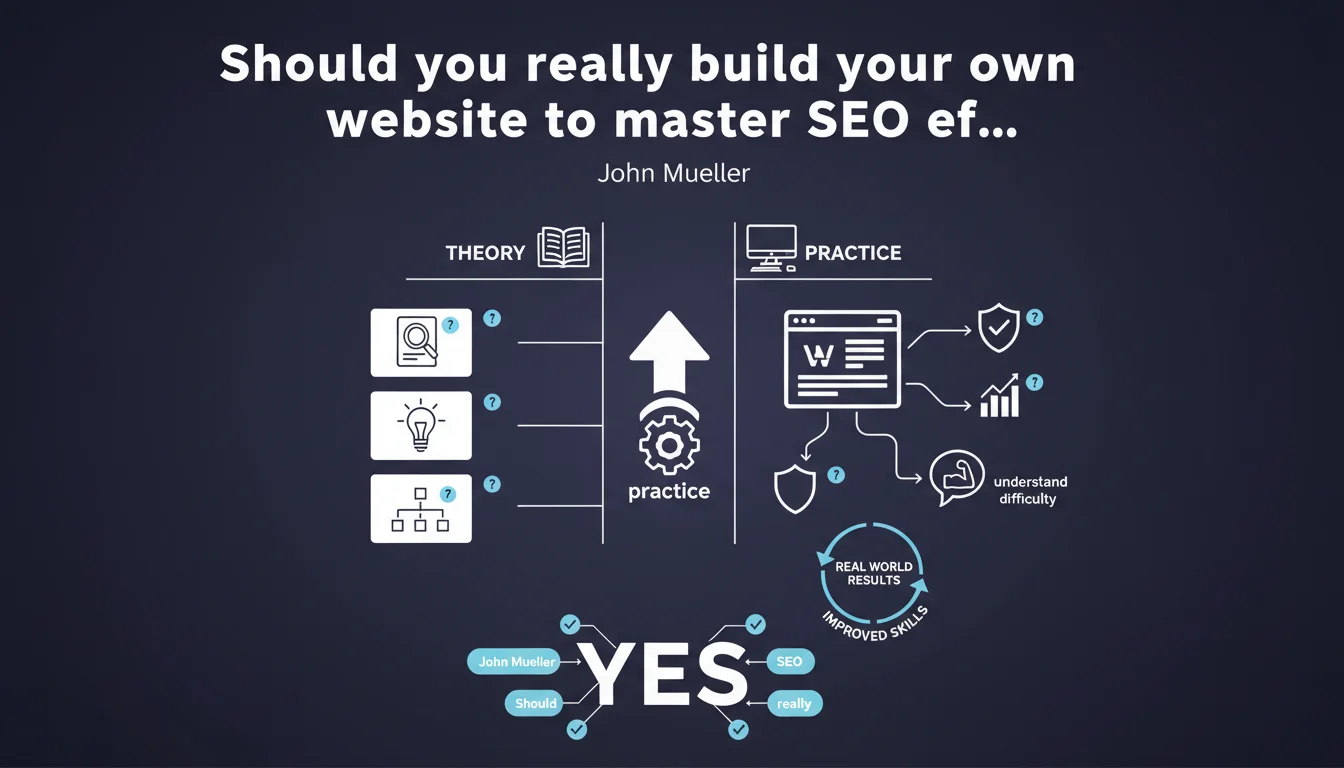
Google recommends aspiring SEO professionals to create their own website to test and validate what they learn. This approach allows you to measure the gap between theory and real-world practice, and to understand the actual complexity of SEO tasks before applying them to client websites.
What you need to understand
Why does Google insist on creating a personal website?
The answer comes down to one word: experimentation. Reading SEO guides or watching tutorials isn't enough to grasp the reality of the profession. Building your own website forces you to face the same constraints as a client project: crawl time, technical difficulties, indexing delays, real impact of optimizations.
A personal website becomes a laboratory without commercial pressure. You can test risky hypotheses, measure the impact of structural changes, observe how Google actually responds — not how blog articles claim it responds.
What does this recommendation reveal about learning SEO?
It confirms that SEO remains an empirical profession. Algorithms evolve, official documentation remains deliberately vague, and many "best practices" are folklore rather than solid evidence.
Google implicitly acknowledges that the gap between theory and practice is huge. A junior who has never managed a website systematically underestimates the difficulty of tasks: migrating a website without breaking indexation, fixing mass 404 errors, optimizing internal linking across 10,000 pages — it all takes time and creates unexpected problems.
Does this approach apply to all profiles?
Yes, but differently depending on experience. A beginner should create a simple site (blog, brochure website) to understand the basics: indexation, tags, linking, performance. An intermediate practitioner can tackle more ambitious projects: e-commerce, HTTPS migration, structural redesign.
The key is having a playground where failure costs nothing. You test, you break, you fix — and you learn infinitely more than reading sanitized case studies.
- Risk-free experimentation: test hypotheses without client pressure
- Measuring the theory/practice gap: understanding what really works versus what's repeated everywhere
- Learning technical constraints: crawl time, indexation, unexpected bugs
- Developing critical thinking: distinguishing relevant advice from SEO myths
SEO Expert opinion
Is this recommendation actually followed by SEO professionals?
Not nearly as much as it should be. Many practitioners learn directly on client websites, which limits their experimental capacity. ROI pressure and fear of breaking things discourage bold testing.
The best SEO professionals I know all have one or more personal websites — often projects they launched years ago that still serve as testing grounds. That's where they test new data structures, radical linking changes, or hypotheses about Googlebot behavior.
What nuances should be added to this statement?
Creating a website isn't enough. That site also needs to receive traffic to observe measurable effects. A blog generating 10 visits per month will never let you validate the impact of an optimization — statistical noise is too high.
Second nuance: some SEO aspects require large volumes. Optimizing crawl budget on a 50-page site makes no sense. Managing canonicalization on an e-commerce with 100,000 products can't be learned on a basic WordPress blog.
[To verify]: Google doesn't specify what type of website to create or what traffic level to target. The recommendation remains vague enough to not be directly actionable.
In what cases does this approach show its limits?
When SEO depends on specific contexts. Optimizing a news website with hundreds of daily publications, managing SEO for a marketplace with millions of product listings, or working on a complex multilingual site — all of this requires resources a personal project can't reproduce.
Another limit: time. Building a personal website requires a long investment (hosting, design, content production, link building) before you have a credible testing ground. A junior wanting to learn quickly may get discouraged if results take 6 months to appear.
Practical impact and recommendations
What should you do concretely to apply this recommendation?
Choose a topic that interests you — you'll spend time on it, so it might as well be motivating. Avoid ultra-competitive niches if you're starting out ("car insurance", "mortgage credit"): you'll never have the resources to rank and you'll see no results.
Start simple: a properly configured WordPress, a lightweight theme, decent hosting. No need to invest 500 € per month in tools — Search Console, Google Analytics, and a free crawler (limited Screaming Frog) are plenty to start.
Set yourself measurable goals: reach 100 organic visitors per month, rank in top 10 for 5 specific queries, reduce load time under 2 seconds. Without clear goals, you'll procrastinate and abandon the project.
What mistakes should you avoid when creating this website?
Don't fall into the perfectionism trap. Many beginners spend 3 months perfecting the design and structure before publishing any content. Result: zero indexation, zero learning.
Another classic mistake: copy-pasting ready-made recipes without understanding why they work. Installing 15 SEO plugins because a YouTube tutorial recommends it won't teach you anything — it'll just slow your site down and create conflicts.
Finally, avoid automating everything from the start. Yes, there are tools to generate content, schedule publications, manage internal linking automatically. But if you don't understand the underlying logic, you'll never progress.
How do you measure that this approach is working?
See if you can predict the impact of your actions. Before changing a title tag, try to estimate whether it will improve or decrease CTR. After a few weeks, compare your prediction to actual data.
Another indicator: your ability to diagnose problems. When a client tells you "my traffic dropped 30% this month," can you quickly identify probable causes (penalty, technical issue, seasonality, competition)? If you've managed your own site, you'll have already encountered most of these situations.
- Choose a motivating topic and realistic niche to start
- Set up a simple site with essential tools (Search Console, Analytics, crawler)
- Publish content regularly to observe indexation and ranking
- Test specific hypotheses and measure their real impact
- Document your experiments: what worked, what failed, why
- Analyze your mistakes critically — that's where the strongest learning happens
❓ Frequently Asked Questions
Quel type de site créer pour apprendre le SEO efficacement ?
Faut-il investir dans des outils SEO payants dès le début ?
Combien de temps avant de voir des résultats concrets ?
Peut-on apprendre le SEO uniquement sur des sites clients ?
Cette approche fonctionne-t-elle pour le SEO e-commerce ou technique avancé ?
🎥 From the same video 4
Other SEO insights extracted from this same Google Search Central video · published on 17/02/2022
🎥 Watch the full video on YouTube →
💬 Comments (0)
Be the first to comment.