
Official statement
Other statements from this video 4 ▾
- □ Le contenu de qualité prime-t-il vraiment sur la technique SEO ?
- □ Faut-il vraiment créer son propre site pour apprendre le SEO efficacement ?
- □ Faut-il encourager les expérimentations SEO 'sneaky' pour former de meilleurs experts ?
- □ Faut-il vraiment poser toutes ses questions en SEO sans craindre le ridicule ?
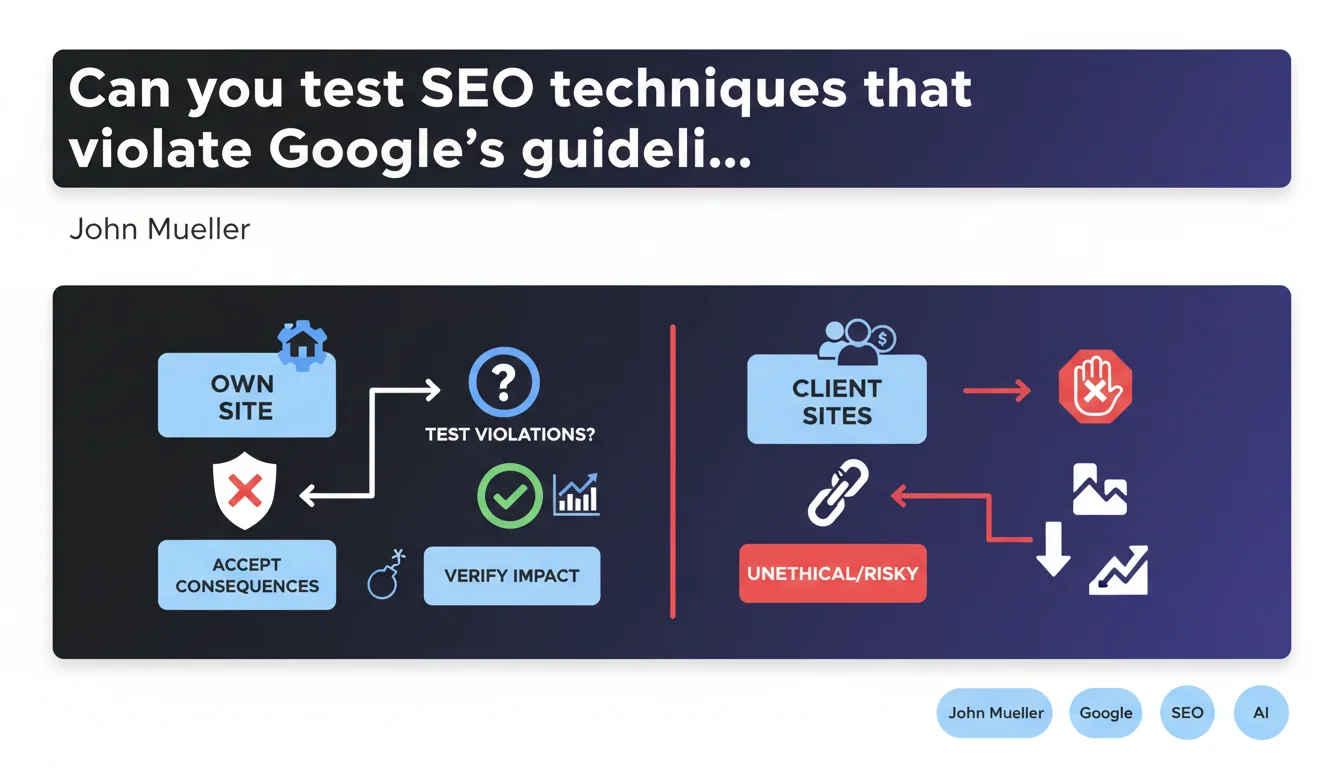
Testing controversial SEO techniques on your own site is acceptable according to Google, provided you accept the consequences. The real ethical problem arises when you apply these risky experiments to client sites that are paying for professional services.
What you need to understand
Why does Google tolerate SEO experimentation on your own sites?
Mueller's position reflects a pragmatic reality: Google implicitly recognizes that SEO learning involves trial and error. Testing techniques at the edge of guidelines on your own domain allows you to understand algorithmic mechanisms without endangering others' assets.
This tolerance is based on a simple principle — it's your risk, your property, your consequences. If your site receives a manual or algorithmic penalty as a result of testing cloaking or link networks, you directly experience the business impact. Nobody paid you for this result.
Where is the red line with client sites?
The problem arises with the contractual and fiduciary dimension. A client pays to improve their search rankings, not to serve as a guinea pig for techniques you know are potentially punishable. There is an implicit trust that you apply proven methods.
Testing negative SEO, comment spam, or SERP manipulation techniques on a client site amounts to exposing their business to an unacknowledged risk. And that, precisely, is what Mueller is pointing out.
What nuance should be added to this statement?
This position does not mean that all experiments are encouraged — simply that they are tolerated on your own assets. Google will never give you a blank check to manipulate its results, but accepts that some professionals need to understand how the system's limits work.
- Testing on your own site = acceptable if you accept the consequences (penalties, deindexation, etc.)
- Applying these tests to client sites = breach of trust and potentially of contract
- Ethical responsibility rests on transparency and the informed consent of the site owner
- Google offers no immunity — a test remains a risk, even on your personal domain
SEO Expert opinion
Is this position consistent with practices observed in the field?
Absolutely. We have observed for years that Google clearly distinguishes between SEOs who test and those who massively deploy manipulative techniques. Manual penalties rarely target isolated domains that clearly serve as sandboxes, but hit large-scale commercial networks.
This statement confirms what we already knew empirically: Google tolerates learning through practice, even when pushing boundaries. What bothers them is the industrialization of these techniques and their monetization on third parties. A personal site testing cloaking? Probably ignored or simply neutralized algorithmically. A network of 500 client sites using the same technique? Manual penalty assured.
What gray areas remain despite this clarification?
The statement remains deliberately vague about what constitutes "accepting the consequences". If your test site creates massive spam or manipulates results on sensitive commercial queries, Google could easily decide you've crossed a line. [To verify]: no explicit guarantee that a personal "SEO lab" benefits from total immunity.
Another nuance: what about personal sites that generate advertising revenue? Technically "your" site, but with a commercial dimension that blurs the boundary. Mueller does not clarify whether tolerance applies only to non-monetized domains.
In what cases does this rule not apply?
If you test techniques on a site affiliated with a client network, even without direct billing, you step outside the scope of personal experimentation. Same for domains you manage on a white-label basis for third parties — it's no longer "your" site in an ethical sense.
The rule also does not cover situations where your tests create documentable collateral damage: index pollution, result manipulation affecting competitors, etc. Google could very well decide that beyond a certain threshold, even a "personal test" becomes a systemic problem.
Practical impact and recommendations
What should you do concretely if you want to test borderline techniques?
First, completely isolate these tests on dedicated domains with no connection to your client assets or production domains. Use different registrars, separate hosting, and avoid any Google Search Console connections that could contaminate your other properties.
Next, document rigorously: which test, which metrics observed, what impact. If Google contacts you about a manual penalty, you'll need to prove this was a controlled experiment and not a commercial rollout.
What mistakes should you absolutely avoid with client sites?
Never apply an unproven technique to a client site without informed written consent. If you want to test an aggressive linking strategy or a non-standard markup schema, clearly explain the risks and get formal validation.
Also avoid the trap of "what works on my site will work everywhere." A personal domain with zero commercial history and low visibility does not react the same way as an established client site with actual revenue. The stakes and exposure to penalties are not comparable.
How do you structure an ethical approach to SEO experimentation?
Implement a internal validation protocol: any technique tested on a personal domain must show stable results over 3-6 months before even being considered for a client. And even then, only if it respects guidelines or if the client explicitly accepts the risk.
- Create dedicated test domains isolated from your professional assets
- Document each experiment with dates, metrics, and observed results
- Never apply an unvalidated technique to a client site without written agreement
- Use monitoring tools to quickly detect any penalties on your test sites
- Clearly distinguish between "gray hat" techniques (personal tests only) and white hat methods (deployable to clients)
- Train your teams on the difference between personal experimentation and client delivery
❓ Frequently Asked Questions
Peut-on tester du black hat SEO sur son propre site sans risquer une pénalité ?
Faut-il informer Google qu'on fait des tests SEO sur un domaine personnel ?
Un site client peut-il servir de terrain de test si le client est d'accord ?
Les leçons tirées de tests black hat sur un site perso sont-elles applicables à des sites clients ?
Google fait-il une différence entre un site de test et un réseau de sites manipulateurs ?
🎥 From the same video 4
Other SEO insights extracted from this same Google Search Central video · published on 17/02/2022
🎥 Watch the full video on YouTube →
💬 Comments (0)
Be the first to comment.