
Official statement
Other statements from this video 4 ▾
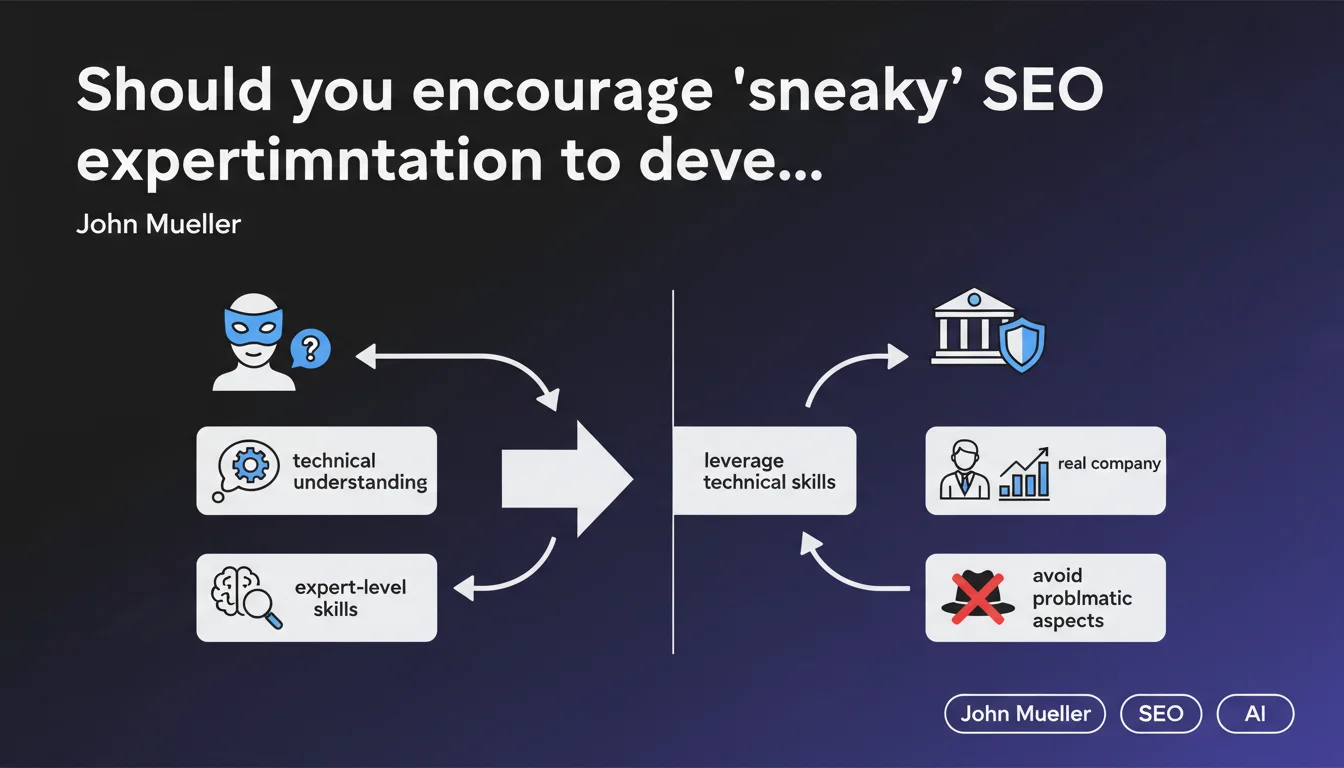
Google acknowledges that SEOs who test borderline or black hat techniques develop deep technical understanding that remains exploitable within legitimate professional frameworks. Learning through transgression forges rare competencies, provided you know how to separate experimentation from professional practice.
What you need to understand
Does Google actually validate black hat practices for educational purposes?
This statement is remarkable: John Mueller explicitly admits that experimenting with 'sneaky' techniques isn't condemned outright. The key takeaway? Technical skills acquired by testing edge-case methods remain valid, even if the methods themselves violate guidelines.
Concretely, an SEO who has tested cloaking, poorly constructed PBNs, or manipulated link schemes understands better how Google detects these patterns. This inverted knowledge becomes an advantage for auditing client sites, identifying penalties, or anticipating risks.
Where's the line between learning and manipulation?
Mueller draws a clear distinction: personal experimentation on test projects is tolerated, but applying these techniques to client or business sites crosses the boundary. The distinction hinges on real-world impact and commercial intent.
The problem is, this tolerance is never formalized in official guidelines. [To verify] — Google doesn't guarantee immunity for experimental domains. A test site can still get deindexed if signals are too visible.
Why is this approach controversial in the industry?
Because it implicitly validates an ethical gray zone. Some white hat practitioners argue that any manipulation, even educational, normalizes harmful behaviors for the ecosystem. Others counter that you can't defend a fortress without understanding how to breach it.
- Learning through transgression builds superior technical understanding compared to simply reading guidelines
- The skills acquired (pattern analysis, reverse engineering, signal detection) are reusable in legitimate contexts
- Google provides no immunity promise for experimental sites — real risk remains
- The boundary between personal testing and professional application must stay sealed
- This tacit tolerance is never formally documented, leaving legal and contractual ambiguity
SEO Expert opinion
Is this statement consistent with what we observe in the field?
Yes and no. We do observe that the best SEO auditors often have a history of aggressive experimentation. They instantly spot a sketchy link scheme or cloaking structure because they know how it's built. This inverted knowledge is a genuine advantage.
But — and here's where it gets sticky — Google doesn't apply this tolerance uniformly. Experimental domains can be penalized as heavily as commercial sites if signals are too visible. The algorithm doesn't distinguish between educational testing and large-scale manipulation attempts. [To verify]: no internal documentation confirms differential treatment.
What real risks do practitioners face following this logic?
The first risk is reputational contamination. If a client discovers your SEO has a history of active manipulation, trust collapses — even if the techniques applied to their site are 100% white hat. Perception matters as much as reality.
The second risk is digital footprint. Test domains, experimental PBNs, associated social accounts — everything leaves traces. If these assets are connected to your professional identity or your clients through footprint signals (WHOIS, analytics, linking patterns), you create an exploitable attack surface for competitors or negative SEO.
Finally, there's the risk of cognitive habituation. The more you manipulate, the more your perception of 'acceptable risk' erodes. I've seen talented SEOs progressively cross the line because they normalized edge-case practices during their learning phase.
In what cases does this rule not apply?
If you work for a large regulated brand (finance, healthcare, public sector), an experimentation history can become a legal or contractual liability. Some industries require compliance audits that scrutinize service providers' professional backgrounds. A CV highlighting black hat testing becomes a handicap.
Practical impact and recommendations
What should you do concretely if you want to experiment without risking your reputation?
First, compartmentalize rigorously. Test domains, analytics accounts, servers, and digital identities must be completely isolated from your professional activity. No shared WHOIS, no common servers, no cross-linking patterns. The goal: make any footprint association impossible.
Next, document your intent. If you're running edge-case tests, keep logs, methodological notes, timestamped screenshots. In case of dispute or client questions, you can prove the experimentation was structured, dated, and never applied to commercial assets.
What mistakes must you absolutely avoid?
Never ever mix experimental and client infrastructure. I've seen SEOs reuse test PBN IPs on client projects 'because they were available.' Result: contamination through association, cascading penalties, and lost clients.
Don't publicly glorify your black hat exploits. What seems like a demonstration of technical competence can be perceived as a confession of manipulation by clients, employers, or regulators. Discretion is a professional requirement.
How do I verify that my experimental history isn't contaminating my legitimate work?
Regularly audit footprint signals: historical WHOIS, shared registrars, common IP ranges, linking patterns between test and client domains. Use tools like Ahrefs, Majestic, or custom scripts to detect any unintended intersections.
Conduct a reputation audit of your online presence. Search for your name, aliases, email addresses in SEO forums, blog archives, social media. Any content associating your professional identity with edge-case techniques must be removed or anonymized.
- Completely isolate experimental infrastructure (domains, servers, accounts)
- Never reuse test assets (IPs, analytics, tools) on client projects
- Document tests with timestamped logs and clear methodology
- Avoid any public communication detailing active manipulation
- Regularly audit footprints and unintended intersections
- Clean your online presence of any content linking professional identity to edge-case practices
- Include explicit contract clauses about excluded methods
❓ Frequently Asked Questions
Google pénalise-t-il les domaines utilisés pour des tests black hat ?
Puis-je mentionner mon expérience en tests SEO limites dans mon CV ?
Les compétences acquises en black hat sont-elles vraiment transférables en white hat ?
Est-ce légal de tester des techniques qui violent les guidelines Google ?
Comment isoler complètement un projet test d'un projet client ?
🎥 From the same video 4
Other SEO insights extracted from this same Google Search Central video · published on 17/02/2022
🎥 Watch the full video on YouTube →
💬 Comments (0)
Be the first to comment.