
Official statement
Other statements from this video 6 ▾
- □ Could Google Search Console be the missing key to unlock your hidden ranking opportunities?
- □ Are your high-visibility pages silently losing clicks in Search Console?
- □ Should you really be reformulating your content based on what users actually search for?
- □ Do you really need to request reindexing every time you update your content?
- □ How can you accurately measure the real impact of your SEO optimizations in Search Console?
- □ Can Google Search Console Really Shape Your SEO Strategy?
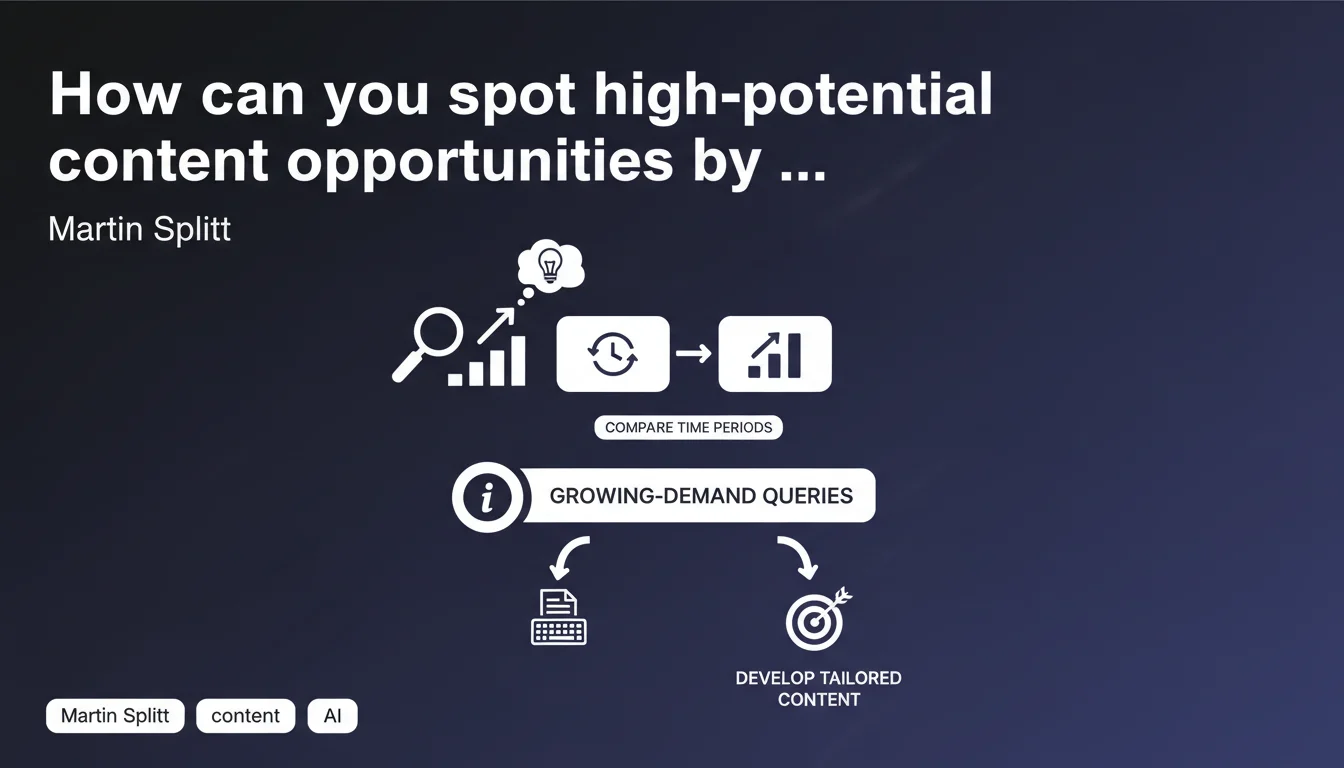
Google recommends using the Search Console Performance report to compare two time periods and identify queries generating more impressions now than previously. These growing-demand queries signal content opportunities you should prioritize creating.
What you need to understand
Why does Google emphasize period comparison in Search Console?
Search Console offers a period comparison tool that lets you overlay two identical date ranges. The goal? Detect variations in user behavior and emerging trends.
When a query generates more impressions in a recent period compared to an earlier one, it signals growing interest from searchers in that topic. Google suggests leveraging these signals to guide your editorial strategy.
What does "growing demand" actually mean in practice?
Growing demand translates to an increase in the number of impressions for a given query, not necessarily a change in your own ranking position. In other words: more people are searching for this information.
This can result from a news event, sector evolution, seasonal trends, or simply a topic gaining popularity. The challenge is to create relevant content before competition intensifies.
What are the key takeaways from this recommendation?
- The Search Console Performance report helps identify queries with growing demand by comparing identical time periods
- A rise in impressions without a rise in ranking position indicates increasing user interest
- These queries represent priority opportunities for content creation
- The method relies on actual behavioral data, not predictions from third-party tools
- The approach promotes a data-driven editorial strategy rather than an intuitive one
SEO Expert opinion
Is this recommendation truly new for SEO practitioners?
Let's be honest: comparing periods in Search Console is nothing revolutionary. Seasoned SEO professionals have been doing this for years to detect weak signals and adjust their content strategy.
What's valuable is that Google explicitly formalizes this methodology. It confirms that the search engine values editorial responsiveness to emerging trends. No surprises, but a welcome validation.
What limitations should you keep in mind with this approach?
First limitation: this method relies on queries for which you're already generating impressions. If your site doesn't appear at all on an emerging topic, you won't detect it via Search Console. [Worth checking] with third-party trend tools.
Second limitation: a rise in impressions can be purely seasonal or temporary. Creating content around an ephemeral spike may backfire if demand collapses afterward. Cross-reference with other sources (Google Trends, industry data).
In which cases is this recommendation insufficient?
If you operate in a highly competitive and mature market, growing-demand queries will likely already be saturated by dominant players before you can position yourself effectively.
In these scenarios, it's sometimes better to target stable but under-exploited queries where your existing content generates impressions without clicks — a sign of relevance or presentation issues, not volume problems.
Practical impact and recommendations
How do you implement this method concretely?
Open Search Console, go to the Performance section. Enable period comparison by selecting two identical date ranges (for example: last 3 months vs previous 3 months).
Export query data and sort by impression variation (positive delta). Filter to isolate queries with significant growth — define your threshold based on your context (for example: +30% minimum and absolute volume >100 impressions).
Then analyze the click-through rate and average position for these queries. If you're poorly positioned (>10th) or your CTR is low, it's a clear signal: you need to create better-targeted content or optimize what you have.
What mistakes should you avoid with this approach?
Don't rush to act on every impression spike without discernment. A peak may be tied to a one-time event, ephemeral news, or a temporary algorithm fluctuation.
Cross-reference with Google Trends to verify the sustainability of interest, and with your ranking tracking tools to confirm that the impression increase isn't due to improvements in your own ranking (in which case it's not growing demand, but improved visibility).
How do you prioritize which content to create?
- Identify queries with impression growth above your defined threshold (e.g., +30%)
- Verify that the absolute volume of impressions justifies the effort (not just growth percentage)
- Analyze your current average position: if you're already in the top 5, optimize existing content rather than creating new
- Cross-check with Google Trends to confirm the trend over the past 12 months
- Assess competitive difficulty: if all competitors have already published, the opportunity window is closing
- Prioritize queries aligned with your business strategy and conversion capabilities
- Build an editorial calendar based on these priorities, while staying flexible for timely topics
❓ Frequently Asked Questions
Quelle période de comparaison choisir dans la Search Console pour détecter la demande croissante ?
Une hausse d'impressions signifie-t-elle automatiquement qu'il faut créer du nouveau contenu ?
Comment distinguer une tendance durable d'un pic éphémère ?
Faut-il créer du contenu sur toutes les requêtes à demande croissante ?
Cette méthode fonctionne-t-elle pour détecter de nouvelles thématiques hors de mon périmètre actuel ?
🎥 From the same video 6
Other SEO insights extracted from this same Google Search Central video · published on 02/11/2023
🎥 Watch the full video on YouTube →
💬 Comments (0)
Be the first to comment.