
Official statement
— O.Andrieu (@abondance_com) July 20, 2017
...
What you need to understand
What exactly does this Google statement about hreflang and canonical mean?
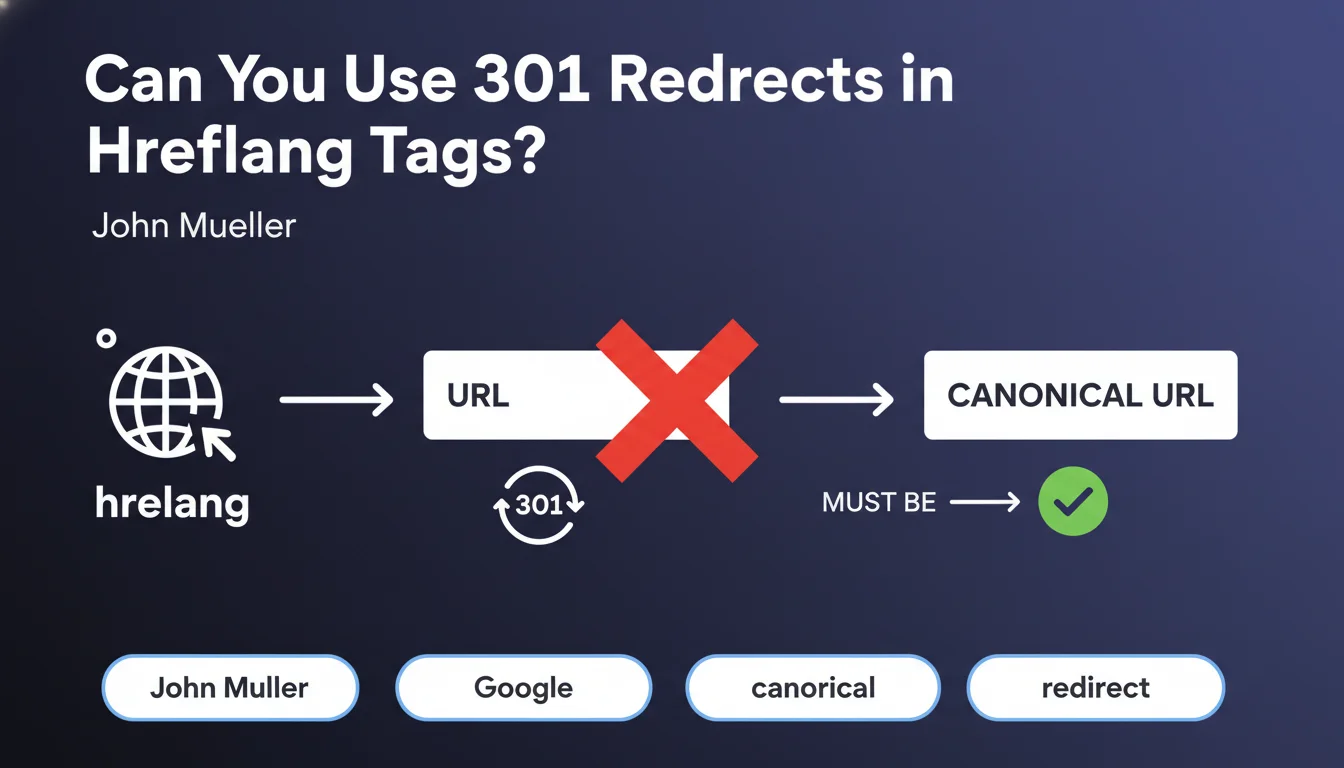
John Mueller clearly established that URLs referenced in hreflang tags must be canonical URLs. This means they should not be redirects, but should point directly to the final version of the page.
In other words, if you implement hreflang tags to indicate to Google the linguistic or regional versions of your pages, each URL mentioned must be directly accessible, without going through a 301 or 302 redirect.
Why does Google impose this constraint on hreflang URLs?
This requirement aims to simplify the processing of international signals by Google's robots. Redirects add a layer of complexity that can create ambiguities in the interpretation of hreflang annotations.
Google must be able to quickly and unambiguously identify which version of a page corresponds to which language or region. Redirects can blur these signals and lead to indexing or display errors in localized search results.
What are the concrete risks of using redirects in hreflang?
Using non-canonical URLs with redirects in your hreflang tags can cause several problems. Google might completely ignore your hreflang annotations, rendering your international configuration ineffective.
You also risk seeing the wrong language version appear in search results depending on the country. In some cases, Google may even consider your hreflang signals as inconsistent and disable them entirely for your site.
- Hreflang URLs must be canonical, without 301 or 302 redirects
- This rule applies to all hreflang implementations (HTML tags, XML sitemap, HTTP headers)
- Redirects in hreflang can lead to complete ignorance of your annotations
- Misconfigured hreflang can display the wrong language version to users
- Consistency between canonical and hreflang is essential for international SEO
SEO Expert opinion
Is this statement consistent with practices observed in the field?
My 15 years of SEO experience fully confirms Google's position. I have observed numerous cases where international sites lost their localized visibility due to redirects in their hreflang tags.
Tools like Google Search Console explicitly report these errors in the section dedicated to international coverage reports. Google detects these inconsistencies and flags them as priority issues to correct.
What important nuances should be brought to this rule?
There is a crucial distinction to make: this rule concerns the URLs declared in hreflang, not necessarily the URL of the page that contains the hreflang tag itself. If page A redirects to B, it is page B that must contain the hreflang annotations.
Furthermore, be careful not to confuse this with IP-based geographic redirects. You can absolutely implement automatic redirects for users while maintaining canonical URLs accessible to robots. The important thing is that Googlebot can access each version directly without redirection.
In which cases does this rule pose particular challenges?
International site migrations represent the most delicate case. When you change URL structure, you must first update all your hreflang annotations before implementing redirects, otherwise you create a period of confusion for Google.
Sites with dynamic URL structures or complex content management systems can also encounter difficulties. Some CMS automatically generate redirects that interfere with hreflang configurations, requiring in-depth technical adjustments.
Practical impact and recommendations
What should you check immediately on your site?
Start by auditing all your hreflang tags to identify URLs that are being redirected. Use a professional SEO crawler to scan your site and automatically detect these inconsistencies.
Then check Google Search Console, "International Targeting" section. Google reports detected hreflang errors there, including non-canonical or inaccessible URLs. Prioritize correcting errors affecting your strategic pages.
How do you effectively fix hreflang errors related to redirects?
The solution consists of replacing all redirected URLs with their final destinations in your hreflang annotations. If https://example.com/fr redirects to https://example.com/fr/, use the second URL directly in your hreflang.
For sites with hardcoded hreflang tags, this means modifying your templates. For those using hreflang sitemaps, update your XML files. Remember that hreflang annotations must be bidirectional and consistent across all language versions.
What practices should you adopt to avoid these problems in the future?
Establish strict governance of your canonical URLs before any hreflang implementation. Clearly document the final URL structure for each language and regional version of your site.
Integrate automated tests into your deployment process to verify that hreflang URLs are always canonical and accessible without redirection. This verification should be part of your quality checklist before each production release.
- Audit all existing hreflang tags to detect URLs with redirects
- Check errors reported in Google Search Console, International Targeting section
- Systematically replace redirected URLs with their final destinations in hreflang
- Ensure each hreflang URL returns an HTTP 200 code (not 301, 302, 307)
- Verify bidirectional consistency: each page must reference all other language versions
- Test the accessibility of each hreflang URL with a crawler or dedicated tool
- Document the canonical URL structure for each international version of the site
- Set up automated tests to prevent regressions during deployments
- Regularly monitor hreflang reports to quickly identify any new errors
The rule is clear: URLs in hreflang tags must be canonical, without any redirection. This requirement ensures that Google can correctly interpret your international signals and display the right language version to users based on their location.
The practical implications are significant: you must audit your existing configurations, correct inconsistencies, and establish rigorous processes to maintain this compliance over time. The complexity of multilingual international architectures often requires in-depth technical expertise combined with a thorough understanding of Google's mechanisms.
Given these technical challenges and the strategic importance of international SEO for your global visibility, support from an SEO agency specialized in multilingual issues can prove invaluable. A professional diagnosis and personalized support will enable you to effectively optimize your hreflang configuration and avoid costly errors in terms of international traffic.
💬 Comments (0)
Be the first to comment.