
Official statement
What you need to understand
What exactly are trust labels and why does this question matter?
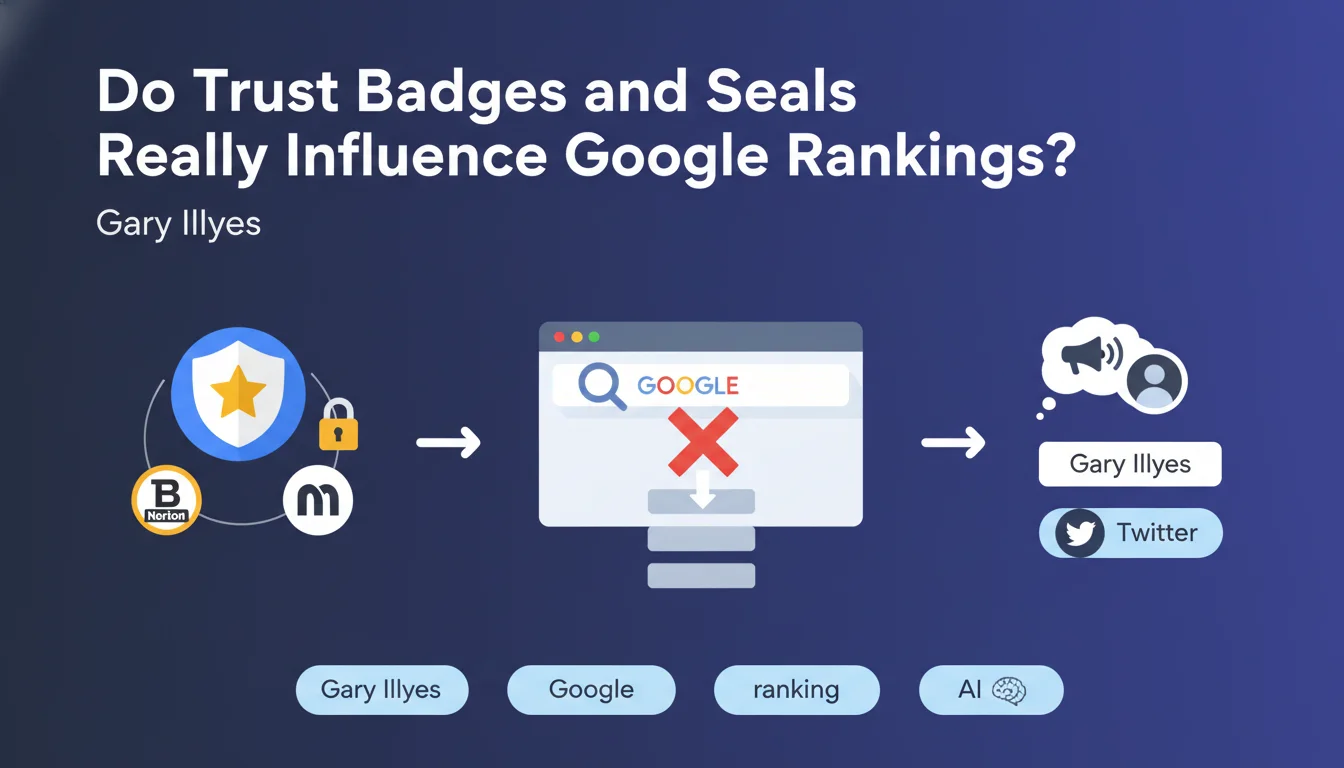
Trust seals are badges displayed on websites to reassure visitors: BBB, Norton Secured, McAfee, Trustpilot, and many others. Many site owners believe that displaying these certifications could improve their organic search rankings.
This belief stems from confusion between user trust and algorithmic trust. Google has clearly stated that these visual elements have no direct impact on rankings, because they are third-party distinctions that the algorithm cannot reliably verify or value.
Why does Google ignore these badges in its algorithm?
The reason is purely technical and logical. These badges are static images that are easily manipulated: anyone can copy a Norton logo and add it to their page without actual certification. Google cannot automatically verify the authenticity of thousands of different certification programs.
Moreover, Google has its own trust indicators: domain authority, content quality, behavioral signals, backlinks, HTTPS, etc. The algorithm doesn't need to rely on external labels when it has its own internal metrics.
Are these badges then completely useless for SEO?
Not exactly. While they don't directly influence the algorithm, they can have a measurable indirect impact. A well-placed trust badge can increase conversion rate, reduce bounce rate, and improve time spent on site.
These behavioral signals are observed by Google and can influence rankings. The nuance is important: it's not the badge itself that matters, but its effect on user experience.
- Trust seals have no direct impact on Google's ranking algorithms
- Google uses its own metrics to assess a site's reliability
- These badges are not automatically verifiable and can be easily faked
- An indirect impact via user experience remains possible but not guaranteed
- The confusion comes from conflating user trust and SEO signals
SEO Expert opinion
Is this statement consistent with what we observe in the field?
After 15 years of experience, I can confirm that Google's position is completely consistent with empirical observations. I've analyzed hundreds of sites with and without trust badges: no direct correlation exists between the presence of these labels and positioning in the SERPs.
The A/B tests we've conducted show that adding or removing badges causes no fluctuation in rankings in the short or medium term. However, the impact on conversion rate is often measurable, particularly in e-commerce and health sectors.
What important nuances should be added to this rule?
The major nuance concerns e-commerce sites and YMYL (Your Money Your Life) sectors. On these sites, trust badges can significantly improve engagement metrics: session time, pages per visit, adjusted bounce rate.
These positive behavioral signals can indirectly influence SEO through mechanisms like RankBrain or the interpretation of user satisfaction. But be careful: this effect remains indirect, not guaranteed, and depends entirely on actual user behavior.
In what cases can these badges become counterproductive?
An excess of badges creates a "banner blindness" effect and can even harm perceived credibility. A site displaying 10 different certifications often appears less professional than a clean site with one or two relevant labels.
Additionally, some obsolete badges or those from little-known programs can create confusion for the user. In the worst case, displaying a fake badge can lead to legal sanctions and a total loss of trust, with catastrophic impact on all indicators.
Practical impact and recommendations
What should you actually do with trust badges on your site?
The recommendation is pragmatic: don't remove them if they're already in place and legitimate, but don't make them an SEO priority either. Focus your efforts on real ranking factors: quality content, technical performance, user experience.
If you're in a sensitive sector (e-commerce, finance, health), keep 1 to 2 relevant and recognized badges for your target audience. Place them strategically on conversion pages (checkout, forms) rather than on all pages.
What mistakes should you absolutely avoid with these elements?
The most serious error is displaying an unearned badge: it's illegal and destructive to your reputation. The second common mistake is adding real-time verification scripts that tank loading speed.
Also avoid visual overload: too many badges create a "Christmas tree" effect that dilutes credibility instead of reinforcing it. Finally, never neglect other trust signals that are genuinely important to Google: HTTPS, clear privacy policy, verifiable contact information.
How can you actually optimize perceived trust for SEO?
Focus on elements that Google truly values: a valid SSL certificate, complete legal pages (legal notices, terms and conditions, privacy policy), visible contact information with physical address if relevant.
Work on your E-E-A-T (Experience, Expertise, Authoritativeness, Trustworthiness): detailed author biographies, cited sources, verified expert content. These elements have a direct SEO impact, unlike third-party badges.
- Verify that your SSL/HTTPS certificate is valid and properly configured
- Display only badges that are legitimately obtained and relevant to your sector
- Limit to 1-2 badges maximum to avoid visual overload
- Test the impact of badge scripts on your Core Web Vitals
- Prefer static images to dynamic widgets for performance
- Place badges on conversion pages rather than on all pages
- Supplement with complete and accessible legal pages
- Develop authentic E-E-A-T signals (authors, sources, expertise)
- Monitor user engagement metrics as indicators of real trust
- Never invest in badges at the expense of true SEO factors
💬 Comments (0)
Be the first to comment.