
Official statement
What you need to understand
Why Does the Meta Keywords Tag Keep Coming Up in SEO Discussions?
The meta keywords tag is a relic from the past that continues to puzzle some SEO professionals. This HTML tag was once used to indicate to search engines the main keywords of a page.
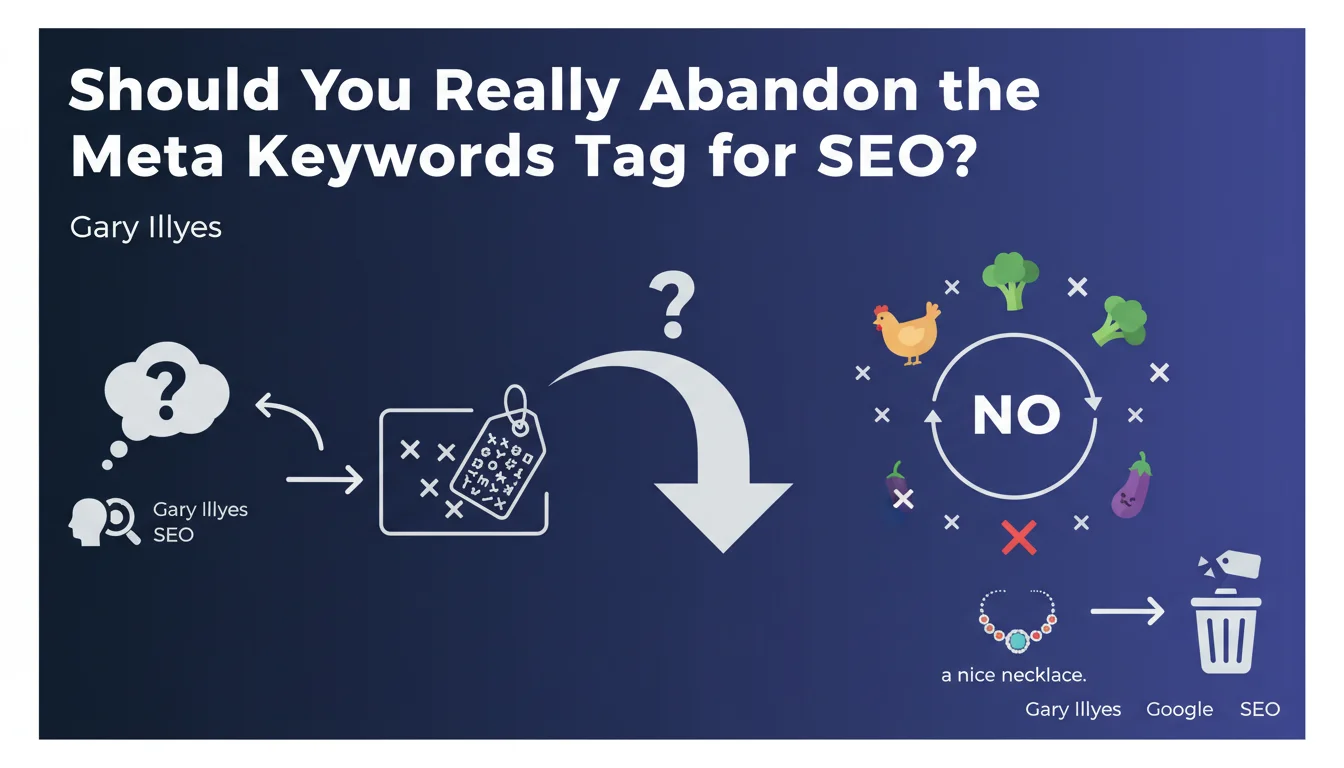
Gary Illyes from Google had to clarify once again that this tag has had no impact on SEO for nearly 20 years. The question raised even concerned a potential penalty for keyword stuffing in this tag, which demonstrates a persistent misunderstanding of how Google currently works.
What Is Google's Official Position on This Tag?
Google clearly states that it does not read the meta keywords tag and has never used it as a ranking factor in its modern algorithms. Gary Illyes' ironic response underscores the absurdity of thinking Google would penalize something it completely ignores.
This statement reaffirms an official position maintained since the 2000s. Google cannot penalize what it doesn't take into account in its indexing and ranking process.
What Are the Key Takeaways from This Clarification?
- The meta keywords tag has not been read by Google for approximately 20 years
- There is no penalty for keyword stuffing in this tag since it is completely ignored
- This tag has no positive or negative impact on organic search rankings
- Resources devoted to optimizing this tag are completely wasted
- Other minor search engines could theoretically use it, but their impact is negligible
SEO Expert opinion
Is This Statement Consistent with Field Observations?
Absolutely. Empirical tests conducted by the SEO community for years confirm the complete absence of impact of the meta keywords tag on Google rankings. No correlation has ever been observed between the presence or optimization of this tag and SEO performance.
This consistency between official statements and practical observations is reassuring. It demonstrates that on this specific point, Google communicates in a transparent and reliable manner with SEO professionals.
Why Do Some CMS and SEO Tools Still Offer This Tag?
Many content management systems and SEO plugins still include a field for the meta keywords tag due to historical compatibility or simple technological inertia. Unfortunately, this perpetuates confusion among beginners.
Some tools maintain this functionality for compatibility with other minority search engines (Yandex, Baidu in certain contexts) or internal site search engines. But for Google, which represents the majority of organic traffic, it's completely useless.
Should You Remove This Tag If It Already Exists on a Site?
Removing or keeping it has absolutely no impact on your Google rankings. However, removing it offers a technical advantage: it slightly lightens the HTML code and avoids unnecessarily transmitting information about your keyword strategy to your competitors.
From a code maintenance and cleanliness perspective, it's preferable to remove it during a redesign or technical audit. But it's clearly not a priority if other more impactful optimizations remain to be performed.
Practical impact and recommendations
What Should You Concretely Do with the Meta Keywords Tag?
The recommendation is simple: spend no time optimizing, filling, or even thinking about this tag for Google. Your energy should focus on factors that have a real impact on search rankings.
If you're launching a new site, don't include this tag in your templates. If it already exists, you can leave it as is or remove it during a future technical update, but it's not urgent.
Which Meta Elements Should You Focus Your Efforts on Instead?
Focus on the elements that truly matter: the title tag (page title), meta description, Open Graph tags for social media, and structured markup (schema.org).
The page title remains the most important on-page factor, followed by the structure of Hn tags and content quality itself. The meta description, although not used for ranking, directly influences click-through rate from search results.
- Remove meta keywords fields from your editorial processes and content creation forms
- Disable or ignore meta keywords options in your plugins and CMS
- Focus your optimization efforts on title tags and meta descriptions
- Invest time in semantic markup (Hn) and quality content
- Train your teams so they don't waste time on this obsolete tag
- Reallocate the time saved toward content optimization, technical performance, or link building
How Do You Audit and Clean Your Site of These Obsolete Practices?
A comprehensive technical audit allows you to identify not only the presence of meta keywords tags, but also other obsolete SEO practices cluttering your code. A crawl of your site with tools like Screaming Frog will quickly reveal these elements.
Beyond this specific tag, it's recommended to regularly perform a cleanup of outdated SEO practices: artificial keyword density, anchor text over-optimization, cloaking techniques, etc.
💬 Comments (0)
Be the first to comment.