
Official statement
Other statements from this video 13 ▾
- □ Will structured data pros/cons in reviews really change the game in search results?
- □ Can structured product data really transform your Google visibility?
- □ Is Google's new Merchant Listings report a game-changer for e-commerce SEO?
- □ Does the Helpful Content Update really penalize your entire site, or just problem pages?
- □ Should you really forget technical SEO to please Google with 'people-first' content?
- □ Why does Google finally maintain a dedicated page to track ranking algorithm updates?
- □ How can you unlock your videos with Google's new Video Indexing Report in Search Console?
- □ How can you leverage the new video data in Google's URL Inspection Tool to boost your rankings?
- □ Can Google's new HTTPS report really prevent your rankings from dropping?
- □ Is Google's Search Console classification update changing how you should prioritize your SEO tasks?
- □ Is Google really abandoning geotargeting controls in Search Console?
- □ Does Google really enforce a strict 15 MB HTML crawl limit per page?
- □ How can you optimize your feeds to make the most of Google Discover's Follow feature?
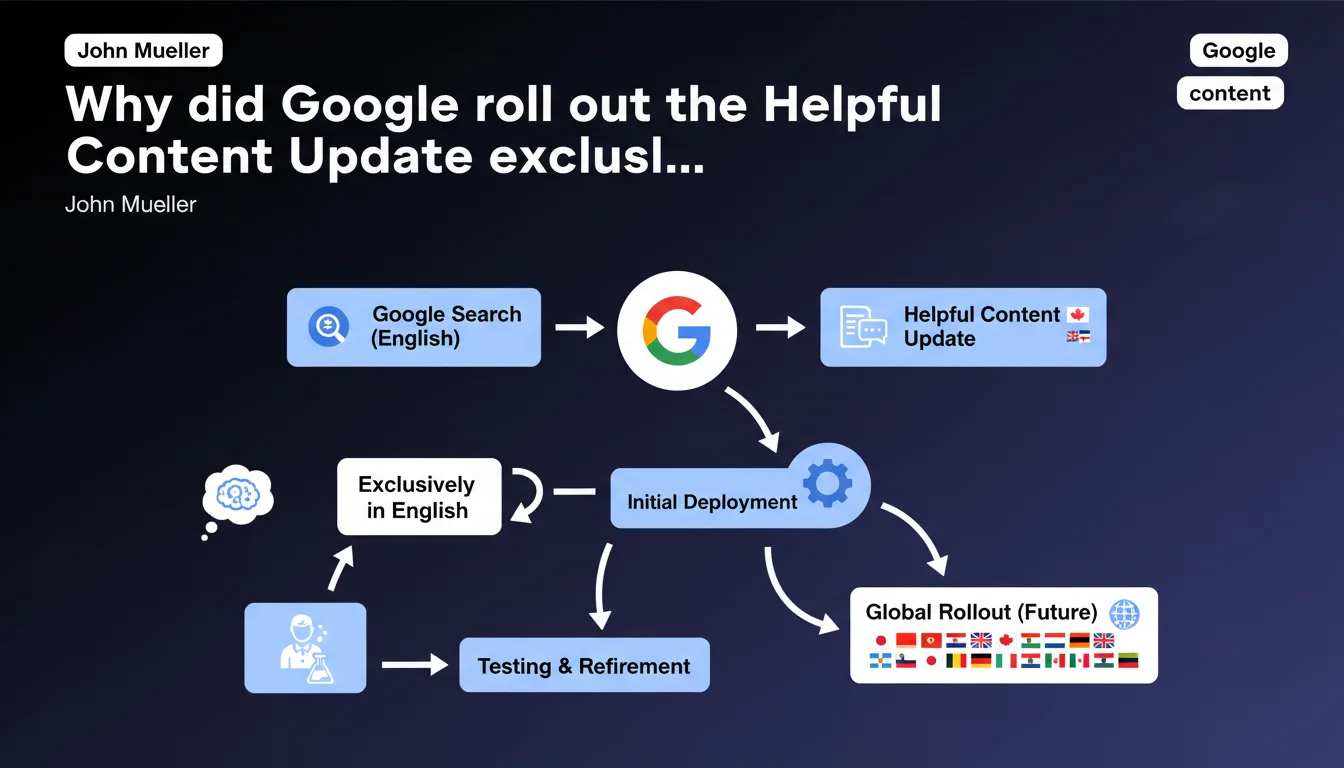
The Helpful Content Update was deployed only for English-language searches initially. Google was testing its algorithm on one language before extending it to other markets. This gradual approach allowed the company to refine its detection of low-quality content before a global rollout.
What you need to understand
Why does Google limit certain updates to a single language?
Google often conducts staggered rollouts to test the effectiveness of its algorithms. English represents the largest search volume and provides sufficient data to calibrate a model.
This approach makes it possible to identify false positives and side effects before impacting smaller markets. If the algorithm wrongly penalizes relevant content in English, the feedback will be massive and immediate.
What exactly is the Helpful Content Update?
This update aims to demote content created for search engines rather than for users. Google seeks to identify sites that mass-produce shallow content without real expertise.
The algorithm analyzes site-level signals — not just page by page. An entire site can be impacted if a significant proportion of its content is deemed unhelpful.
- Initial rollout limited to English to refine the algorithm
- Targets SEO-oriented content rather than user-first content
- Analyzes signals at the site level, not just on individual pages
- Progressive expansion to other languages after validation
Does this English-only limitation mean a reprieve for other languages?
No. The temporary absence of the Helpful Content Update on other languages does not mean that mediocre content is tolerated there. Google's other ranking systems (Panda, etc.) continue to function.
This statement simply indicates that the specific HCU system was not yet active. Sites in French producing hollow content remained exposed to penalties from other filters.
SEO Expert opinion
Is this gradual approach really something new?
Absolutely not. Google has been using this method for years with each major algorithmic update. English systematically serves as a testing ground.
What is interesting here is that Mueller announces it explicitly. Typically, Google rolls out in English first without publicly signaling it — SEOs in other markets discover it through deduction.
Did limiting HCU to English create distortions?
Let's be honest: yes. During the period when only English was targeted, multilingual sites experienced absurd situations. Their English version would drop while their French, German, or Spanish versions remained stable — even though the content followed the exact same editorial logic.
Some SEOs exploited this temporary window by massively producing mediocre content on non-English markets. [To verify]: we lack precise data on the extent of this phenomenon, but SEO forums have documented several flagrant cases.
Does this statement imply that HCU criteria vary by language?
That's where it gets tricky. Mueller does not say whether the algorithm was adapted to linguistic specificities or simply translated. The nuances of what constitutes "helpful content" differ significantly by culture.
For example, the level of detail expected in an in-depth article varies enormously between an American and Japanese audience. [To verify]: Google has never clearly communicated about these regional adaptations of HCU.
Practical impact and recommendations
Should I apply HCU recommendations even if my site is not in English?
Obviously. The underlying principles of the Helpful Content Update are universal: create for users, not for search engines. Waiting for the algorithm to become active in your language before correcting your weak content is taking an unnecessary risk.
Sites that anticipated by cleaning up weak content before HCU expanded to their language generally weathered it better. Those that waited suffered sharp drops.
How do you identify vulnerable content before HCU strikes?
Analyze your pages with a strict quality filter. Ask yourself these questions: does this page provide information you won't find elsewhere? Is it written by someone who truly masters the subject?
Look at your engagement metrics — not just traffic. A high bounce rate or low session time on pages meant to be informative is a red flag.
- Systematically audit all content created "for SEO" without real user value
- Delete or consolidate thin pages that only serve to target keywords
- Verify that each page demonstrates genuine expertise, not just paraphrasing third-party sources
- Analyze engagement signals (time spent, bounce, scroll depth) across the entire site
- Document author expertise — Google increasingly values bios and credibility
- Don't wait for a specific algorithm to become active in your language to clean up your site
What strategy should you adopt for a multilingual site?
Standardize your editorial policy across all language versions. If your English version was hit by HCU, it's a preview of what awaits your other languages.
Some sites made the mistake of improving only their English version after a penalty, then were surprised when their other languages dropped months later. Quality consistency must be global.
Implementing a truly user-first content strategy requires a deep methodological overhaul — far beyond simple technical tweaks. Analyzing hundreds or thousands of pages to identify those that amount to padding, restructuring an editorial line, training writers to E-E-A-T standards… this project can quickly exceed the internal resources of a team.
If your site shows concerning signals (gradual drop in organic traffic, multiplication of weak content) or if you manage a complex multilingual catalog, the expertise of a specialized SEO agency can make the difference between a successful overhaul and a brutal algorithmic penalty. An outside perspective often identifies blind spots that the internal team no longer sees.
❓ Frequently Asked Questions
Le Helpful Content Update s'applique-t-il désormais à toutes les langues ?
Un site peut-il être pénalisé par HCU dans une langue mais pas dans une autre ?
Faut-il réécrire tout son contenu pour être conforme à HCU ?
Comment Google détermine-t-il qu'un contenu est 'utile' ou non ?
Les sites d'affiliation sont-ils particulièrement visés par HCU ?
🎥 From the same video 13
Other SEO insights extracted from this same Google Search Central video · published on 28/09/2022
🎥 Watch the full video on YouTube →
💬 Comments (0)
Be the first to comment.