
Official statement
What you need to understand
What does Google actually say about using H1 tags?
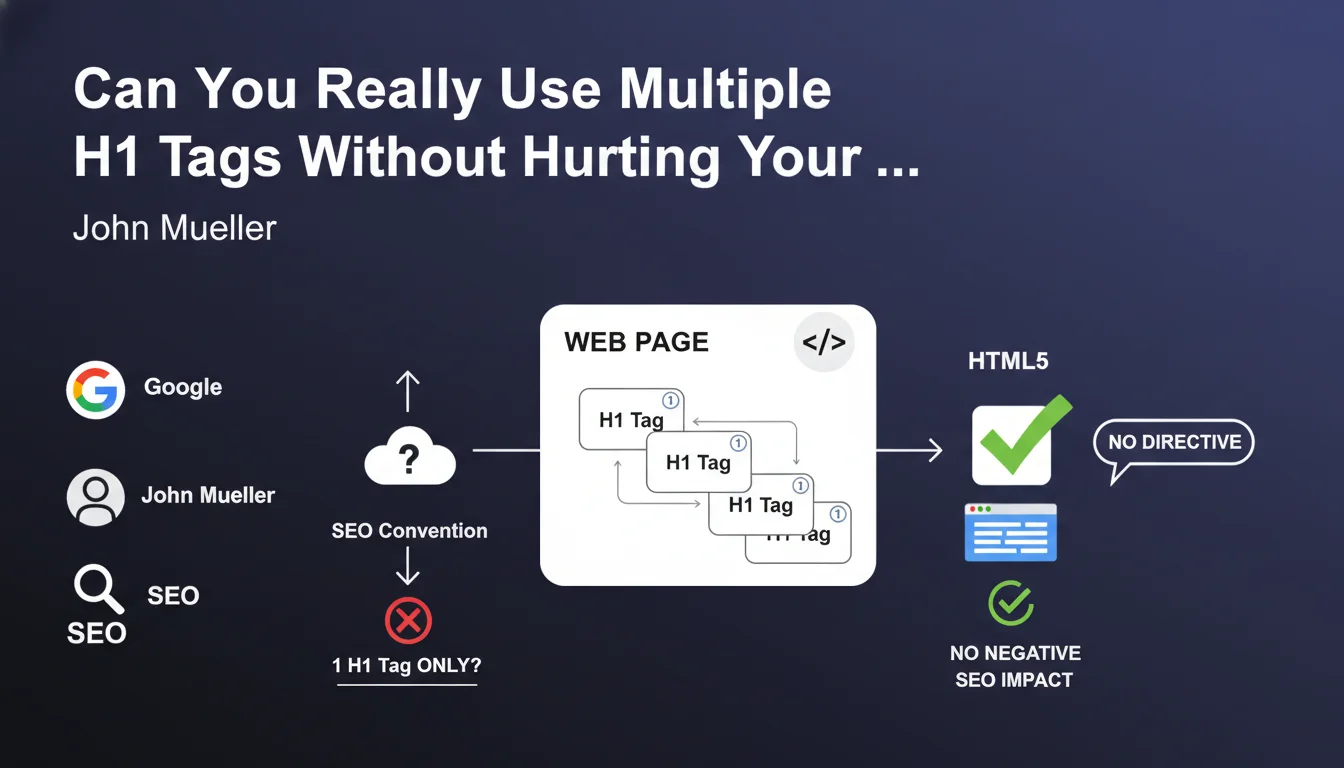
John Mueller's statement officially confirms that there is no technical limitation regarding the number of H1 tags on a page. Google can perfectly understand and process a page containing multiple H1s.
This position aligns with HTML5 specifications, which explicitly allow multiple H1s per page, particularly in the context of semantic sections. The myth of a single H1 per page is more a practice inherited from the past than a current technical constraint.
Where does the traditional recommendation of a single H1 come from?
This rule stems from the era when search engine algorithms were less sophisticated. The unique H1 served to clearly identify the main topic of the page, functioning as a document title.
With the evolution of HTML5 and semantic algorithms, this limitation has become technically obsolete. Google now perfectly understands the structure and hierarchy of content, even with multiple H1s.
What's the difference between technical possibility and best practice?
Just because Google accepts multiple H1s doesn't automatically mean it's the best approach. Technical possibility should not be confused with strategic optimization.
- Google can technically process as many H1s as you want
- HTML5 officially allows multiple H1s in different sections
- There is no algorithmic penalty for using multiple H1s
- Semantic structure remains essential for content understanding
- Editorial clarity should always take precedence over technical considerations
SEO Expert opinion
Is this statement consistent with what we observe in the field?
After 15 years of practice, I observe that Mueller's statement is technically accurate, but only tells part of the story. Tests indeed show that a page with multiple H1s is not penalized.
However, pages that rank best in SERPs generally present a clear hierarchical structure with a dominant H1. This correlation is not coincidental: it reflects better semantic organization and a more clearly defined search intent.
What essential nuances should be added to this statement?
The real question isn't "Can I use multiple H1s?", but rather "Should I do it?". The absence of a penalty doesn't mean optimization. A unique and descriptive H1 helps Google immediately identify the main topic of the page.
Multiple H1s can create semantic dilution, making it more difficult for the algorithm to determine what the real priority theme is. This ambiguity can indirectly impact rankings, not through penalty, but through lack of strategic clarity.
In which specific contexts are multiple H1s justified?
There are legitimate use cases for multiple H1s, particularly in modern web applications using reusable components. Pages with independent sections (such as aggregated articles) can benefit from multiple H1s.
Modern JavaScript frameworks (React, Vue, Angular) sometimes automatically generate multiple H1s in their components. In these specific technical contexts, forcing a single H1 can prove counterproductive and unnecessarily complicate development.
Practical impact and recommendations
What should you actually implement on your site?
My recommendation after 15 years of experience: favor a unique and descriptive H1 per page in 95% of cases. This approach guarantees maximum clarity for search engines and users.
Reserve the H1 for the main title of your content, the one that directly answers the search intent. Then use the H2-H6 hierarchy to structure subsections in a logical and progressive manner.
If your CMS or framework automatically generates multiple H1s, don't panic: you won't be penalized. But if you have the ability to correct this structure, it's preferable to optimize the semantics of your pages.
What critical mistakes should you absolutely avoid?
Never multiply H1s to attempt "keyword stuffing" or manipulate the algorithm. This practice is not only ineffective, but can be interpreted as keyword stuffing in certain contexts.
Also avoid empty H1s, those that are too short (less than 3 words), or duplicated across multiple pages. Each H1 should be unique and descriptive, faithfully reflecting the main content of the page.
- Verify that each page has at least one clear and descriptive H1
- Audit your site to identify pages with multiple H1s
- Prioritize correcting strategic pages (product pages, landing pages)
- Ensure your H1 contains the primary keyword of the page
- Test the hierarchy with tools like Screaming Frog or Semrush
- Document your structure choices for editorial teams
- Monitor the impact of modifications on your rankings over 3-6 months
How do you effectively audit and optimize your heading structure?
Start with a complete crawl of your site to map current H1 tag usage. Identify recurring patterns and anomalies requiring priority correction.
Then create clear editorial guidelines for your team, specifying when to use each heading level. Train your contributors on the importance of semantic structure in natural search engine optimization.
💬 Comments (0)
Be the first to comment.