
Official statement
What you need to understand
What's Google's Official Stance on Using Multiple Structured Data Types?
Google permits the use of multiple schema.org tag types on a single web page. There is no direct algorithmic penalty for this practice.
However, this permission comes with an essential condition: the implementation must be logical and coherent with the actual content of the page. Each tag must correspond to an element that is genuinely present and significant on the page.
What Display Limitations Exist in Search Results?
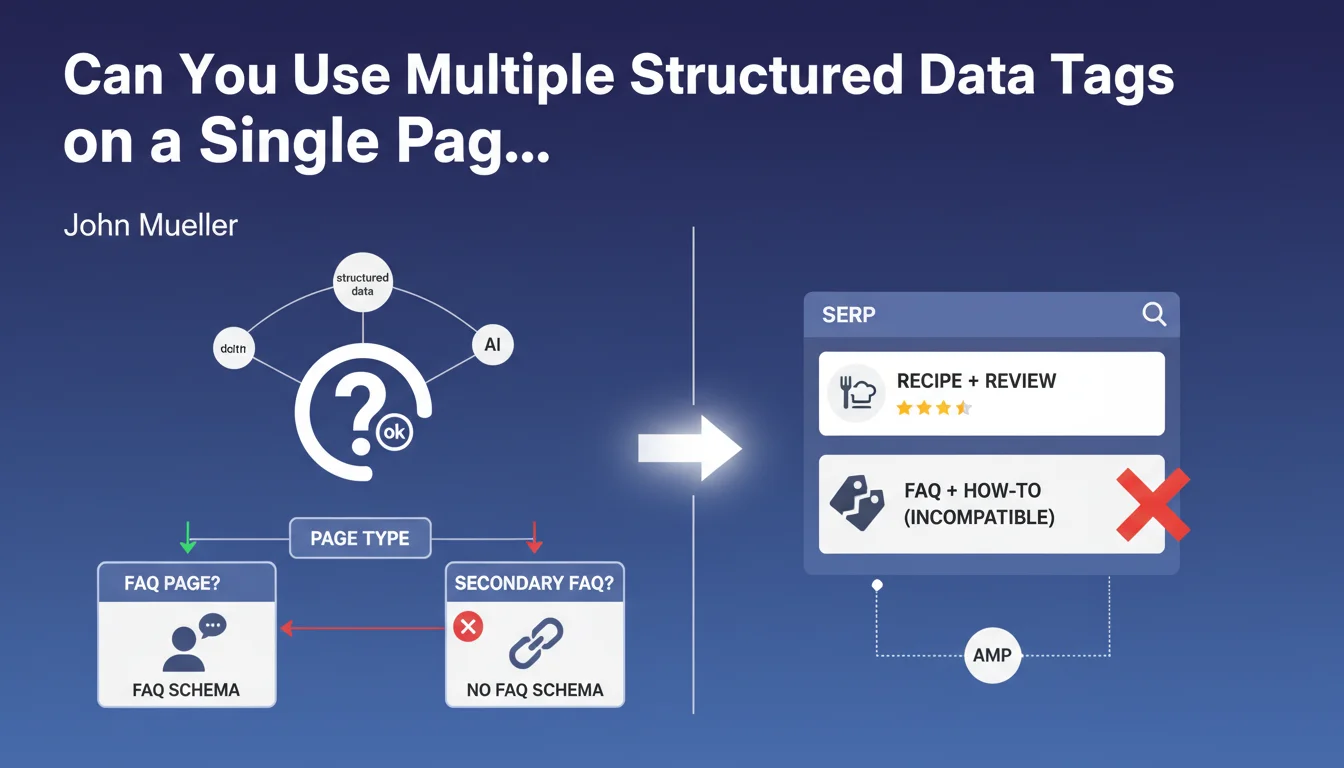
Google's system imposes display restrictions for certain combinations of rich snippets. For instance, FAQ and HowTo tags cannot simultaneously generate enriched results in the SERPs.
On the other hand, other combinations are perfectly compatible, such as the combination of Recipe and Review tags, which can be displayed together to enrich a single search result.
How Should You Assess the Relevance of a Structured Data Tag?
The central question to ask is that of the relative importance of the content concerned. If an FAQ section represents an accessory element of a product page, the FAQ tag could be considered inappropriate.
The marked element must constitute a substantial and central part of the page's content to justify the use of a dedicated tag.
- Google allows multiple schema tags on the same page without direct penalty
- Some tag combinations are incompatible for display in SERPs (FAQ + HowTo)
- Other combinations are compatible and can be displayed together (Recipe + Review)
- Each tag must correspond to substantial and relevant content on the page
- Logic and coherence take precedence over quantity of markup
SEO Expert opinion
Does This Statement Align with Real-World Observations?
In practice, this position from Google does indeed correspond to behaviors observed in the SERPs. Sites that intelligently use multiple compatible tags do obtain multiple enriched displays.
Nevertheless, experience shows that Google applies increasingly sophisticated relevance filters. Pages that artificially over-optimize their structured data without actual correspondence to the content regularly see their rich snippets deactivated.
What Important Nuances Should Be Added to This Recommendation?
The notion of "logic and discernment" remains subjective and can be interpreted differently depending on context. What seems logical to a webmaster may be perceived as manipulative by Google's algorithm.
Moreover, display compatibility rules evolve regularly. What works today may change tomorrow, particularly with the evolution toward the Search Generative Experience, which modifies the display logic for enriched results.
In Which Cases Does This Rule Become Counterproductive?
For pages with mixed or complex content, wanting to mark up everything can dilute the impact of each structured element. It is sometimes more effective to create separate and specialized pages.
For example, a product page containing a mini-FAQ could generate better results by creating a dedicated and comprehensive FAQ page rather than adding a secondary FAQ tag to the product page.
Practical impact and recommendations
What Should You Concretely Do to Optimize Your Structured Data?
Start with an audit of existing markup: identify all tags currently present on each page type of your site. Verify their coherence with the content actually displayed.
Systematically use Google's Rich Results Test to technically validate each implementation. But most importantly, monitor the actual display in the SERPs for your strategic queries.
Favor a qualitative rather than quantitative approach: one perfectly relevant tag is better than three approximate tags on the same page.
What Common Mistakes Should You Absolutely Avoid?
The most frequent error consists of marking up minimal or barely visible content in the hope of obtaining a rich snippet. Google detects these practices and may permanently deactivate the enriched display.
Also avoid stacking incompatible tags hoping that "one or the other" will display. This approach creates semantic confusion and can harm the overall interpretation of your page.
Never duplicate the same information in several different tags solely to multiply display chances. Google favors clarity and uniqueness of semantic markup.
How Can You Verify and Maintain Your Markup's Compliance?
Implement regular monitoring of your rich snippets' display in the SERPs. Modern rank tracking tools allow you to capture these visual elements.
Document for each page template the adopted markup strategy and the reasons for your choices. This will facilitate future audits and decisions in case of redesign.
- Audit all schema.org tags present on your site
- Verify coherence between markup and visible content of each page
- Systematically test with Google's official tool before production deployment
- Document known display incompatibilities for your sector
- Consider creating dedicated pages rather than multi-markup on complex pages
- Prioritize relevance and quality of marked content over quantity
- Regularly monitor the actual display of rich snippets in real results
- Update your markup strategy according to Google's evolutions
💬 Comments (0)
Be the first to comment.