
Official statement
What you need to understand
Why is this internal linking practice so widespread?
The logic behind this technique is appealing: the homepage generally concentrates the most authority and popularity of a site. By creating links from this page to all other pages, the goal is to distribute this SEO juice uniformly.
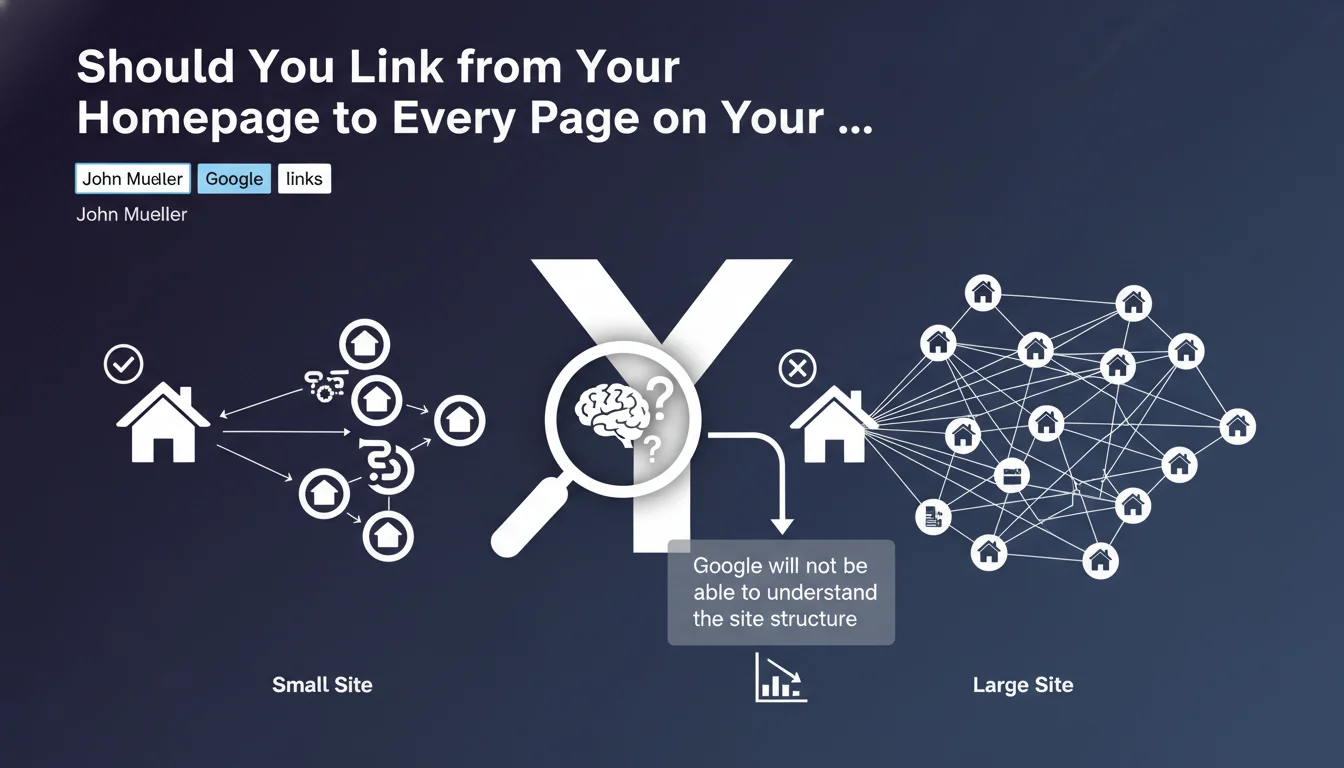
This approach does work effectively for small sites (fewer than 50 pages), where it ensures rapid indexing and coherent distribution of authority. Google's crawl is facilitated and all pages benefit from direct access.
What's the problem with large-scale sites?
For large sites, this strategy becomes counterproductive. Google analyzes links to understand the hierarchical structure and relative importance of different sections.
When all links originate from the homepage, this hierarchy becomes unreadable for algorithms. Google can no longer distinguish strategic pages from secondary pages, nor identify the site's main themes.
What is Google really trying to understand?
Google's algorithms use internal linking as a semantic map of your site. The link structure reveals relationships between content, pillar pages and supporting content.
A clear architecture with logical depth levels helps Google evaluate topical expertise and prioritize indexing of the most important pages.
- The homepage should point to main categories, not to all pages
- Google uses internal linking to understand thematic hierarchy
- Mega-menus and fat footers dilute the relevance signal
- An overly flat structure prevents Google from distinguishing strategic pages
- The number of links on a page impacts the PageRank transmitted to each destination
SEO Expert opinion
Is this recommendation consistent with field observations?
Absolutely. SEO audits of e-commerce sites or media outlets systematically show that sites with overloaded footers (200+ links) suffer from indexing and ranking problems.
I regularly observe sites where deep but strategic pages don't rank, precisely because Google cannot identify their importance in an ocean of uniform links. Conversely, sites with clear thematic silo architecture perform better on their target queries.
What nuances should be applied to this rule?
Mueller's recommendation doesn't mean you should avoid all footer or navigation links. It's about avoiding excess and lack of coherence.
A footer containing 15-20 links to essential pages (contact, legal notices, pillar pages) remains relevant. The problem arises with sprawling footers listing all products, all categories, all cities served.
In which cases does this approach remain valid?
Micro-sites and landing pages (fewer than 20 pages) can indeed benefit from complete navigation from the homepage. This is also true for one-page sites or minimalist portfolios.
Sites in progressive development can also temporarily list all their pages in navigation, before restructuring when volume increases. The key is to anticipate this evolution and not lock in an unsuitable architecture.
Practical impact and recommendations
How do you restructure an existing site's navigation?
Start with an audit of current internal linking. Identify how many links originate from your homepage and footer. If this number exceeds 100-150 links, you're probably in the red zone.
Organize your content into coherent thematic categories. The homepage should point only to these main categories (5-10 maximum), which themselves will distribute links to subcategories and final pages.
Replace mega-menus with structured dropdown menus with 2-3 levels maximum. Limit your footer to truly essential links: legal pages, contact, and 3-5 strategic pillar pages.
What critical mistakes must be absolutely avoided?
Never create an exhaustive geolocated footer listing all cities or regions where you operate. This practice, very common in local SEO, massively dilutes authority and obscures thematic understanding.
Avoid tag clouds in sidebars present on all pages. These elements create thousands of redundant links that provide no value to users or Google.
Don't duplicate your main navigation in multiple page areas. A header menu is sufficient, accompanied by a minimalist footer. Link repetition doesn't increase their value.
How can you verify that your new structure is working?
Use crawl tools (Screaming Frog, Oncrawl) to visualize your page depth. Ideally, 90% of your important pages should be accessible within 3 clicks maximum from the homepage.
Monitor Search Console for changes in indexing and performance after restructuring. Better understanding of your architecture by Google generally translates into improved positions on your strategic queries.
- Limit links from the homepage to 50-70 maximum (excluding footer)
- Create a clearly defined thematic silo architecture
- Reserve the footer for the 15-20 truly essential links
- Remove mega-menus listing all site pages
- Favor logical depth rather than universal direct access
- Use breadcrumbs to maintain user navigation
- Create hub/pillar pages distributing links to related content
- Regularly audit internal PageRank distribution
- Verify that strategic pages receive the most internal links
💬 Comments (0)
Be the first to comment.