
Official statement
Other statements from this video 4 ▾
- □ Is your content being invisibly filtered by SafeSearch without you knowing it?
- □ Does Google really filter content automatically without your consent, and how much are you actually missing?
- □ Is Google's Default Blur Mode Going to Hurt Your Image Search Rankings?
- □ Does Google automatically filter your content for minors with SafeSearch?
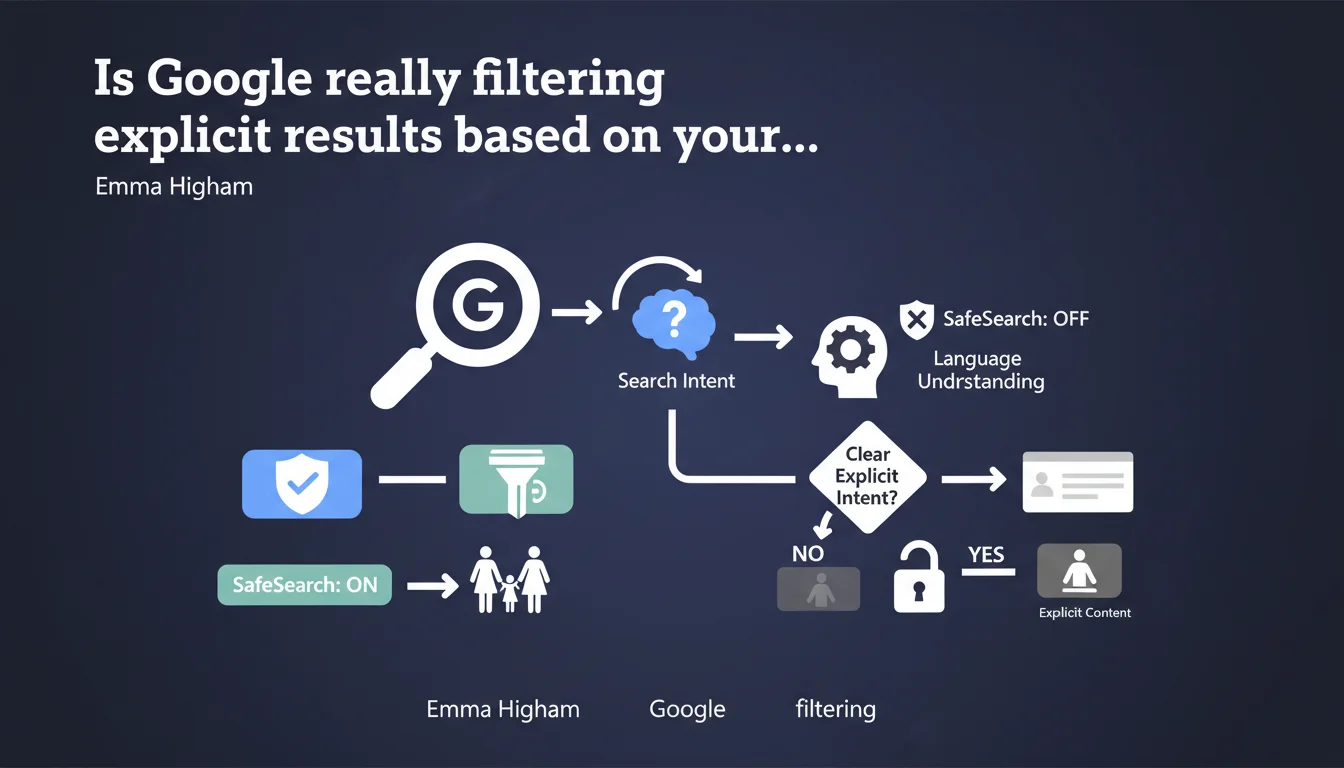
Google uses language understanding to interpret the intention behind ambiguous queries. When a search can have multiple meanings, the engine only provides explicit results if the user appears to be clearly looking for them. This nuance in semantic interpretation directly affects the ranking of sensitive or double-meaning content.
What you need to understand
How does Google interpret query ambiguity?
When you type a query that can have multiple meanings — some neutral, others explicit — Google doesn't flip a coin. The engine analyzes the semantic context to determine what you're really looking for.
Take an example: a query like "massage" can return both therapeutic practices and explicit content. Google therefore crosses multiple signals: search history, geolocation, exact phrasing, associated terms.
What does this change when SafeSearch is disabled?
The nuance is essential: this logic only applies when SafeSearch is disabled. In other words, Google doesn't systematically restrict explicit results, but it only displays them if the intention is clear.
It's a "safe by default" approach. If doubt persists about what the user really wants, Google leans toward neutral results. Explicit content must therefore cross a threshold of manifest intention to appear.
What signals does Google use for this detection?
Google remains vague about the precise signals — typical. We can assume the engine combines lexical analysis, user history, and behavioral signals. Query reformulation probably plays a key role.
- Google favors neutral results when faced with ambiguity even with SafeSearch disabled
- Semantic interpretation goes beyond raw keywords — context takes priority
- Explicit content must match a detectable explicit intention
- This logic affects the ranking of any page that could have multiple interpretations
SEO Expert opinion
Is this statement consistent with field observations?
Yes and no. On paper, this approach seems logical: avoid polluting SERPs with unwanted explicit content. But in practice, we've observed for years that Google struggles to correctly interpret certain ambiguous queries.
Perfectly neutral sites sometimes get filtered too aggressively, while other borderline content passes without issue. That famous "language understanding" remains imperfect and inconsistent depending on the sector. [To verify]: Google specifies neither the thresholds nor the exact metrics.
What nuances should be added?
First point: this statement mainly concerns queries with real double meanings. If your query is unambiguous, this logic doesn't apply. It's conditional filtering, not a universal rule.
Second nuance — and this is where it gets tricky: Google talks about "language understanding" as if it were an exact science. Except that in real life, the algorithm gets it wrong. Regularly. Especially with slang terms, culturally connotated language, or languages with less coverage.
In what cases does this rule not apply?
This filtering logic fails if the user adds explicit modifiers to their query. A simple word like "video", "photo", or clear slang, and Google understands the intention. The filter becomes inoperative.
Another case: brand or highly specific queries. If you type an explicit domain name or unambiguous cultural reference, Google doesn't guess. The rule mainly targets ambiguous generic queries.
Practical impact and recommendations
What should you do if your site operates in a sector with ambiguous vocabulary?
First action: clarify your semantics from the Title and Meta Description tags. If your content is neutral but uses potentially ambiguous terms, add contextual modifiers. "Certified therapeutic massage" beats "Massage" outright.
Second point: work on your lexical field in the content. The more you semantically mark your universe, the less Google risks misinterpreting your editorial intent. Semantic cocoons become a real defense here.
How do you verify your site isn't being filtered unfairly?
Test your target queries in private browsing with SafeSearch disabled. Compare with results when SafeSearch is enabled. If you disappear completely while your content is neutral, you have a classification problem.
Also use Search Console to spot queries generating impressions but zero clicks. That can signal filtering where your page appears but is pushed too low by algorithmic caution.
What mistakes must you absolutely avoid?
Don't overload your pages with disclaimers or overly defensive wording — that can actually signal to Google that your content is borderline. Stay natural and professional.
Also avoid the opposite trap: euphemizing too much to bypass filters if your content is actually explicit. Google detects semantic camouflage and that always ends badly in terms of trust.
- Clarify your vocabulary in Title, H1, and Meta Description tags
- Enrich the contextual lexical field to lift any ambiguity
- Test your target queries in private browsing with SafeSearch disabled
- Monitor Search Console for queries with impressions but no clicks
- Avoid overly defensive wording that could signal borderline content
- Don't semantically camouflage explicit content — Google detects it
❓ Frequently Asked Questions
Cette logique de filtrage s'applique-t-elle aussi avec SafeSearch activé ?
Un site neutre peut-il être pénalisé par ce filtre ?
Comment Google détermine-t-il qu'une intention est explicite ?
Les modificateurs de requête contournent-ils ce filtre ?
Faut-il modifier son contenu existant face à ce filtre ?
🎥 From the same video 4
Other SEO insights extracted from this same Google Search Central video · published on 24/10/2023
🎥 Watch the full video on YouTube →
💬 Comments (0)
Be the first to comment.