
Official statement
What you need to understand
What's Happening with Events in Google's SERPs?
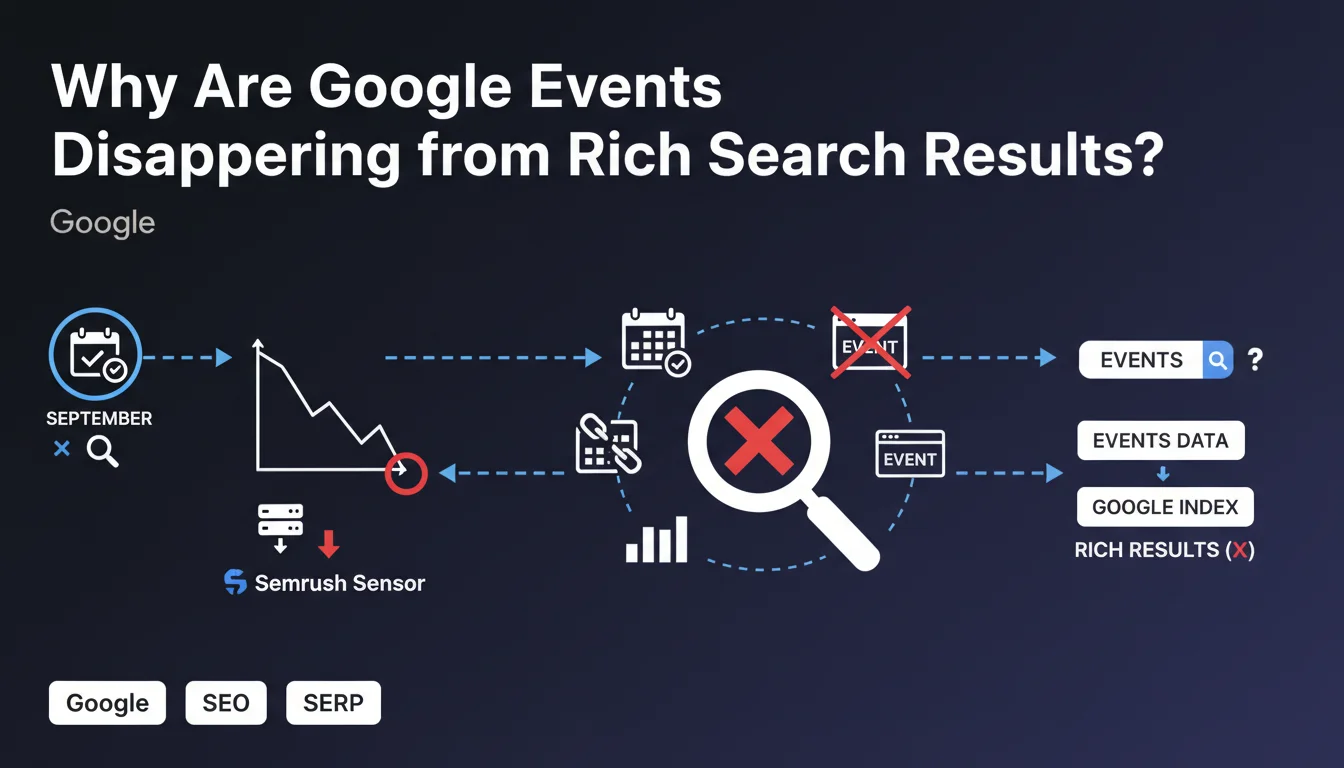
Since late September, rich results for events have virtually disappeared from Google's search results pages. This phenomenon was detected by several SEO professionals and confirmed by Semrush Sensor data.
The presence of these structured elements, normally displayed as event cards, has become almost non-existent in the SERPs. This situation affects many sites, but not all, which makes the analysis even more complex.
Is This a Technical Bug or a Deliberate Change?
The origin of this disappearance remains unclear and debated within the SEO community. Several hypotheses are circulating: a bug related to the October Core update, a widespread Schema.org tag implementation issue, or a deliberate choice by Google.
The fact that not all sites are uniformly affected suggests a technical problem rather than a global strategic decision. Nevertheless, Google has provided no official communication on this subject.
What Types of Events Are Affected by This Disappearance?
Observations indicate that the disappearance concerns all Event-type rich results, whether concerts, conferences, webinars, sporting events, or cultural events.
- Timeline: The phenomenon began in late September according to the first reports
- Detection: Identified via professional social networks and monitoring tools like Semrush Sensor
- Variable impact: Not all sites are affected in the same way
- No official communication: Google has not provided a clear explanation for this situation
- Possible correlation: Temporal coincidence with the October Core update
SEO Expert opinion
Does This Disappearance Align with Observed Trends at Google?
After 15 years of observing Google's practices, this situation presents atypical characteristics. When Google voluntarily removes a feature, the company typically communicates in advance, as it has done for other types of rich snippets.
The fact that the disappearance is partial and non-uniform strongly supports a technical bug. Google's strategic changes are usually deployed progressively but consistently, not randomly depending on the site.
What Technical Clues Help Us Better Understand the Situation?
Analysis of the disappearance patterns reveals several interesting elements. The temporal coincidence with the October Core Update suggests a possible regression introduced during the algorithmic deployment.
Sites that continue to display events often share common characteristics: very strict Schema.org implementation, long history of structured markup, and strong domain authority. This could indicate a quality filter that has become too restrictive.
What Strategic Lessons Can You Draw from This Incident for Your SEO?
This situation illustrates the fragility of dependency on rich results to generate traffic. Sites that have diversified their visibility sources (traditional SEO, featured snippets, People Also Ask) experience less impact.
It also demonstrates the importance of proactive monitoring. Professionals using SERP tracking tools detected the problem quickly, while others experienced a traffic drop without immediately understanding its origin.
Practical impact and recommendations
What Should You Check Immediately on Your Event Sites?
The first action is to audit the current state of your rich results. Use Search Console to check whether your event pages are still generating impressions and clicks since late September.
Analyze your Analytics data to identify any traffic drop correlated to this period. Segment by page type (events vs. other content) to isolate the actual impact.
- Check the "Rich results" report in Google Search Console
- Verify the implementation of Schema.org Event tags with the Rich Results Test
- Analyze the evolution of organic traffic on event pages since late September
- Compare performance with competitors via SERP monitoring tools
- Document observed changes with timestamped screenshots
What Corrective Actions Should You Take Right Now?
Even if the problem seems external, optimize your existing implementations. Ensure that your Schema.org Event markup strictly complies with Google's official guidelines, without obsolete properties.
Simultaneously strengthen your alternative SEO strategies. Optimize your title tags and meta descriptions for event-related queries, create rich content around your events, and work on internal linking.
Multiply touchpoints with your audience: local SEO via Google Business Profile for physical events, presence on specialized platforms (Eventbrite, Meetup), and optimization for featured snippets.
How Can You Anticipate and Limit the Impact of Future Google Volatility?
This situation demonstrates the importance of a diversified visibility strategy. Never rely exclusively on a single type of rich result to generate your organic traffic.
Implement a robust monitoring system including daily position tracking, analysis of displayed SERP features, and automatic alerts in case of significant changes.
- Maintain perfect structured data implementation to be ready for the return
- Never remove existing Schema tags during this period of uncertainty
- Diversify traffic sources beyond event rich results
- Monitor official Google announcements and discussions in the SEO community
- Regularly test your pages with Google's Rich Results Test
- Strengthen traditional SEO for your event pages (content, linking, on-page optimization)
💬 Comments (0)
Be the first to comment.