
Official statement
What you need to understand
What's the core issue raised by this statement?
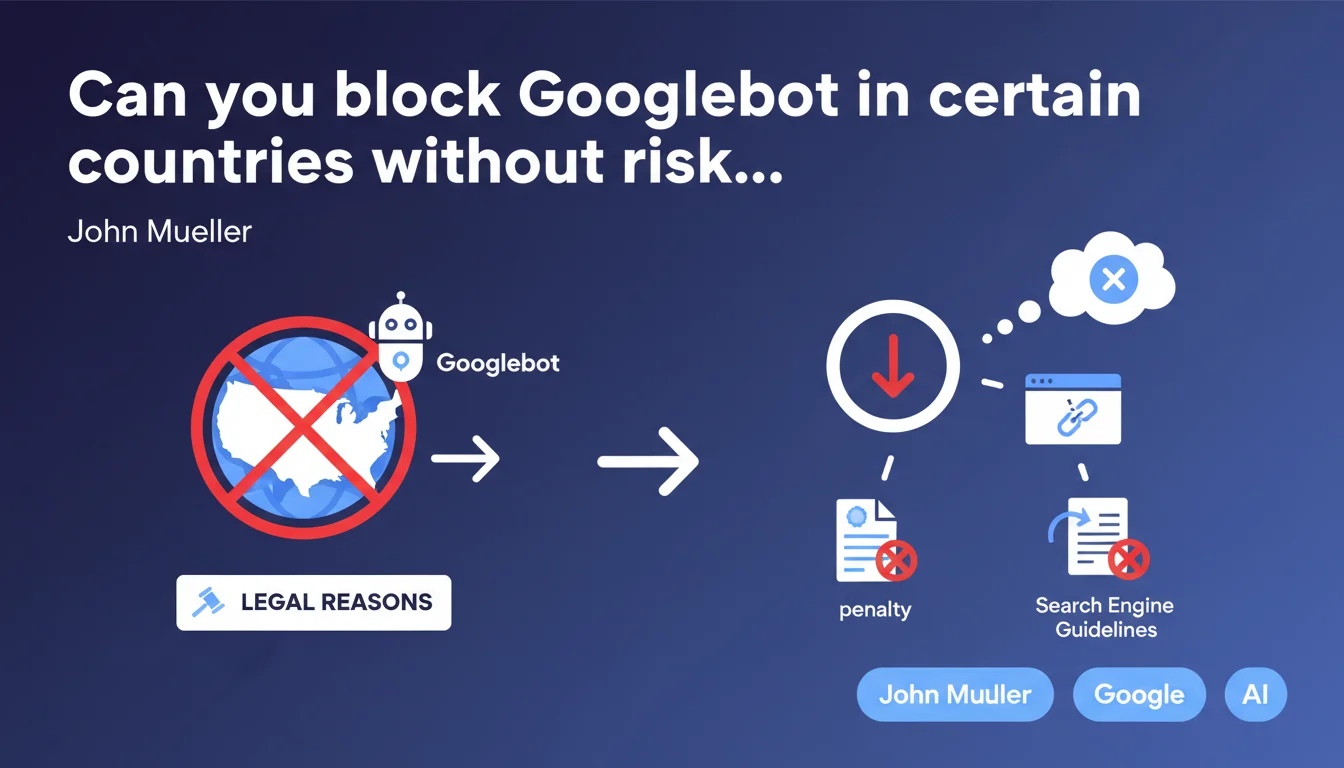
A user questioned Google about the possibility of blocking their site's display in search results for a specific country, particularly the United States. John Mueller was categorical: this practice violates Google's guidelines, even when motivated by legal constraints.
The technical problem is straightforward: if you allow Googlebot to crawl your site, but then block users from a given country, you create a discrepancy between what the bot sees and what users see. This technique is considered cloaking.
Why does Google view this practice as problematic?
Google primarily uses American IP addresses to crawl the web. If you block American visitors but let Googlebot through, you create a user experience different from what the search engine analyzes.
This divergence between crawled content and content accessible to users constitutes a violation of anti-cloaking rules. Google cannot guarantee the relevance of its results if users don't have access to the indexed content.
In what contexts does this situation arise?
This issue primarily concerns sites with legal geographic restrictions: streaming platforms, e-commerce sites with territorial limitations, services subject to specific national regulations.
It also affects businesses that want to target only certain markets without appearing in other countries' results for commercial or strategic reasons.
- Post-crawl geographic blocking is treated as cloaking
- This rule applies even for legitimate legal reasons
- The majority of Google bots use American IPs
- Consistency between crawl and user display is fundamental
- Geographic restrictions must be applied before crawling
SEO Expert opinion
Is Google's position consistent with market practices?
Google's position may seem rigid given the legal realities of many businesses. Entire sectors (gambling, healthcare, finance) must comply with strict territorial regulations that sometimes force them to block certain geographic zones.
However, this rule is technically consistent with Google's anti-cloaking principles. The search engine cannot create exceptions without opening the door to massive abuse. The position is therefore logical, but puts certain sites in an uncomfortable situation.
What nuances should be brought to this statement?
There's an important difference between blocking display after crawl and preventing crawling from the start. If you use robots.txt rules or noindex tags for geo-restricted sections, you remain compliant.
The crucial nuance also concerns different language versions of a site. Offering country-adapted content via distinct subdomains or directories, with appropriate hreflang, remains perfectly acceptable and poses no problem.
Does this rule create problems for legitimate sites?
Yes, this position creates a dilemma for legally constrained sites. A French sports betting site cannot legally serve its content to American users, but blocking these visitors after being crawled violates the guidelines.
Google's recommended solution - completely blocking crawling for these countries - results in total loss of visibility in these markets. It's a binary choice: legal compliance or SEO visibility, but not both simultaneously.
Practical impact and recommendations
What should you do if you need to restrict access geographically?
The cleanest solution is to block crawling upstream via robots.txt for geo-restricted sections. You can create specific directories by country and block their indexation according to your legal constraints.
Alternatively, structure your site with distinct domains or subdomains by geographic zone. Each version will be hosted in the target country with access restrictions consistent between crawl and user display.
If your business requires it, use geographic detection before even displaying content, with 302 redirects to explanatory pages for unauthorized zones. Ensure that Googlebot receives the same treatment as users from its IP zone.
What critical mistakes must you absolutely avoid?
Never show Googlebot complete content then block access to actual users via IP detection. This is the very definition of cloaking and can lead to severe penalties, even deindexation.
Also avoid relying solely on user-agent to differentiate Googlebot from users. Google uses various signatures and IPs, and this approach will be detected as manipulation.
Never use delayed JavaScript to block display after initial rendering. Google now executes JavaScript and will detect this discrepancy between initial HTML and final display.
- Audit your current geographic detection and verify crawl/display consistency
- Implement restrictions from robots.txt for geo-sensitive content
- Use multilingual/multi-country structures with appropriate hreflang
- Test your site with Google Search Console's URL inspection tool
- Document your legal constraints and adapt your architecture accordingly
- Favor explicit redirects rather than silent blocking
- Verify that your blocked pages don't generate 4xx errors in GSC
💬 Comments (0)
Be the first to comment.