
Official statement
What you need to understand
Google officially confirms that there is no problem with modifying your website to improve your organic search rankings. This statement puts an end to certain persistent fears within the SEO community regarding frequent adjustments.
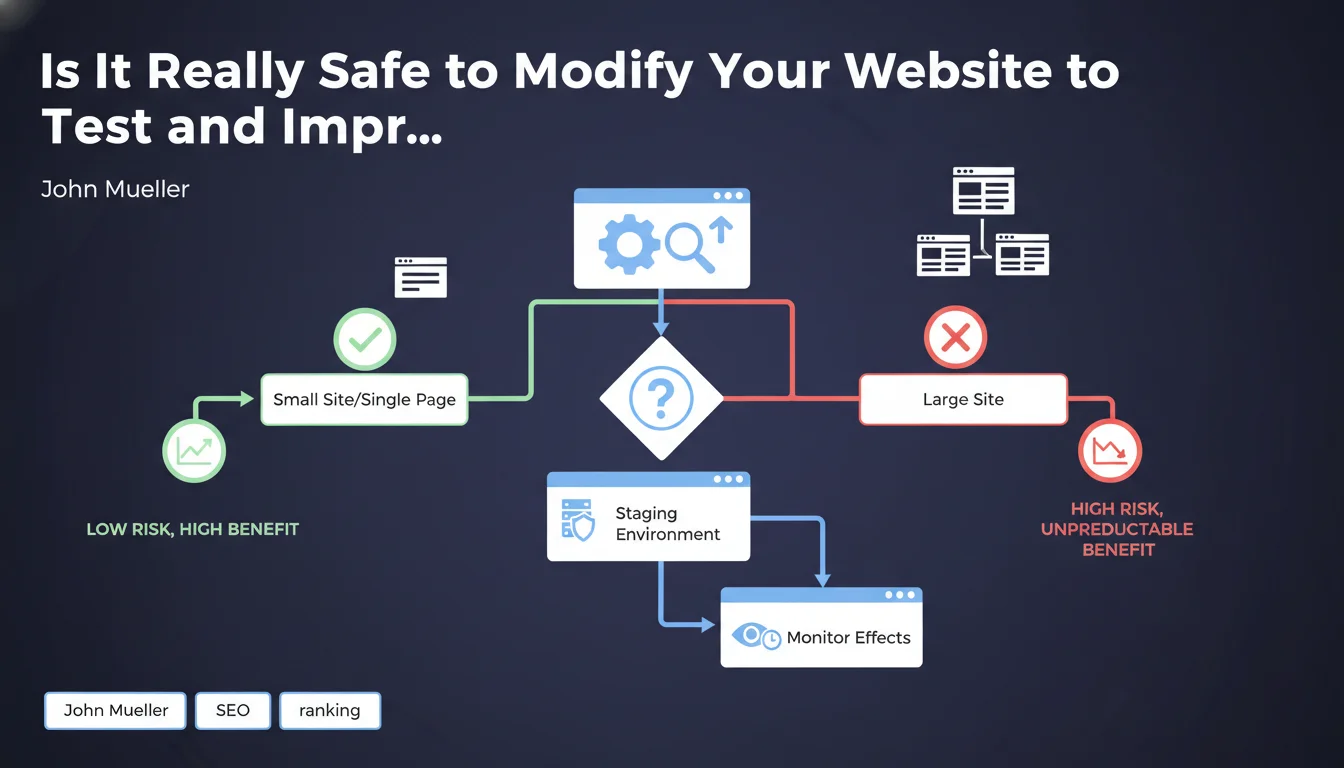
The recommended approach is based on analyzing the risk/benefit ratio. A small site or an isolated page can withstand experimentation without major consequences. However, on a large-scale site, each modification can have significant repercussions on traffic and visibility.
The advocated methodology includes testing in a staging environment before any large-scale deployment. This approach allows you to anticipate potential issues and refine changes before their final launch.
- SEO modifications are encouraged by Google itself
- The size of the site determines the necessary level of caution
- Staging tests limit risks on large sites
- Monitoring via Search Console and Analytics is essential
- An iterative and measured approach is preferable to abrupt changes
SEO Expert opinion
This position is perfectly consistent with field observations from recent years. Sites that stagnate are often those that no longer dare to change anything for fear of losing their rankings. Conversely, high-performing sites regularly test new approaches and optimizations.
An important nuance concerns the speed and scope of changes. Modifying 50% of your site all at once remains risky, even with Google's approval. The algorithm needs time to reassess pages. A gradual deployment by segments allows you to validate the positive impact before generalization.
Post-modification monitoring is often the weak link in SEO strategies. Many modify their site without precisely analyzing the actual impact. Without quantified data, it's impossible to distinguish an effective optimization from a counterproductive change.
Practical impact and recommendations
- Establish a structured testing protocol: document each modification, its deployment date, and its measurable objectives
- Prioritize tests on low-traffic sections for large sites: validate the approach before generalization
- Configure tracking in Search Console: monitor the evolution of impressions, clicks, and positions on modified pages
- Create dedicated Analytics segments: isolate traffic from tested pages to measure real impact
- Wait for a sufficient period: allow 2-4 weeks minimum before evaluating the impact of an SEO change
- Use a staging environment: test major technical modifications before production
- Document results: create a knowledge base of successful and failed tests
- Adopt an iterative approach: prefer regular and measured adjustments to abrupt overhauls
Implementing a rigorous SEO testing strategy requires cross-functional skills: technical analysis, data interpretation, algorithm understanding, and project management. For sites with high commercial stakes, this complexity often justifies support from experienced professionals.
Internal teams sometimes lack perspective or time to orchestrate a continuous optimization approach while managing daily operations. Engaging a specialized SEO agency allows you to benefit from a proven methodology, professional monitoring tools, and an external perspective capable of identifying opportunities that daily proximity to the site can sometimes cause you to miss.
💬 Comments (0)
Be the first to comment.