
Official statement
Other statements from this video 14 ▾
- □ Can you really use a single subdirectory to manage multiple international markets with hreflang?
- □ Why doesn't Google index every single URL on your site?
- □ Can you use third-party reviews to power product rich results on Google?
- □ Is Google really penalizing your site, or is it just an algorithm update?
- □ Should you really abandon NALT thesaurus URIs to boost your SEO rankings?
- □ Why are robots.txt unreachable errors always your own fault?
- □ Should you really redirect all your 404 errors to your homepage?
- □ Should you really maintain redirects when migrating to a new domain?
- □ Should you really worry about millions of unindexed URLs on your website?
- □ Is deliberately serving different HTTP status codes to Googlebot really that risky for your site?
- □ Does Google really treat 308 and 301 redirects the exact same way?
- □ Does content quality really impact how fast Google indexes your pages?
- □ Does Google really distinguish between WiFi and Wi-Fi for SEO purposes?
- □ Does a zero review count hurt your product page's search rankings?
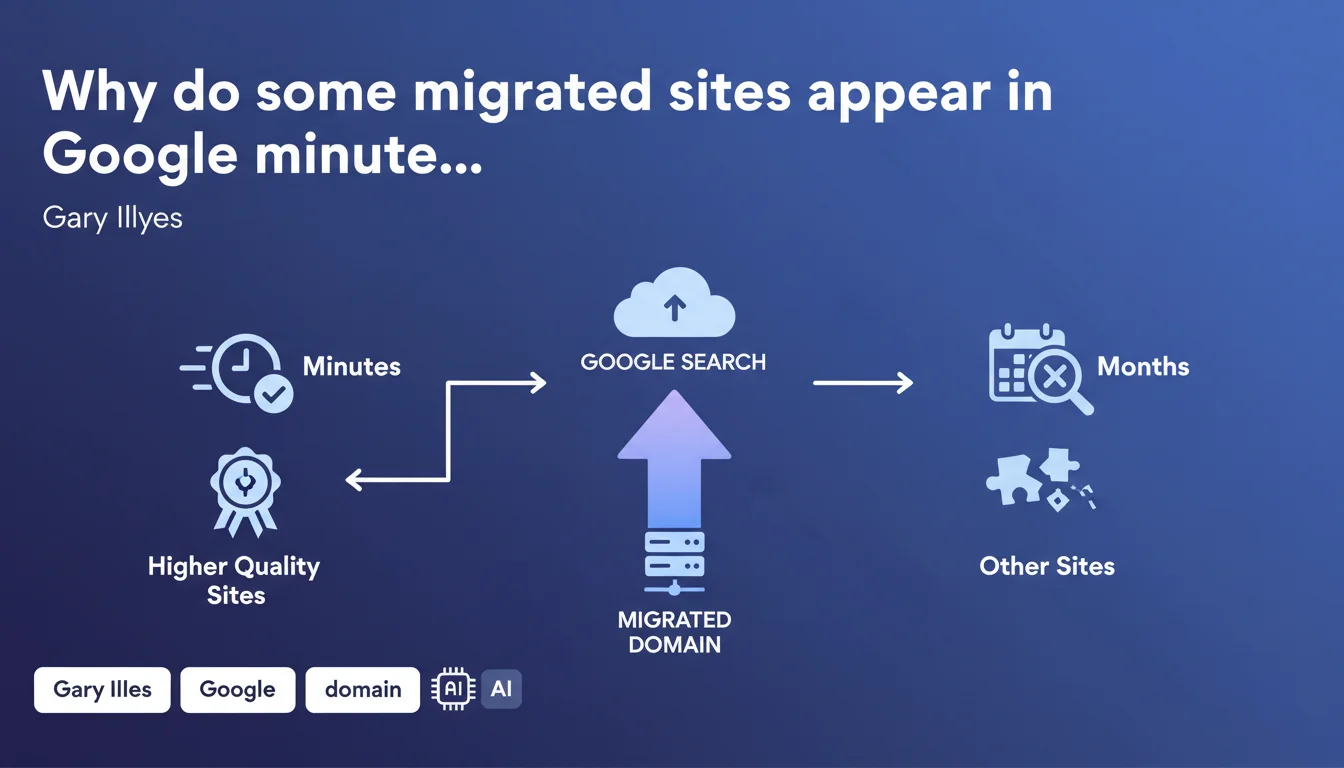
Gary Illyes confirms that the time it takes for a migrated domain to appear in Google Search varies depending on the perceived quality of the site. A site judged to be high quality can be indexed within minutes, while a lower quality site may wait several months. This official statement formalizes what many have already observed: Google does not treat all sites equally during a migration.
What you need to understand
What does Google mean by "quality" in this context?
The notion of quality mentioned by Gary Illyes remains intentionally vague. It can be assumed to encompass Core Web Vitals, content relevance, domain authority (backlinks), user experience, and site history. But Google provides no precise framework.
In practical terms? A site with a strong link profile, expert content, and smooth navigation will likely be prioritized. A site filled with thin content or with a troubled history will wait its turn — and possibly for a long time.
Does this variable delay apply to all types of migrations?
The statement does not specify whether it concerns only domain migrations (change of root URL), URL structure changes, or both. In practice, this phenomenon is observed mainly during a complete domain name change.
Intra-domain migrations (URL structure changes on the same domain) generally follow a different pace, as Google retains the trust acquired on the existing domain. But again, nothing definitive in this statement.
- Post-migration indexing delay depends directly on Google's quality perception
- "High quality" sites can appear within minutes
- Sites deemed less trustworthy may wait several months
- Google does not detail the exact criteria that define this "quality"
- This variability applies primarily to domain migrations
SEO Expert opinion
Is this statement consistent with real-world observations?
Yes, completely. Experienced SEOs have always noticed this disparity. A recognized news site or an established e-commerce platform will see its new URLs indexed almost instantly. A newly launched site or one with a questionable history will wait weeks, even months.
What is new is that Google is officially acknowledging it. Goodbye to the myth of equal treatment: reality is a multi-speed system where pre-existing reputation plays a major role.
What gray areas remain in this assertion?
First problem: no quantified metrics. What is a "quality site" for Google? A Domain Authority of 50+? A high organic click-through rate? A history free of penalties? Impossible to know precisely. [To be verified]
Second unclear point: "minutes to several months" is a colossal gap. Where is the average? What specific factors speed up or slow down the process? Gary Illyes provides no usable quantitative benchmark.
In what cases might this rule not apply?
If you migrate a site to a domain with a toxic history (spam, manual penalties), even irreproachable content won't be enough. Google remembers a domain's past wrongdoings, and this baggage can nullify your quality efforts.
Likewise, a poorly executed technical migration (302 redirects instead of 301, redirect chains, massive 404 errors) can delay indexing, regardless of perceived content quality. Technical excellence remains a non-negotiable prerequisite.
Practical impact and recommendations
What should you do before migrating a domain to maximize your chances?
Before any migration, audit the perceived quality of your current site. Analyze your Core Web Vitals, clean up thin content, fix technical errors, and strengthen your backlink profile. The "cleaner" your site is before the migration, the faster Google will process it.
Also ensure that the target domain has no problematic history. Check its past via the Wayback Machine, analyze its existing link profile if it's a purchased domain. A brand new domain is often safer than a recycled one.
How to accelerate indexing post-migration?
Submit your priority URLs via Google Search Console immediately after migration. Use a clean and up-to-date XML sitemap. Ensure all your 301 redirects are in place and working without chains or loops.
Boost the crawl by creating fresh content and earning some backlinks to the new URLs. Google returns faster to an active site. But if your site is judged to be low quality, these actions will have limited impact — that's the whole paradox of this statement.
- Audit the technical and editorial quality of the site before migration
- Verify the history and reputation of the target domain
- Implement clean 301 redirects, without chains
- Submit the new XML sitemap via Google Search Console
- Create fresh content and earn backlinks to the new URLs
- Monitor indexation daily during the first few weeks
- Prepare a Plan B if indexation drags beyond 4-6 weeks
What mistakes should you absolutely avoid?
Never migrate a low quality site hoping that the domain change will fix things. Google doesn't reward quick fixes: if your content was mediocre on the old domain, it will remain so on the new one.
Also avoid migrating during periods of high activity (sales, product launches) without testing the migration in pre-production first. An undetected technical bug can paralyze indexation for weeks.
❓ Frequently Asked Questions
Un site récent peut-il être indexé rapidement après migration ?
Les redirections 301 garantissent-elles une indexation rapide ?
Peut-on forcer Google à indexer plus vite après une migration ?
Combien de temps attendre avant de s'inquiéter d'une indexation lente ?
Google pénalise-t-il les migrations de domaine fréquentes ?
🎥 From the same video 14
Other SEO insights extracted from this same Google Search Central video · published on 12/04/2023
🎥 Watch the full video on YouTube →
💬 Comments (0)
Be the first to comment.