
Official statement
Other statements from this video 1 ▾
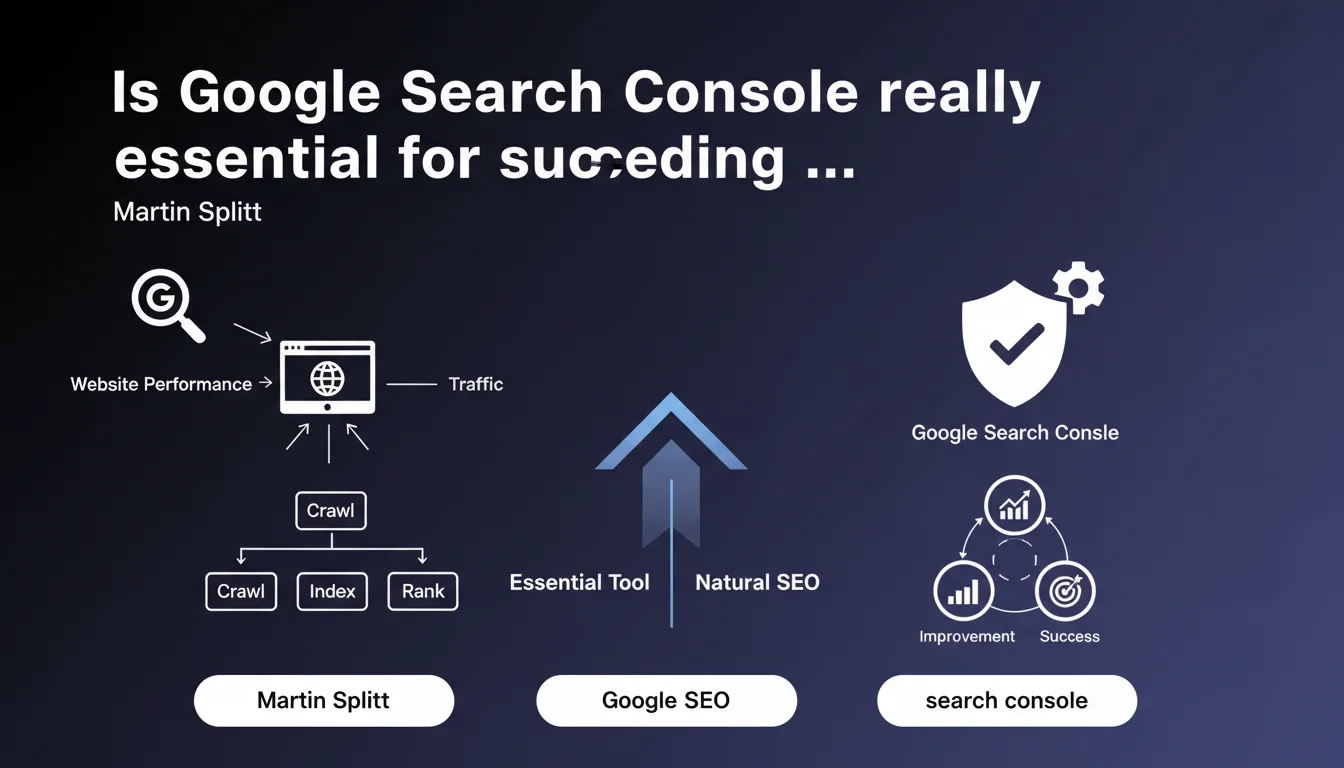
Martin Splitt asserts that Google Search Console is a crucial tool for improving site performance and traffic. He even goes so far as to consider its use essential for any effective natural search optimization. This statement positions GSC not as a simple diagnostic tool, but as a fundamental element of any SEO strategy.
What you need to understand
Why does Google push Search Console so hard?
Google never communicates by accident. When Martin Splitt describes Search Console as "crucial" and "essential", this isn't a casual recommendation but a clear signal: this tool is the official communication channel between your site and Google.
GSC does more than provide statistics — it reveals how Googlebot actually perceives your site, which pages are indexed, which ones have issues, and how users find you through search. It's the only source that combines crawl data, indexation, and SERP performance all in one place.
What does "crucial" actually mean for performance?
The word "crucial" is far from neutral. It implies that neglecting Search Console is like flying blind. Without GSC, you can't detect crawl errors, identify indexation issues, or understand which queries actually drive your traffic.
Splitt makes a direct connection here between GSC usage and traffic improvement. The underlying message: Search Console data lets you act on the right levers, those that directly impact visibility in search results.
Does this declaration change anything for SEO professionals?
For seasoned practitioners, nothing revolutionary — GSC is already part of the daily toolkit. But this official stance legitimizes its status as a reference tool and reinforces its importance with decision-makers who sometimes underestimate free tools.
It's also Google's way of saying: "If you're not checking Search Console, you're missing information we're voluntarily giving you." Ignoring this data means ignoring signals Google is sending you directly.
- GSC is the official channel of communication between Google and your site
- It combines crawl, indexation, and SERP performance data in one place
- Neglecting this tool means operating without visibility into what Google actually sees
- Google explicitly positions GSC as essential, not just useful
SEO Expert opinion
Is this claim consistent with real-world observations?
Absolutely. Every serious SEO audit starts with a thorough review of Search Console. The data it provides — 404 errors, coverage issues, Core Web Vitals, search queries — are elements that no third-party tool can replace with the same precision.
Where it falls short is that GSC remains imperfect and sometimes opaque. Query data is sampled, some metrics lag in refreshing, and explanations for indexation problems can be frustratingly vague. Saying it's "crucial" doesn't mean it's sufficient on its own.
Is Search Console really enough to manage everything?
No, and that's where nuance is needed. GSC excels at diagnosing technical issues from Google's perspective, but it doesn't replace server log analysis tools, third-party crawlers like Screaming Frog or OnCrawl, or position tracking platforms.
It tells you what Google sees, but not always why it sees it that way. For example, a page marked "discovered but not indexed" can have ten different causes, and GSC will only give you a general diagnosis. [To verify]: Google regularly improves the granularity of explanations, but there's still a long way to go.
Should you take this statement at face value?
Yes, in the sense that not using Search Console is a major strategic mistake. But beware of falling into the trap of thinking it solves everything. Google has every incentive to promote its own tool — legitimately so, since it's excellent.
Let's be honest: some professionals underutilize GSC out of habit or lack of familiarity with its advanced features. This official statement should prompt them to dive deeper into available reports, particularly page experience data and enhanced exploration reports.
Practical impact and recommendations
What should you prioritize checking in Search Console?
Start with the coverage report: this is where you see which pages Google actually indexes and which it excludes. 404 errors, redirect chains, canonicalization issues — it's all there.
Next, dive into search performance. Identify queries generating impressions but low clicks (low CTR), those where you're stuck in positions 8-15 (optimization potential), and pages losing traffic without apparent reason.
What errors must you absolutely avoid?
The first mistake is consulting GSC only in reactive mode, when there's a problem. Data should be analyzed regularly — at minimum weekly for an active site — to detect anomalies before they impact traffic.
Second common error: ignoring Core Web Vitals. Google displays them clearly in GSC, and they directly influence user experience and, consequently, rankings. Don't let pages sit with catastrophic LCP or unstable CLS.
Third trap: relying solely on aggregated data without segmenting by page type, device, or country. A global dip can mask a dramatic collapse on mobile or in a specific market.
How do you effectively integrate GSC into your SEO workflow?
Set up automatic alerts via the Search Console API or Google Sheets/Data Studio connectors. Monitor spikes in crawl errors, drops in clicks, newly excluded pages. Don't rely on sporadic manual checks.
Systematically cross-reference GSC data with Google Analytics and your server logs. GSC tells you what Google sees, Analytics shows you what users do, and logs reveal what Googlebot actually crawls. All three sources combined provide complete visibility.
- Check the coverage report each week to catch new indexation errors
- Analyze search performance: low CTR, positions 8-15, traffic-losing pages
- Monitor Core Web Vitals and fix problematic pages as priority
- Segment data by device, country, and page type to uncover hidden anomalies
- Set up automatic alerts via API or connectors for quick response
- Cross-reference GSC with Analytics and server logs for 360° visibility
- Train teams or stakeholders in GSC data interpretation to legitimize SEO actions
❓ Frequently Asked Questions
La Search Console remplace-t-elle les outils SEO payants comme SEMrush ou Ahrefs ?
Pourquoi certaines requêtes n'apparaissent-elles pas dans le rapport de performances ?
À quelle fréquence les données de la Search Console sont-elles mises à jour ?
Faut-il obligatoirement valider la propriété du site pour bénéficier de la GSC ?
Les données de la Search Console sont-elles fiables à 100% ?
🎥 From the same video 1
Other SEO insights extracted from this same Google Search Central video · published on 06/11/2023
🎥 Watch the full video on YouTube →
💬 Comments (0)
Be the first to comment.