
Official statement
Other statements from this video 1 ▾
Google confirms that adding structured data enables visually enhanced rich results to appear in the SERP. However, this statement remains vague about eligibility criteria and display guarantees — a gray area that every SEO practitioner knows all too well in the field.
What you need to understand
What does "displaying rich results" really mean?
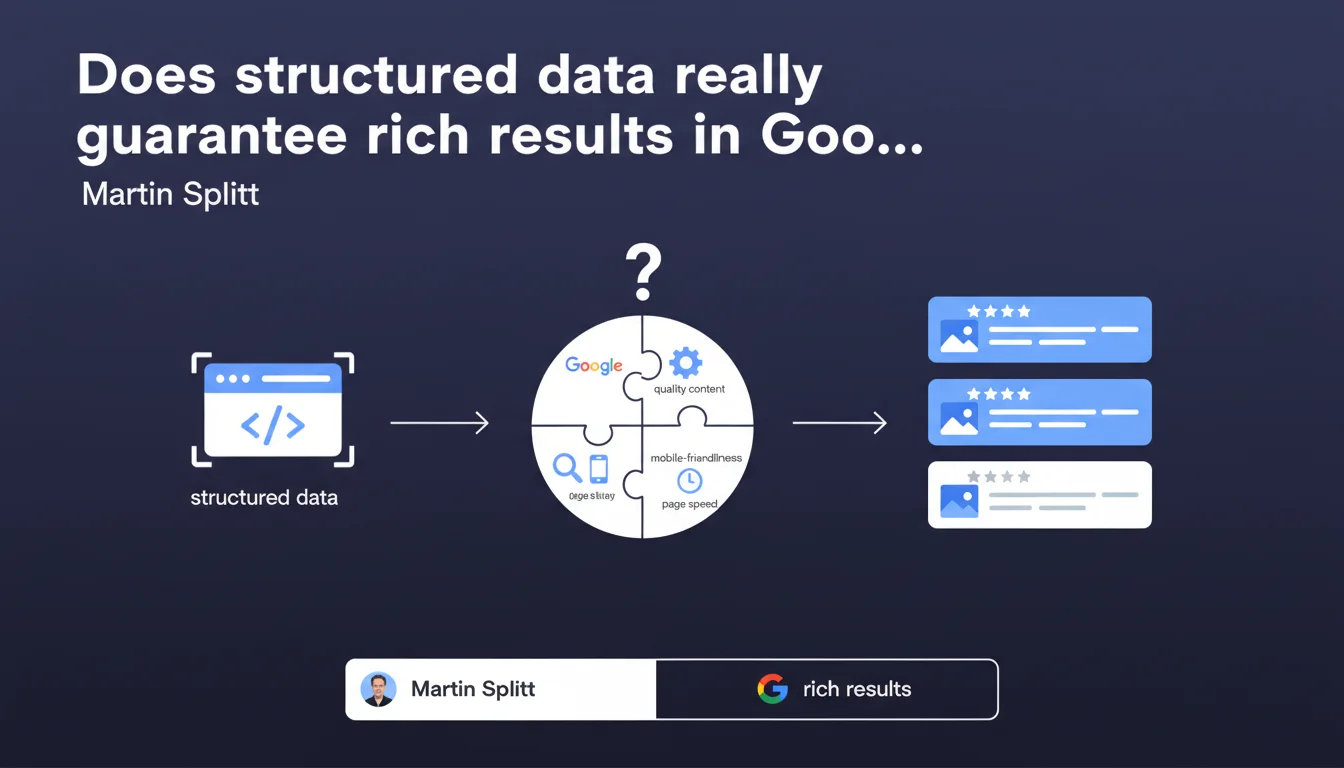
Martin Splitt mentions rich results that stand out from classic blue links through additional visual elements: star ratings, prices, availability, expandable FAQs, recipes with cooking time, and more. These formats take up more space in the SERP and capture more attention.
Google's wording remains cautious: "can use" and "can display." In other words, adding Schema.org or JSON-LD guarantees no automatic display. It's a necessary condition, not a sufficient one.
What types of structured data are involved?
Google supports dozens of structured markup types: Product, Recipe, Event, Article, FAQPage, HowTo, JobPosting, LocalBusiness, Review, VideoObject, and more. Each type follows specific rules defined in the official documentation.
Not all Schema.org types result in rich results. Some serve only to help Google understand content better with no direct visual impact in the SERP. Others trigger enriched formats but only if the content meets Google's quality guidelines.
Why doesn't Google always display structured data that is technically valid?
Even with technically correct markup, several factors block display: content quality, consistency between markup and visible text, compliance with specific guidelines (no self-serving reviews, no manipulative FAQs), and above all the format's relevance to the query.
Google reserves the right not to display a rich result if it believes the standard format better serves the user. This algorithmic logic remains opaque — it's impossible to predict with certainty whether an enriched snippet will appear.
- Structured data is a necessary but not sufficient condition for rich results
- Google supports dozens of markup types with specific rules for each
- Display depends on content quality, markup consistency, and query relevance
- No guarantee of display even with technically valid markup
SEO Expert opinion
Does this statement really bring anything new to the table?
Let's be honest: Martin Splitt's claim reveals nothing that SEO practitioners don't already know. For years, structured data has conditioned access to rich results — it's documented, tested, and proven.
What stands out here is the cautious language: "can use," "can display." Google refuses to commit to a direct cause-and-effect relationship. This vague wording reflects ground reality: we observe cases where perfect markup displays nothing, and others where sloppy Schema still generates stars. [To verify]: the precise criteria for triggering remain largely opaque.
Do field observations contradict this statement?
No, but they seriously qualify it. We regularly observe Google removing rich results without explanation, even when markup hasn't changed. FAQPage, for example, went through several waves of sectoral restrictions — health, finance — without prior notice.
Another point worth noting: Google favors certain types of sites for certain formats. Recipes from major media outlets trigger carousels more easily than those from independent blogs, with equal markup. The domain trust likely plays a role, even if Google never admits it explicitly.
What are the practical limitations of this approach?
The main pitfall is believing that adding Schema.org is enough to boost visibility. In reality, if the content is mediocre or the page poorly ranked, structured data will change nothing in rankings — it merely improves presentation if the page already appears on the first page.
Another limitation: maintenance. Google's guidelines evolve, certain markup types become deprecated (like Speakable), others become mandatory. Monitoring these changes and regularly auditing markup requires time — time that many sites don't spend, leaving obsolete Schema.org to rot.
Practical impact and recommendations
What should you implement as a priority on your site?
Start by identifying the content types eligible for rich results on your site: e-commerce products, blog articles, events, job listings, recipes, videos, FAQs. Prioritize pages that already generate organic traffic — that's where the visual impact of rich results will be most profitable.
Use Google's rich results test in Search Console to technically validate your markup. Also verify that the marked-up content corresponds exactly to the visible content — any discrepancy can block display or trigger a quality alert.
What mistakes should you absolutely avoid?
Never mark up content invisible to users. Google penalizes Schema.org that describes elements absent from the page or hidden by CSS. Self-attributed reviews, FAQs written solely to capture traffic without adding value, fictional prices — all of this exposes you to sanctions.
Also avoid over-optimization: stacking multiple Schema types on the same page without editorial coherence creates confusion for Google. Prioritize precision and relevance over blind exhaustiveness.
How do you measure the effectiveness of structured data?
In Google Search Console, check the "Enhancements" report to track errors and warnings on your markup. Cross-reference this data with the "Performance" report by filtering for rich result types (when available) to measure impact on CTR.
Monitor display fluctuations: a rich result can disappear overnight without explanation. Document markup changes and algorithm updates to correlate variations. And remember that ranking remains the #1 factor — a rich result on page 2 is worthless.
- Identify content eligible for rich results and prioritize high-traffic pages
- Validate markup using Google Search Console's rich results test
- Verify strict consistency between markup and visible content
- Avoid self-attributed reviews and manipulative FAQs
- Monitor the "Enhancements" report in GSC to detect errors and warnings
- Measure impact on CTR via the "Performance" report filtered by result type
- Document markup changes and monitor display fluctuations
❓ Frequently Asked Questions
Les données structurées améliorent-elles directement le positionnement dans Google ?
Pourquoi mon balisage Schema.org valide n'affiche aucun résultat enrichi ?
Quels types de Schema.org génèrent le plus souvent des rich results ?
Faut-il utiliser JSON-LD, Microdata ou RDFa pour les données structurées ?
Les données structurées peuvent-elles entraîner une pénalité manuelle ?
🎥 From the same video 1
Other SEO insights extracted from this same Google Search Central video · published on 31/01/2024
🎥 Watch the full video on YouTube →
💬 Comments (0)
Be the first to comment.