
Official statement
Other statements from this video 1 ▾
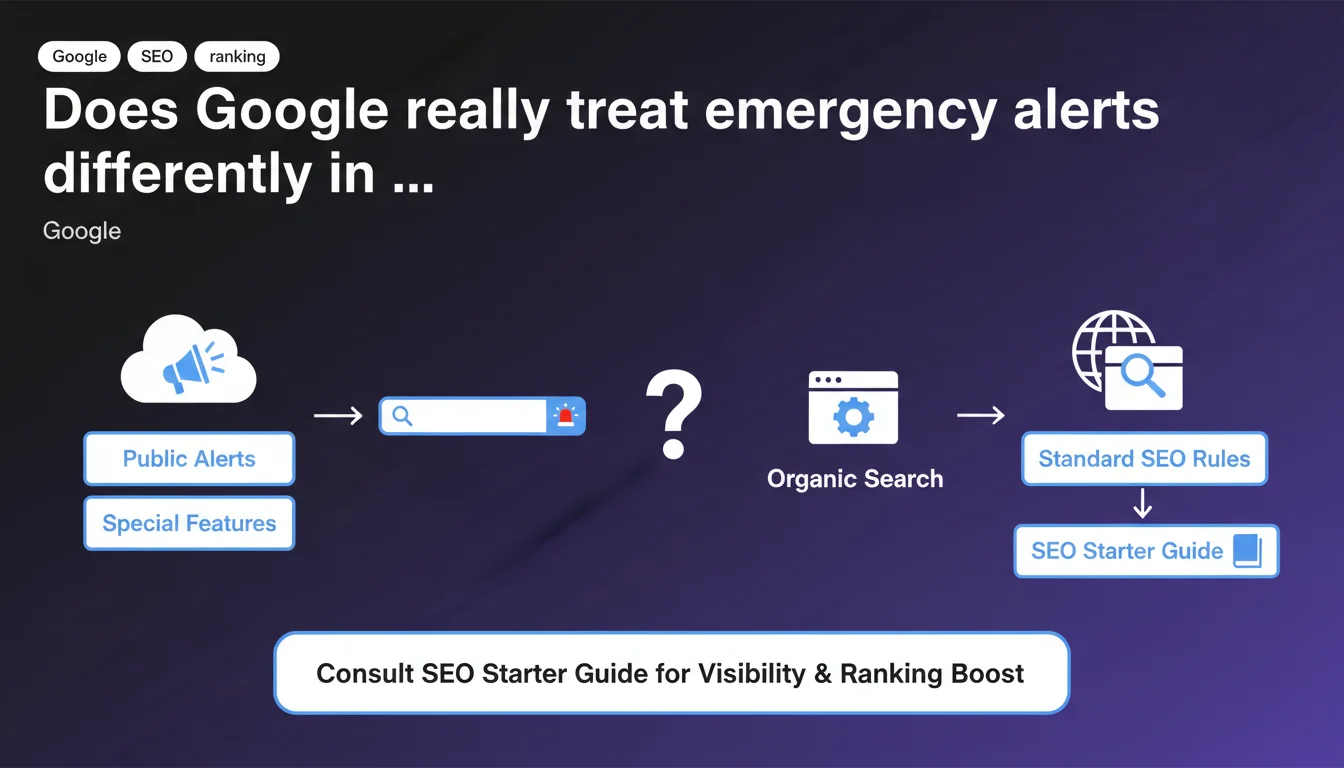
Google confirms that websites managing emergency alerts and public warnings can appear in standard organic search results. The official recommendation? Apply the fundamentals from the SEO Starter Guide to improve visibility and ranking. Nothing specific to public alerts, so.
What you need to understand
What exactly is Google Public Alerts?
Google Public Alerts is a feature that displays geolocation-specific emergency alerts directly in search results — natural disasters, critical weather alerts, public safety incidents. These alerts come from official sources (governments, weather agencies, emergency services).
The statement clarifies that this content is not confined to a special display format: it can also rank in regular organic search, like any other web page. No special treatment, then — at least according to Google.
Why is Google making this announcement?
Because some emergency content publishers probably thought they'd benefit from an automatic priority fast-track. Google clarifies: yes, you can appear, but you play by the same SEO rules as everyone else.
The mention of the SEO Starter Guide is telling. Google offers no specific optimization for this type of critical content — just the generic fundamentals. That's surprising for content where rapid visibility can literally save lives.
What are the implications for emergency and alert websites?
If you manage weather, health, or security alerts, you need to optimize your pages like any other content. Title tags, meta descriptions, HTML structure, structured data — the whole package.
And here's where it gets tricky: this content often has an ultra-short lifespan and must be indexed almost instantly. Applying standard SEO optimizations to pages that need to be visible within minutes is no small technical challenge.
- Public alert websites appear in regular organic search with no automatic priority treatment
- Google recommends only the SEO Starter Guide fundamentals — nothing specific to emergencies
- Fast indexation remains critical for this type of very short-lived content
- No mention of accelerated mechanisms like IndexNow or specific pings for emergency content
SEO Expert opinion
Is this statement consistent with real-world practices?
In theory, yes. In reality — it's more complicated. Government sites and official agencies that publish alerts often have high domain authority and solid technical infrastructure. They naturally rank well.
But for smaller local media outlets or municipal websites that relay these alerts, competition is fierce. They compete directly with powerhouses like Météo France, the Red Cross, or powerful news aggregators. [To verify]: Does Google actually apply a source reliability criterion for these critical contents? Nothing in this statement explicitly confirms it.
What nuances should we add to this generic claim?
Google talks about "improving visibility and potentially ranking." That "potentially" is crucial. Applying the SEO Guide guarantees nothing — it's pure conditional language.
For emergency content, freshness becomes a dominant factor. An alert published 3 hours ago loses all relevance if the event evolves quickly. Yet Google never mentions how its algorithm handles this specific time parameter in this context.
In what cases does this recommendation become insufficient?
When a major disaster strikes. Search spikes are massive and concentrated over just a few minutes. If your content isn't indexed and served instantly, you miss the critical window.
The SEO Starter Guide doesn't cover accelerated indexation strategies — Search Console submission, dynamic sitemaps, CDN cache management, Google News coordination if eligible. For these use cases, the fundamentals aren't enough.
Practical impact and recommendations
What do you need to do concretely to optimize alert content?
Apply the SEO basics, yes, but adapt them to time constraints. Your alert pages must be technically flawless to maximize fast indexation chances.
Prioritize a flat architecture — alert pages should never be more than one click from the homepage. Use short, explicit URLs with the date and alert type. Care for Open Graph and Twitter Card tags for social sharing, which amplifies visibility.
- Implement Schema.org SpecialAnnouncement markup to signal the urgent nature of the content
- Set up a dynamic XML sitemap that automatically updates with each new alert
- Submit new URLs via the Google Search Console Indexing API (formerly Ping) to speed up discovery
- Optimize Core Web Vitals — slow loading time is critical on mobile during emergencies
- Ensure clear canonical tags if multiple pages cover the same alert
- Implement automatic archival with robots noindex tag once the alert expires
What mistakes must you avoid at all costs?
Never duplicate official alert content word for word. Even if it's urgent, Google penalizes duplicate content — you risk not ranking at all.
Another trap: publishing alerts with vague titles like "Important Alert." Be explicit and geolocation-specific: "Flood Alert Lyon 3rd District" performs infinitely better.
How do you verify your site is properly optimized?
Test your alert pages with Google's Mobile-Friendly Test tool and the structured data validator. A non-mobile-friendly page or one with Schema.org errors will be disadvantaged.
Monitor indexation metrics in Search Console: how much time between publication and appearance in the index? If it exceeds 30 minutes, you have a technical problem to solve.
Optimizing public alert content for Google requires mastering SEO fundamentals while managing fast-indexation constraints that few sites encounter. Between technical architecture, specific structured data, and real-time monitoring, complexity accumulates quickly.
If your organization regularly publishes this type of critical content, hiring a specialized SEO agency may be worthwhile — these professionals have the tools and experience to implement accelerated indexation solutions and guarantee optimal visibility during emergency events.
❓ Frequently Asked Questions
Google indexe-t-il plus rapidement les contenus d'alerte publique ?
Le balisage Schema.org SpecialAnnouncement est-il obligatoire ?
Peut-on dupliquer le texte officiel d'une alerte gouvernementale ?
Comment gérer l'archivage des anciennes alertes expirées ?
Les alertes publiques bénéficient-elles d'un boost dans Google News ?
🎥 From the same video 1
Other SEO insights extracted from this same Google Search Central video · published on 12/02/2025
🎥 Watch the full video on YouTube →
💬 Comments (0)
Be the first to comment.