
Official statement
Other statements from this video 1 ▾
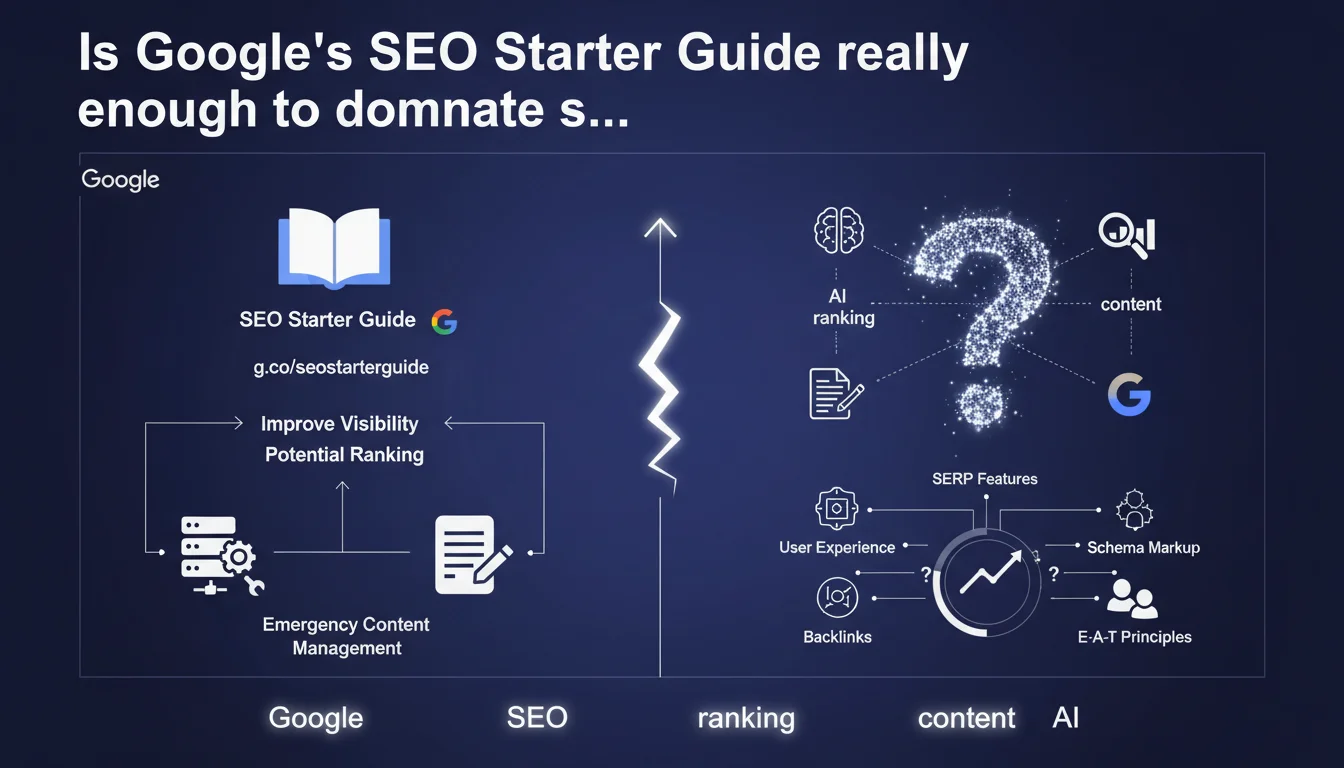
Google officially positions the SEO Starter Guide as the reference resource for improving visibility and ranking potential in its search results, including for emergency response websites. This document, accessible via g.co/seostarterguide, becomes the recommended foundation by Mountain View for structuring your SEO strategy. Yet the question remains: is this generalist resource sufficient to keep pace with an increasingly complex algorithm?
What you need to understand
Why is Google pushing this guide now?
The SEO Starter Guide isn't new—it's been sitting in Google's archives for years. But this official endorsement marks a turning point: Mountain View wants to standardize SEO best practices, especially for websites that can't afford a €150/hour consultant.
The specific mention of emergency content websites (natural disasters, health alerts, etc.) reveals a concern: these platforms need to be indexed quickly and properly. Google is telling them clearly: "Even under pressure, stick to the fundamentals."
What does this guide actually contain?
You'll find the canonical on-page SEO basics: HTML structure, meta tags, image optimization, internal linking, mobile-first approach. Nothing revolutionary if you've been doing this since 2010.
The guide remains generic. It doesn't cover advanced nuances like crawl budget optimization for large sites, semantic silo strategies, or technical optimization for E-E-A-T. This is 101-level material, not a master's course.
What are the limitations of a standardized guide?
A one-size-fits-all document can't apply to every industry. An e-commerce site with 50,000 product pages faces different challenges than a 20-page WordPress blog.
Google recommends this guide as a starting point, not as the complete bible. If you follow this guide word-for-word without adapting it to your context, you risk stalling on page two.
- The SEO Starter Guide establishes technical and editorial foundations validated by Google
- It primarily targets sites with low SEO maturity or in emergency situations
- Advanced optimizations (semantic clusters, entity optimization, sculpted internal PageRank) are not covered
- This guide remains an official resource, but not an exhaustive roadmap for all industries
SEO Expert opinion
Is this recommendation consistent with observed practices?
Yes and no. Google has always advocated for educational transparency through its official documentation. But in reality, sites that perform in 2025 go far beyond this guide.
Take a concrete example: the guide mentions the importance of descriptive title tags. But it says nothing about named entities' weight, Core Web Vitals latency on mobile 3G, or the real impact of dwell time. [To verify]: Does following this guide alone rank you on competitive queries? Spoiler: no.
What nuances should we add to this statement?
Google sells this guide as a universal solution, but deliberately omits gray areas. Nothing on negative SEO, nothing on managing manual penalties in depth, nothing on offshore linking strategies.
The emphasis on emergency websites is clever: it allows Google to say "Look, even in crisis, we're helping you." But an emergency alert site doesn't need semantic cluster optimization—it needs indexation speed and immediate trust. Two variables the guide barely touches on.
In what cases is this guide insufficient?
As soon as you move beyond the "small informational website" context, this guide shows its limits. High-volume e-commerce, multilingual SaaS platform, news site publishing 200 articles per day: you need much more.
The guide also ignores programmatic challenges: large-scale content generation, Liquid/Twig template optimization, client-side JavaScript facet management. These topics require expertise that Google doesn't document publicly.
Practical impact and recommendations
What should you concretely do with this guide?
If you're starting a site or have never audited your fundamentals, read it line by line. Verify that each recommendation is applied: unique title tags, compelling meta descriptions, optimized images with alt text, coherent heading structure.
For existing sites, use it as a basic compliance checklist. Review each section and identify gaps. But don't stop there—this guide is a floor, not a ceiling.
What mistakes should you avoid when following this guide?
Classic mistake: mechanically applying recommendations without contextualizing them. For example, the guide advises short, descriptive URLs. But on a classifieds site with millions of pages, an overly verbose structure could explode your crawl budget.
Another trap: thinking that checking every box in the guide = guaranteed first-page ranking. SEO is poker, not chess. You're competing against rivals who've also read this guide. The difference comes down to advanced execution and content strategy.
How can I verify that my site complies with the guide's recommendations?
Run a comprehensive technical audit: Screaming Frog, Sitebulb, or even Google Search Console are enough to catch the basics (duplicate titles, images without alt text, orphaned pages). Cross-reference with PageSpeed Insights for Core Web Vitals.
Also verify semantic consistency: Does your content really answer search intent? Use Google Trends, AnswerThePublic, or tools like Semrush to validate that your topics match actual search queries.
- Audit titles, meta descriptions, heading tags: uniqueness and relevance
- Optimize images: WebP compression, descriptive alt attributes, lazy loading
- Verify URL structure: short, readable, consistent with site architecture
- Test mobile version: smooth navigation, minimal CLS, clickable buttons
- Analyze internal linking: click depth, PageRank distribution
- Validate Core Web Vitals: LCP < 2.5s, FID < 100ms, CLS < 0.1
- Control indexation: robots.txt, XML sitemap, properly configured canonicals
❓ Frequently Asked Questions
Le SEO Starter Guide de Google est-il mis à jour régulièrement ?
Ce guide suffit-il pour ranker sur des requêtes compétitives ?
Pourquoi Google mentionne-t-il spécifiquement les sites d'urgence ?
Faut-il suivre ce guide à la lettre ou l'adapter à son contexte ?
Ce guide aborde-t-il l'E-E-A-T et les signaux de qualité ?
🎥 From the same video 1
Other SEO insights extracted from this same Google Search Central video · published on 12/02/2025
🎥 Watch the full video on YouTube →
💬 Comments (0)
Be the first to comment.