
Official statement
What you need to understand
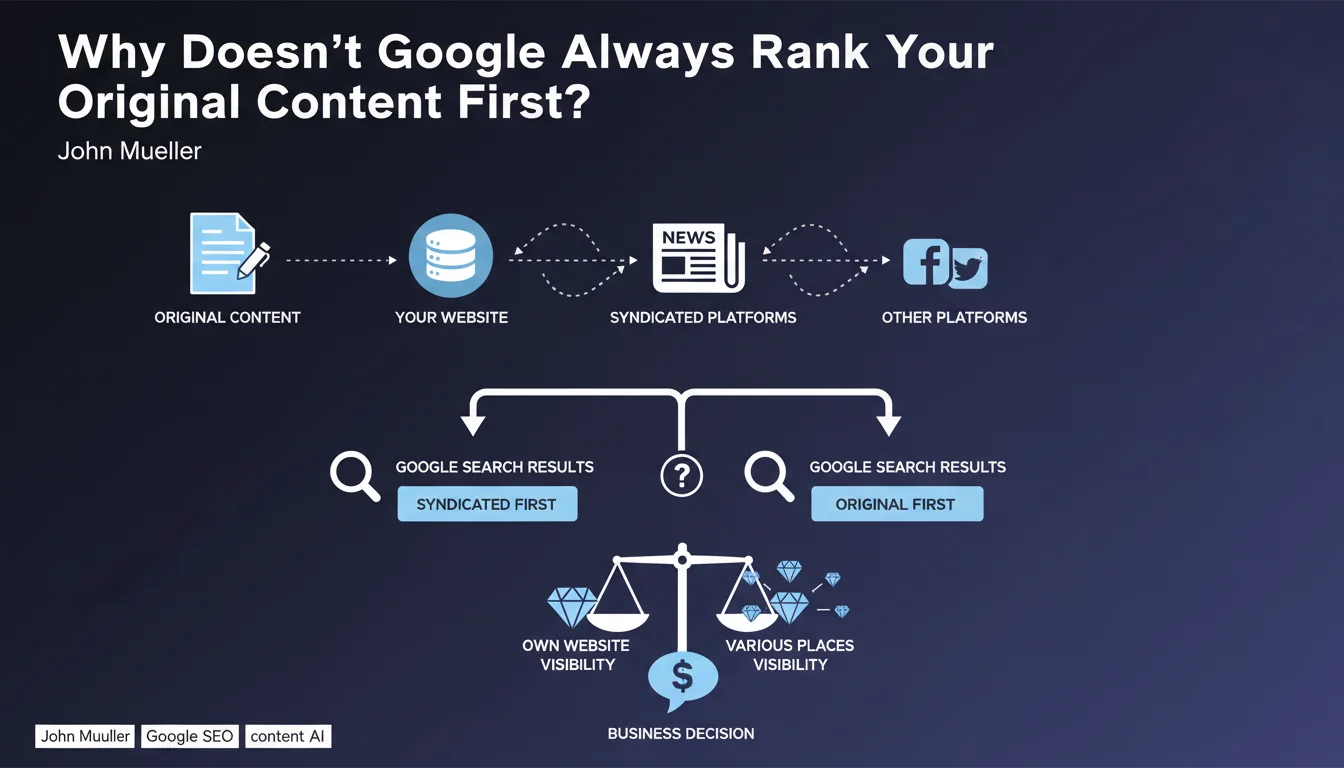
Google does not guarantee that your original site will appear first in search results, even if you are the initial author of the content. When your content is syndicated or republished on other platforms, these platforms can potentially outrank you.
This situation creates a strategic dilemma for site owners. On one hand, syndication offers broader visibility and reaches new audiences. On the other hand, it risks diluting your authority and creating result cannibalization.
According to Google, this is primarily a business trade-off: do you prefer maximum visibility or total control over your content?
- The original source is not automatically prioritized by the algorithm
- Syndication sites can outrank the original site in SERPs
- It's a strategic decision that depends on your business objectives
- Technical control over alternative versions is crucial
SEO Expert opinion
This statement indeed aligns with what we've been observing in the field for years. Sites with strong domain authority (media outlets, established platforms) regularly capture traffic intended for original sources, particularly in highly competitive sectors.
However, this "business" approach from Google includes important nuances. The algorithm incorporates canonicalization signals, first indexation date, and author-related entities. If you publish expert content with a strong author signature and rapid indexation, your chances of maintaining the dominant position increase significantly.
The reality is more complex than "original source vs syndication." Contextual factors such as content freshness, depth of treatment, E-E-A-T signals, and even query type influence which content Google will prioritize.
Practical impact and recommendations
- Prioritize publishing on your site first and wait for complete indexation before any syndication (24-48h minimum)
- Enforce canonical tags pointing to your original URL in all syndication agreements
- Request a noindex attribute on syndicated versions when contractually negotiable
- Use publication delays: publish on your site first, then syndicate 1-2 weeks later
- Avoid full syndication: instead, offer excerpts with a link to the complete article
- Monitor your rankings with monitoring tools to quickly detect any cannibalization
- Strengthen your authority signals: author signatures, Article schemas, contextual internal links
- For strategic content, maintain total exclusivity on your domain rather than risking dilution
- Systematically negotiate technical syndication conditions before acceptance
Implementing an optimized syndication strategy requires a thorough understanding of indexation and canonicalization mechanisms. Between contractual negotiations with partners, technical implementation of proper tags, and constant position monitoring, these optimizations can quickly become complex to orchestrate alone. For companies managing large volumes of content or multiple partnerships, support from a specialized SEO agency enables the establishment of solid editorial governance and helps avoid costly mistakes in organic visibility.
💬 Comments (0)
Be the first to comment.