
Official statement
What you need to understand
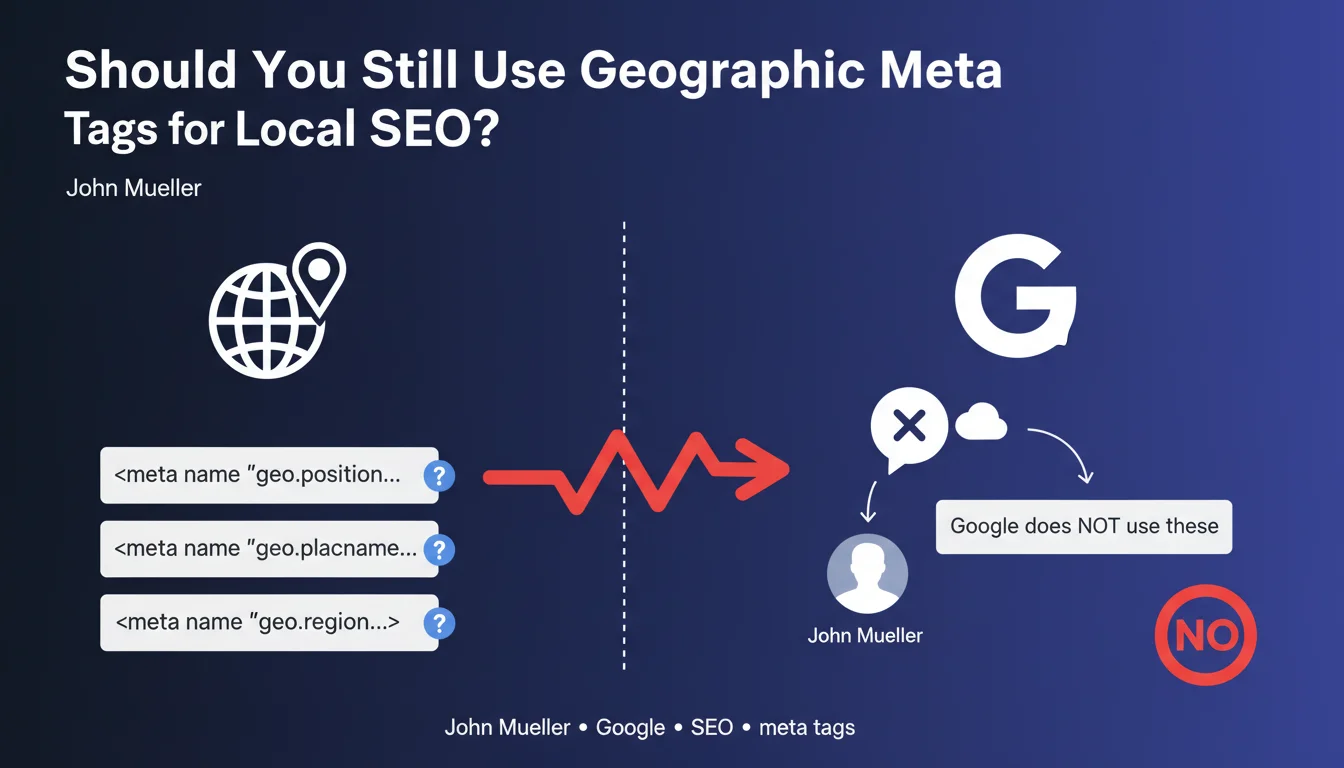
Google has officially confirmed that geographic meta tags are not taken into account by its ranking algorithm. These tags notably include geo.position, geo.placename and geo.region which were once supposed to indicate the geographic location of a website or business.
This statement is not really news, but rather an official confirmation of an obsolete practice. These geographic metadata, inherited from the early days of the web, have probably never had any real impact on rankings in Google search results.
For geotargeted SEO, Google relies on far more reliable and structured signals:
- The domain name extension (.fr, .be, .ch, .ca) which clearly indicates the targeted country
- Hreflang tags which allow you to specify the linguistic and geographic versions of a page
- Configuration in Search Console where you can define geographic targeting
- Google Business Profile for local SEO of physical establishments
- LocalBusiness structured data which provides actionable geographic information
This clarification allows SEO practitioners to focus their efforts on truly effective methods rather than wasting time with tags that have no impact.
SEO Expert opinion
This statement is perfectly consistent with field observations from recent years. No serious SEO audit has ever demonstrated a correlation between the presence of these geographic meta tags and better positioning in localized results.
Google's position is easily explained: these tags are too easily manipulated and lack reliability. Any website could claim to be located anywhere without any possible verification. Google therefore favors more robust signals such as the address provided in Google Business Profile, consistent local citations, or the analysis of content and backlinks.
It is also important to note that while these tags do not help, they do not harm either. Their presence in the code does not result in any penalty, they are simply ignored. However, maintaining unnecessary code is never an optimal practice.
Practical impact and recommendations
Following this official confirmation, here are the concrete actions to implement to optimize your geographic SEO:
- Remove geographic meta tags from your templates if you want to clean up your HTML code (optional but recommended)
- Check your geographic targeting in Google Search Console and ensure it matches your target market
- Properly implement hreflang tags if you target multiple countries or languages with distinct content
- Optimize your Google Business Profile listing with complete, accurate and consistent information (address, hours, categories, photos)
- Integrate LocalBusiness structured data (Schema.org) in your strategic pages with GPS coordinates, complete address and service area
- Ensure NAP consistency (Name, Address, Phone) across all your web properties and local directories
- Create relevant geolocated content that naturally mentions your service areas and target localities
- Develop a local backlink strategy through partnerships, quality local directories and regional press relations
- Use the appropriate domain extension (.fr, .be, .ch...) if you primarily target a specific national market
In summary: Stop wasting time with obsolete geographic meta tags and focus on the levers that actually work. Modern geolocated SEO relies on a coherent ecosystem combining structured data, Google Business Profile optimization, Search Console targeting and local content strategy.
Implementing an effective geolocated SEO strategy requires a methodical approach and sharp technical expertise, particularly for the correct implementation of hreflang, structured data and coordination between different geographic signals. Faced with this growing complexity and to guarantee flawless implementation of these critical optimizations, support from a specialized SEO agency can prove valuable in structuring your strategy and maximizing your visibility in your target markets.
💬 Comments (0)
Be the first to comment.