
Official statement
Other statements from this video 9 ▾
- □ Is Google Search Console really the only reliable tool to verify your site's crawl status?
- □ Does Google Search Console really detect all indexing problems on your website?
- □ Should you really submit a sitemap via Search Console to optimize your pages' indexation?
- □ Are you tracking the right structured data metrics in Search Console to maximize your rich results visibility?
- □ Is Search Console really the only reliable source for measuring your organic traffic?
- □ How can you leverage Search Console to diagnose organic traffic collapse?
- □ Why Should You Cross Search Console and Google Analytics Data to Drive Your SEO Strategy?
- □ Is your Search Console data actually reliable for recent performance analysis?
- □ How can you pinpoint exactly which pages and queries are causing your traffic to drop?
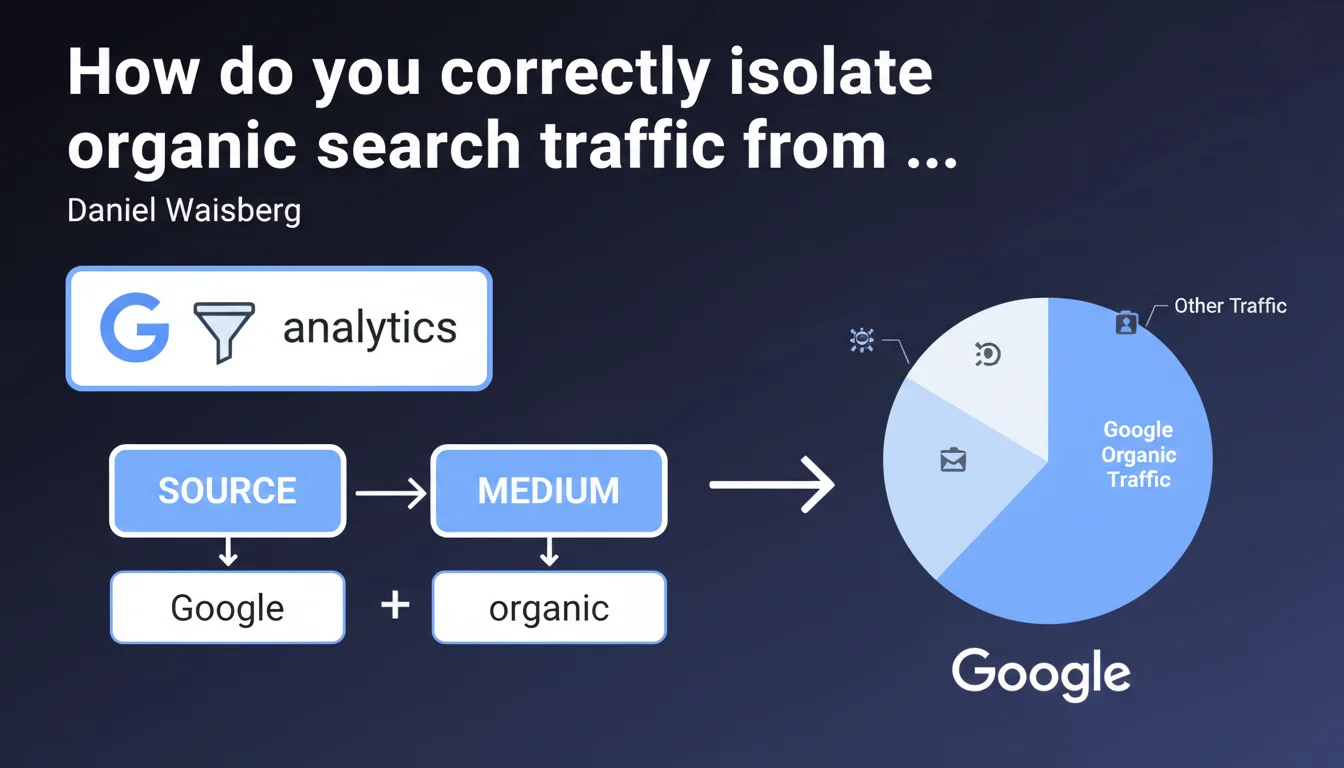
Google confirms that to isolate organic search traffic in Google Analytics, you must apply two filters: source=google AND medium=organic. This precise combination ensures you exclude other channels (Ads, Display, etc.) and measure only natural SEO performance.
What you need to understand
Why is this filtering precision necessary?
In Google Analytics, traffic coming from Google can take multiple different channels: organic search, paid ads, Display campaigns, YouTube, etc. Filtering only on the source "google" aggregates all these streams — which completely distorts your SEO analysis.
The medium=organic parameter allows you to strictly isolate traffic from natural results. Without this second filter, you're mixing SEO performance and advertising performance.
What's the difference between source, medium, and other dimensions?
The source indicates the origin of traffic (google, bing, facebook). The medium qualifies the channel type (organic, cpc, referral, email). These two dimensions combined form what's called a source/medium pair.
Google Analytics automatically classifies visits based on these criteria. However, third-party tools, misconfigured UTM parameters, or certain redirections can blur this classification — which is why it's important to check regularly.
What are the common pitfalls in this measurement?
The first pitfall: confusing direct traffic with organic traffic. Direct traffic (source=direct, medium=none) often groups together organic traffic where the referrer has been lost (HTTPS to HTTP, redirects, mobile apps).
Second pitfall: poorly tagged UTM campaigns. If you tag an internal link with utm_source=google and utm_medium=organic, you're polluting your data. UTM parameters should only be used for external sources.
- Always filter with source=google AND medium=organic for pure SEO traffic
- Exclude other mediums (cpc, display, referral) that might have google as a source
- Regularly audit the source/medium pairs in your reports to spot anomalies
- Never use UTM parameters on internal links — this resets the session and skews attribution
- Verify that third-party tools (CRM, email platforms) aren't adding automatic inconsistent UTM parameters
SEO Expert opinion
Is this recommendation really sufficient to measure SEO?
Let's be honest: this statement outlines a basic best practice, but it remains quite basic. Yes, source=google + medium=organic isolates Google organic traffic — that's mathematically sound. But it says nothing about the margins of error inherent to this measurement.
Direct traffic often contains a significant portion of organic visits whose referrer has disappeared. Users who click from Gmail, from Google Docs, from certain mobile apps — all of that falls into direct. [To verify]: Google provides no indication of the proportion of this "dark traffic" that should be reattributed to SEO.
What nuances are missing from this statement?
First, Daniel Waisberg doesn't mention the differences between Universal Analytics and GA4. In GA4, source/medium dimensions work differently, and multi-touch attribution logic further complicates the picture.
Second, nothing about unsampled sessions. On high-traffic sites, applying multiple filters can trigger sampling — you're then analyzing a fraction of your data, not the totality. For a rigorous SEO audit, you sometimes need to export via BigQuery or use GA360.
Finally, this recommendation completely ignores conversions attributed to SEO. Filtering traffic is good. But if you don't then segment by landing page, device, geography — you're missing the essentials.
Does this method work for all search engines?
Yes, the logic applies to Bing (source=bing, medium=organic), DuckDuckGo, Ecosia, etc. But traffic volume outside Google is often so low that it doesn't always justify a dedicated filter — except in very specific sectors (B2B, tech, privacy-first).
The real problem? Alternative search engines and search aggregators (third-party mobile apps, voice assistants) whose referrer isn't standardized. Some pass as referral, others as direct. Again, Google provides no guidance on this.
Practical impact and recommendations
What should you do concretely in Google Analytics?
In Universal Analytics, create a custom segment with two conditions: "Source contains exactly google" (in lowercase) AND "Medium contains exactly organic". Apply this segment to your Acquisition, Behavior, and Conversions reports.
In GA4, use comparisons with the same criteria: "Session source" = "google" AND "Session medium" = "organic". GA4 also offers exploration reports where you can cross these dimensions with other metrics (engagement, revenue, etc.).
Automate your reporting by creating dedicated SEO dashboards that systematically isolate this traffic. Avoid reapplying the filter manually each time you analyze — it's a waste of time and a source of errors.
What mistakes should you absolutely avoid?
Never confuse "google" and "Google" — capitalization sometimes matters depending on your configuration. By default, Analytics normalizes to lowercase, but certain GTM implementations or certain CMS platforms may send inconsistent values.
Never use UTM parameters on your internal links. This is the most common mistake: you create a link from your blog to a product page with utm_source=google&utm_medium=organic to "simulate" an SEO click. Result: you reset the session, you lose the real user journey, and you pollute your reports.
Final pitfall: don't rely solely on the source/medium filter to measure your SEO conversions. If you use an attribution model other than "last interaction," some of your organic conversions will be attributed to other channels (email, direct, remarketing). Always cross-reference with a multi-touch attribution report.
- Create a dedicated Analytics segment with source=google AND medium=organic
- Verify consistency with Search Console data (sessions vs. clicks, acceptable gaps ~10-15%)
- Set up automatic alerts if organic traffic drops more than 20% in 24 hours
- Exclude bots and referrer spam via view filters (or GA4 data stream configurations)
- Segment organic traffic by landing page to identify which pages generate the most sessions and conversions
- Cross-reference with ranking data (Semrush, Ahrefs, etc.) to correlate visibility and traffic
- Automate weekly reports by channel to quickly spot anomalies
Correctly filtering organic Google traffic in Analytics is a fundamental step, but it's far from sufficient. SEO analysis requires cross-referencing multiple data sources, understanding attribution bias, and segmenting finely to extract actionable insights.
These optimizations — advanced GA4 configuration, custom attribution models, automated dashboards, anomaly detection — can quickly become time-consuming and technical. If you don't have the internal resources to structure all of this, it may be wise to call on an SEO agency specialized in these tools who can accompany you over the long term to manage your performance with rigor.
❓ Frequently Asked Questions
Dois-je aussi filtrer sur les majuscules/minuscules pour "Google" et "google" ?
Pourquoi mes sessions organiques dans Analytics ne correspondent-elles pas aux clics dans Search Console ?
Le trafic direct contient-il vraiment du trafic organique masqué ?
Faut-il créer un filtre de vue ou un segment pour isoler le trafic organique ?
Cette méthode de filtrage fonctionne-t-elle aussi dans GA4 ?
🎥 From the same video 9
Other SEO insights extracted from this same Google Search Central video · published on 06/02/2025
🎥 Watch the full video on YouTube →
💬 Comments (0)
Be the first to comment.