
Official statement
What you need to understand
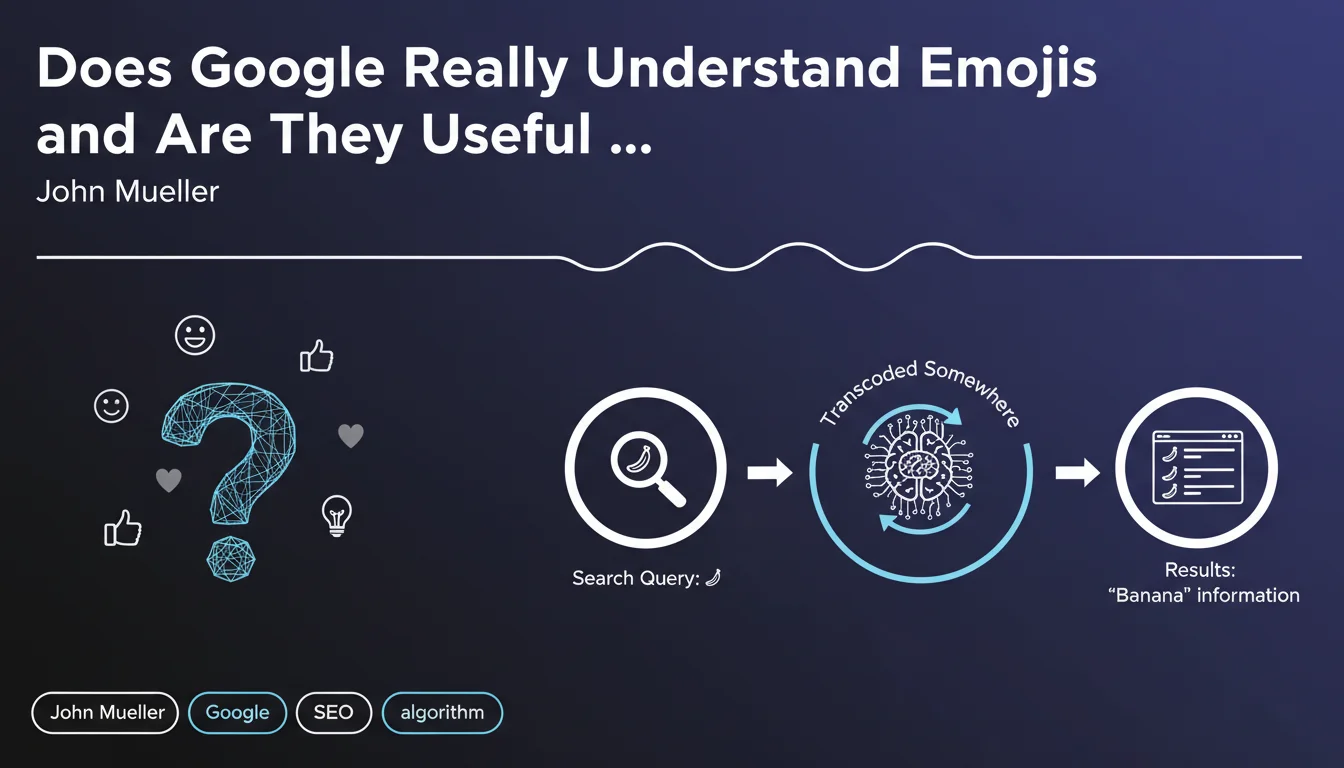
Google has officially confirmed that its search engine understands the meaning of emojis and processes them as semantic elements in their own right. When a user performs a search using an emoji like the banana 🍌, the algorithm is capable of interpreting this query and suggesting relevant results about bananas.
This understanding capability relies on a transcoding system integrated into Google's algorithms. Emojis are therefore not simply ignored or treated as special characters without value: they possess exploitable meaning for the search engine.
However, it's important to note that the use of emojis in queries remains marginal. The majority of users still favor traditional keywords for their searches, which limits the direct SEO impact of these pictograms.
- Google understands and interprets the meaning of emojis in search queries
- Emojis are transcoded and processed as semantic elements by the algorithm
- The volume of searches using emojis remains low
- Emoji usage should remain moderate and relevant, not systematic
SEO Expert opinion
This statement confirms what we've been observing for several years: Google is investing massively in understanding natural language and modern communication formats. The ability to interpret emojis aligns with this evolution toward more intuitive and multimodal search.
Nevertheless, an important nuance must be made regarding the real SEO impact. While Google does indeed understand emojis, their massive use in titles, meta-descriptions, or content does not constitute a winning strategy. Behavioral data shows that less than 1% of queries contain emojis, which considerably limits their optimization potential.
However, emoji usage can present an interest for click-through rate (CTR) in SERPs, particularly for consumer-facing sectors, e-commerce, lifestyle, or food. A well-placed emoji in a meta-description can improve the visibility and attractiveness of the snippet, even if the direct SEO impact remains limited.
Practical impact and recommendations
- Test the moderate addition of emojis in your meta-descriptions for consumer-facing content to improve CTR in search results
- Absolutely avoid massive emoji usage in page titles and main content, as this can be counterproductive for SEO
- Favor relevant emojis that reinforce the message rather than decorative pictograms unrelated to the content
- Don't use emojis for professional B2B sites, corporate sites, or in sectors requiring a serious image (finance, legal, healthcare)
- Reserve emojis for appropriate sectors: e-commerce, restaurants, tourism, lifestyle, social media
- Don't count on emojis as a direct ranking factor, their impact remains primarily linked to CTR improvement
- Monitor your competitors in SERPs to identify whether emoji usage is an adopted practice in your sector
- Test and measure the impact via A/B testing on your meta-descriptions to validate whether emojis are beneficial for your audience
In summary: Google understands emojis but their use must remain strategic and measured. They can improve CTR in certain contexts, but don't constitute a priority SEO lever.
Fine-tuning these elements requires in-depth expertise in user behavior and precise sector analysis. Implementing rigorous A/B tests, monitoring performance, and adapting to your audience's specificities can prove complex to orchestrate alone. Engaging a specialized SEO agency will allow you to benefit from personalized support to identify real optimization opportunities tailored to your sector and avoid the pitfalls of counterproductive usage.
💬 Comments (0)
Be the first to comment.