
Official statement
Other statements from this video 4 ▾
- □ Do Quality Rater Guidelines Reveal Google's Secret Algorithm Roadmap?
- □ Should you really stop writing for Google and focus entirely on your audience instead?
- □ Should you really follow Google's Quality Rater Guidelines to boost your SEO rankings?
- □ Can AI-Generated Content Really Rank on Google If a Human Reviews It?
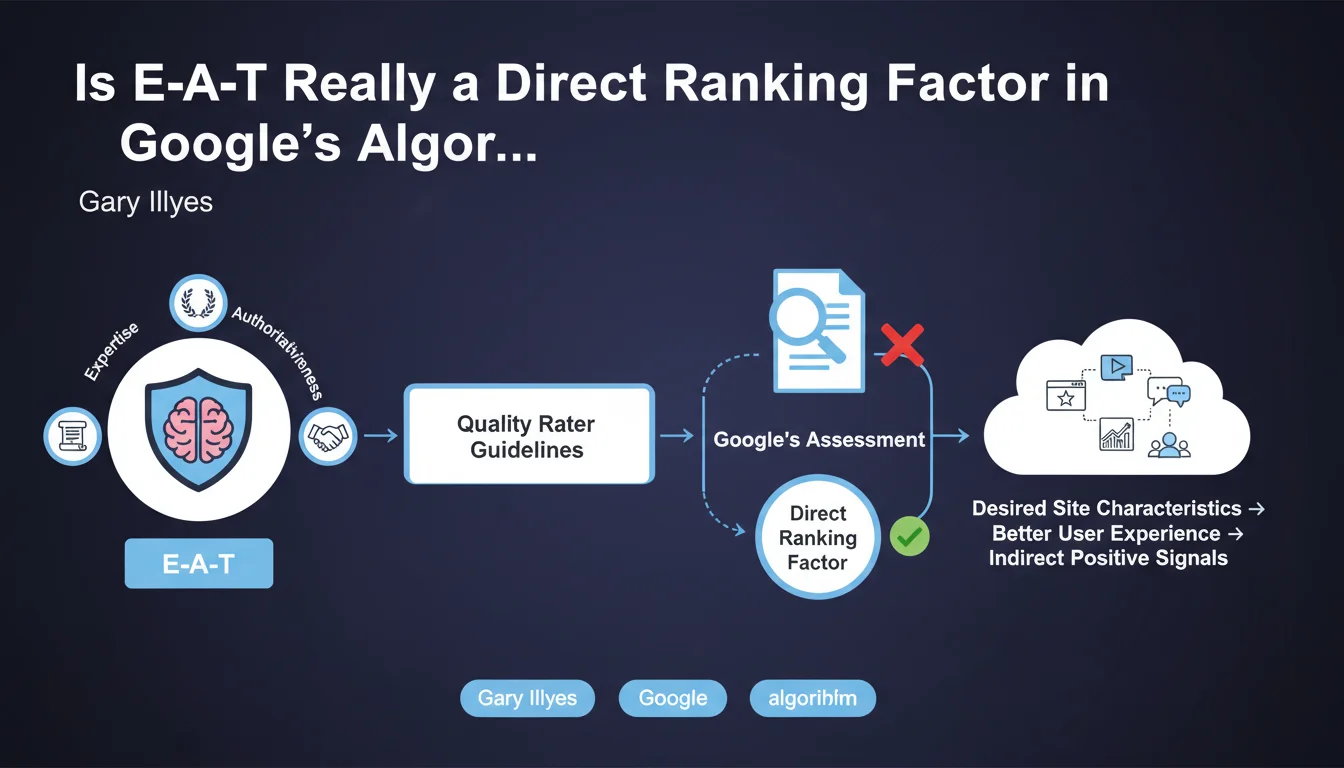
Google claims that E-A-T (Expertise, Authoritativeness, Trustworthiness) represents what it wants to see on highly-rated sites, but these criteria originate from the Quality Rater Guidelines — a document designed for human evaluators, not the algorithm itself. The distinction is critical: E-A-T is not a direct ranking signal, but rather an evaluation framework that reflects Google's expectations for quality content.
What you need to understand
This statement from Gary Illyes comes up regularly in SEO discussions, often misinterpreted. E-A-T is not a ranking factor in the technical sense — it's a set of principles Google uses to manually evaluate search result quality.
What's the Difference Between Quality Rater Guidelines and Search Ranking Algorithm?
The Quality Rater Guidelines are a 175-page manual intended for thousands of human evaluators who rate the relevance of search results. These ratings don't directly modify rankings, but instead serve to train and validate algorithms.
In concrete terms? Google uses these evaluations to verify whether its algorithmic updates are moving in the right direction. If a site loses rankings after a Core Update, there's a strong chance its E-A-T profile is being judged as insufficient by Quality Raters' standards.
How Does Google Measure Expertise, Authority and Trustworthiness Without a Direct Signal?
This is where things get interesting — and murky. Google doesn't have an "E-A-T score" you can check in Search Console. However, the algorithm analyzes indirect signals: author mentions, external citations, backlinks from recognized sites, content consistency with displayed expertise.
YMYL (Your Money Your Life) sectors — health, finance, law — are particularly scrutinized. A medical article written by an identifiable doctor with cited sources will mechanically carry more weight than anonymous text filled with approximations.
Why Does Google Push E-A-T So Hard If It's Not a Technical Criteria?
Because E-A-T is a conceptual framework that guides all of Google's product decisions. Every algorithmic update — Medic Update, successive Core Updates — aims to better identify sites that respect these principles.
In other words: even though E-A-T isn't "in the code," the algorithm is trained to recognize the characteristics of sites that embody it.
- E-A-T is not a ranking signal in the technical sense, but rather a set of human evaluation criteria
- Quality Raters score results according to these criteria to train the algorithm
- Google uses indirect signals (backlinks, mentions, editorial consistency) to approximate E-A-T
- YMYL sectors (health, finance, law) face particularly strict scrutiny
- Each Core Update refines Google's ability to detect these characteristics
SEO Expert opinion
Does This Statement Align With Real-World Observations?
Yes and no. On paper, Google is telling the truth: E-A-T is not a direct ranking factor. But in practice, sites displaying strong E-A-T signals consistently outperform after Core Updates. Coincidence? No.
What we observe: sites that have invested in editorial credibility — detailed author biographies, expert author attribution, source citations, backlinks from recognized media — weather algorithmic turbulence better. [To verify]: Google publishes no numerical data on the correlation between "E-A-T signals" and ranking gains, but field case studies are nearly unanimous.
What Nuances Should We Add to This Statement?
Gary Illyes is speaking of an ideal — what Google "wants to see." But not all sectors are treated equally. A lifestyle blog can rank without displaying degrees, while a legal advice site will be punished if it lacks institutional credibility.
Another nuance: E-A-T has become a catch-all term in SEO jargon. It's invoked to explain every post-Core Update traffic drop, when sometimes the problem stems from intrinsic content quality, keyword relevance, or technical issues. E-A-T isn't a magical diagnostic wand.
In What Cases Is This Recommendation Insufficient?
Building E-A-T doesn't compensate for mediocre or off-topic content. A legal news site written by certified attorneys can still underperform if articles are generic, poorly structured, or don't match search intent.
Similarly, a site accumulating quality backlinks but publishing superficial or duplicate content won't see miracles. E-A-T is a necessary condition in certain sectors, but never sufficient on its own. Relevance always comes first.
Practical impact and recommendations
What Should You Concretely Do to Strengthen E-A-T?
First step: identify and showcase authors. Every article must clearly display who wrote it, with a detailed bio, links to LinkedIn or a professional website, and ideally a photo. Google seeks identifiable humans, not pseudonyms or anonymous "editorial teams."
Next, structure institutional legitimacy. Comprehensive "About" page, mentions in recognized media, visible professional certifications, affiliations with reference organizations. If you're an expert in a YMYL domain, these elements aren't optional.
Finally, cite reliable sources and earn quality backlinks. A medical article referencing PubMed, WHO or peer-reviewed journals will infinitely outweigh unsourced text. Meanwhile, incoming links from recognized sites in your sector strengthen your perceived authority.
What Mistakes Must You Avoid?
Don't create fake biographies or fake expert profiles. Google and users quickly spot inconsistencies. If your "contributing doctor" has zero online presence, no publications, no verifiable credentials, you lose all credibility.
Also avoid mixing aggressive commercial content with expertise claims. A site presenting itself as a medical authority while pushing miracle products in every paragraph will rapidly lose trust — from both users and the algorithm.
Another trap: diluting expertise by covering too many disparate topics. A site discussing finance, gardening, and parenting simultaneously will struggle to build coherent authority. Better to have a focused, mastered editorial scope.
How Can You Verify Your Site Respects E-A-T Principles?
Use the Quality Rater Guidelines as your evaluation framework. Ask yourself the questions raters would ask: Is the author identifiable? Do they have recognized qualifications in the field? Does the content cite verifiable sources? Does the site display legal notices, privacy policy, contact information?
Also test external perception. Search your site name or authors on Google: what appears? Are there positive mentions in media, forums, professional networks? Or nothing at all — or worse, negative reviews?
- Clearly display name, bio and photo of each author on articles
- Create a detailed "About" page with history, team, qualifications
- Publish complete legal notices and a privacy policy
- Systematically cite reliable and verifiable sources in content
- Earn backlinks from recognized sites in your industry
- Avoid aggressive promotional content that undermines editorial credibility
- Focus expertise on a coherent editorial scope, not a hodgepodge
- Regularly check your site and authors' online reputation
❓ Frequently Asked Questions
E-A-T est-il un facteur de classement officiel dans l'algorithme Google ?
Dois-je obligatoirement afficher les diplômes de mes auteurs pour ranker ?
Comment Google mesure-t-il la fiabilité d'un site sans score E-A-T visible ?
Un site récent peut-il bâtir son E-A-T rapidement ?
Google a-t-il ajouté un critère supplémentaire à E-A-T récemment ?
🎥 From the same video 4
Other SEO insights extracted from this same Google Search Central video · published on 30/11/2022
🎥 Watch the full video on YouTube →
💬 Comments (0)
Be the first to comment.