
Official statement
Other statements from this video 4 ▾
- □ Is E-A-T Really a Direct Ranking Factor in Google's Algorithm?
- □ Should you really stop writing for Google and focus entirely on your audience instead?
- □ Should you really follow Google's Quality Rater Guidelines to boost your SEO rankings?
- □ Can AI-Generated Content Really Rank on Google If a Human Reviews It?
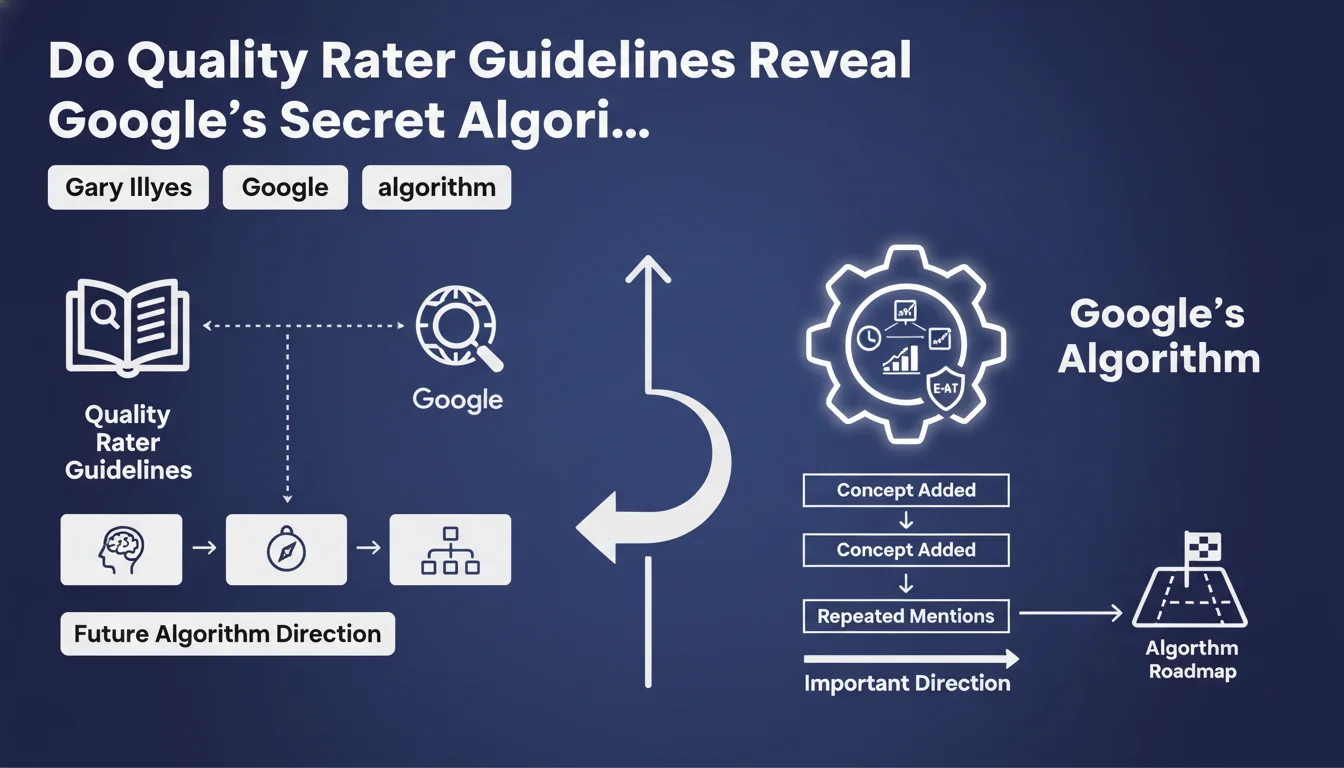
Quality Rater Guidelines don't directly drive the algorithm, but they chart the direction Google wants to take it. When a concept appears repeatedly throughout these guidelines, that's a strong signal: Google is working to integrate it algorithmically. In other words, the guidelines are a map — not the territory.
What you need to understand
Are Quality Rater Guidelines Really Just a Manual for Evaluators?
No, and that's the whole point. These documents are not mere instructions for Quality Raters — those thousands of humans who evaluate search result relevance. They embody Google's strategic vision of what a good search result should be.
When Google publishes or updates these guidelines, it actually exposes its ideal model. The algorithm, meanwhile, tries to move closer to it. But it's not there yet. Hence the gap between what the guidelines say and what the algo actually does day-to-day.
Why Do Certain Concepts Keep Appearing Throughout These Documents?
Because Google beats the drum. When a criterion — say E-E-A-T (Experience, Expertise, Authoritativeness, Trustworthiness) — is mentioned in multiple places, cited in different contexts, broken down from different angles, that's a priority indicator.
Gary Illyes confirms what many suspected: this repetition is not editorial accident. It's a signal of intent. Google is telling raters "focus on this," and implicitly telling algorithm teams "you need to find a way to measure this at scale."
What's the Difference Between an Algorithmic Signal and a Directive for Human Evaluators?
An algorithmic signal is a measurable, automated metric at industrial scale: backlink count, page load speed, bounce rate, keyword presence. The algorithm integrates it directly into its scoring.
A directive for evaluators is a qualitative, subjective criterion, often hard to measure automatically: "Does the content demonstrate lived expertise?" "Does the author inspire trust?" Quality Raters judge manually — then Google uses these judgments to train and refine its AI models.
- Guidelines express the end goal, not the algorithm's current state
- A criterion's repetition in guidelines signals a strategic priority for Google
- Quality Raters serve as ground truth to calibrate the algorithm
- What's in guidelines today can become an algorithmic signal tomorrow
SEO Expert opinion
Does This Statement Really Change Our Understanding of How Google Works?
Not radically — but it formalizes an intuition advanced SEOs already had. For years, we've observed that criteria highlighted in guidelines eventually, with a 6- to 18-month lag, visibly influence rankings.
The most glaring example: E-A-T (now E-E-A-T). Introduced in guidelines in 2014, it took several years to translate into measurable SERP impact — notably with the Medic updates (2018) and subsequent Core Updates. Today, demonstrated expertise and author credibility clearly weigh on ranking, especially in YMYL.
Can You Really Anticipate Future Algorithm Changes by Reading the Guidelines?
Yes, but with caveats. [To be verified]: timing remains unclear. Google publishes no calendar, no deployment promise. A criterion hammered in guidelines can take years to materialize algorithmically — or never make it if the technical solution is too complex.
Another nuance: not all criteria are equally "algorithmizable." Some — like content freshness or thematic consistency — translate easily into metrics. Others — like "the author's lived personal experience" — still largely elude algorithms, even machine-learning-powered ones.
Does This Logic Apply to All Query Types and Sites?
No. The guidelines are heavily YMYL-focused (Your Money Your Life): health, finance, legal. In these domains, Google is paranoid about quality, credibility, accuracy. E-E-A-T is crucial here.
But on low-stakes informational queries — "best pancake recipe" or "what movie to watch tonight" — E-E-A-T impact is far more diluted. Google then prioritizes other criteria: user engagement, freshness, format diversity. Don't overweight guidelines if your niche isn't YMYL.
Practical impact and recommendations
What Should You Actually Do With This Information?
First step: read and reread the Quality Rater Guidelines — not as a technical document, but as a strategic vision. Identify concepts that come back insistently. Today, that's E-E-A-T, search intent disambiguation, low-quality AI-generated content detection.
Next, audit your site through this lens. Ask yourself the same questions a Quality Rater would: does my content demonstrate lived expertise? Is the author clearly identified and credible? Does the site inspire trust (legal notices, privacy policy, cited sources)?
But — and this is crucial — don't rush into costly optimizations if you're not in YMYL. Test small-scale first, measure real impact on your SERPs before scaling.
What Mistakes Should You Avoid Facing These Guideline-Announced Changes?
Mistake #1: bet everything on guidelines and neglect classic technical signals. E-E-A-T won't save a slow, poorly structured site with disastrous crawl budget. Fundamentals stay top priority.
Mistake #2: blindly implement all guideline criteria. Some aren't (or will never be) algorithmized. Others apply only to specific niches. Prioritize based on your sector and resources.
Mistake #3: treat guidelines as static documents. Google updates them regularly — sometimes multiple times per year. What was secondary 18 months ago may be central today. Subscribe to alerts on these updates.
How Do You Verify Your Site Anticipates Algorithm Changes Correctly?
Set up regular E-E-A-T audits: identified authors, credible bios, cited sources, organizational transparency. Compare your pages to better-ranking competitors: what do they have that you don't?
Monitor Core Updates. If your rankings drop after a major update, cross-reference with recent guideline changes — there's often a correlation.
Finally, test with semantic A/B testing: create two page versions, one optimized per guidelines (demonstrated expertise, identified author, sources), one more standard. Watch which performs better over 3-6 months.
- Read the Quality Rater Guidelines in full at least once per year
- Identify repeated criteria and cross-reference with your sector (YMYL or not)
- Audit E-E-A-T of your content: authors, sources, credibility, transparency
- Prioritize optimizations per niche and available resources
- Measure real impact of each optimization before scaling
- Monitor Core Updates and cross-reference with guideline updates
- Never neglect technical fundamentals (speed, crawl, structure)
❓ Frequently Asked Questions
Les Quality Rater Guidelines influencent-elles directement mon classement ?
Dois-je optimiser mon site pour tous les critères des guidelines ?
Combien de temps faut-il pour qu'un critère des guidelines devienne algorithmique ?
Les Quality Rater Guidelines sont-elles mises à jour régulièrement ?
Faut-il craindre une pénalité si mon site ne suit pas les guidelines ?
🎥 From the same video 4
Other SEO insights extracted from this same Google Search Central video · published on 30/11/2022
🎥 Watch the full video on YouTube →
💬 Comments (0)
Be the first to comment.