
Official statement
Other statements from this video 4 ▾
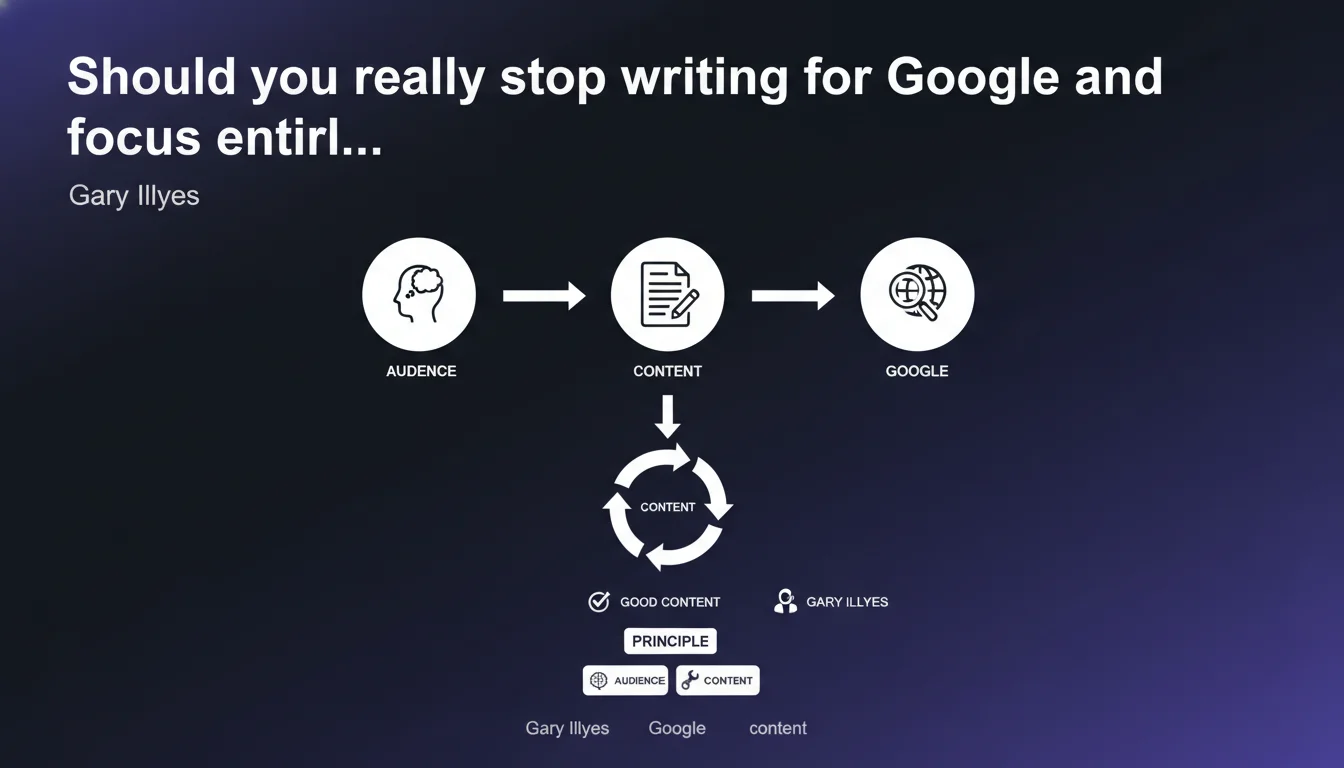
Google claims that content should be created for the audience, not for keywords or search engines. This fundamental principle seems to contradict common SEO practices like semantic optimization and query targeting. Yet, real-world evidence shows that completely ignoring algorithmic constraints limits visibility.
What you need to understand
What exactly does Google mean by "writing for your audience"?
Google advocates a user-centered approach where content first addresses the real needs of visitors. The idea: natural, informative text that is relevant and satisfies search intent without keyword stuffing.
This philosophy aligns with the Helpful Content Guidelines. Algorithms are supposed to reward content created to inform, not to manipulate rankings. Let's be honest — it's a message Google has been repeating for years.
Why does Google emphasize this principle so much?
Two main reasons. First, to limit abuse: keyword stuffing and texts generated solely for ranking degrade user experience. Second, to align incentives: if creators aim for user satisfaction, Google mechanically improves the quality of its results.
The problem? This statement remains vague about technical reality. No search engine can evaluate "quality" without relying on signals — including keywords, semantic structure, and thematic coverage.
Does this principle apply uniformly to all types of search queries?
No. On broad informational queries, natural and comprehensive content can actually perform well without aggressive optimization. But on transactional queries or highly competitive niches, ignoring precise semantic targeting is shooting yourself in the foot.
And that's where it gets tricky. SERPs regularly show that ranking pages combine user relevance AND advanced technical optimization. Saying "just write for your audience" oversimplifies a far more complex reality.
- Creating for your audience means answering search intent with clarity and depth
- Google discourages keyword stuffing and manipulative content
- This principle is part of the Helpful Content Guidelines
- The algorithm cannot evaluate quality without semantic and structural signals
- Application varies based on query type and competition level
SEO Expert opinion
Is this statement consistent with practices observed in the field?
Partially. Ultra-optimized content, packed with exact repetitive variations, genuinely loses ground against more natural and exhaustive texts. The Helpful Content updates confirmed this trend.
But — and this is a big but — pages dominating competitive SERPs don't "just write for their audience." They combine deep understanding of intent, strategic semantic coverage, optimized internal linking, and authority signals. Claiming that SEO optimization is secondary is either naïve or corporate messaging.
What nuances should we add to this principle?
"Writing for your audience" doesn't mean ignoring algorithmic constraints. Excellent invisible content is useless. Semantic optimization — using vocabulary your audience actually searches for — is part of meeting user needs.
The real advice would be: "First understand what your audience is looking for, then structure and phrase your content so both Google AND users understand it." But this version is less marketable. [To verify]: Google claims its NLP naturally detects relevance, but tests show that the presence of expected terms remains a strong signal.
In what cases does this rule not fully apply?
On queries with strong commercial intent, competition demands precise optimization. An e-commerce site that "writes naturally" without targeting product attributes, FAQs, and comparison terms gets crushed.
Same for technical niches where specialized vocabulary is expected. "Natural" but technically imprecise content satisfies neither Google nor expert audiences. The line between "smart optimization" and "over-optimization" is thin — and Google gives no clear metrics to draw it.
Practical impact and recommendations
What should you do concretely to apply this principle?
Start by mapping the real search intentions of your audience. Analyze SERPs, questions asked on forums/social media, Search Console data. The goal: understand what people are REALLY looking for, not what you think they want.
Then, structure your content to directly and fully answer these needs. Prioritize clarity, depth, and completeness over variations stuffing. Good content naturally covers the relevant semantic field without forcing it.
What mistakes should you absolutely avoid?
First trap: believing that "writing for your audience" means zero optimization. You can write the world's best guide — but if it's not structured (Hn, short paragraphs, lists) and doesn't contain expected terms, Google will struggle to position it correctly.
Second mistake: producing "natural" but shallow or off-topic content. Google rewards relevance AND depth. Readable text that answers only 30% of the intent loses to a more comprehensive competitor.
How do you verify that your content respects this principle?
Simple test: have someone unfamiliar with SEO read your text. If that person finds the content useful, clear, and complete without detecting odd repetitions or forced phrasing, you're on the right track.
Next, compare with the top 3 Google results on your target query. Does your content provide equivalent or superior value? Does it cover the same essential aspects? If not, you have a fundamental problem, not a formatting one.
- Analyze actual search intentions via SERPs, forums, and user data
- Prioritize clarity, depth, and completeness over keyword stuffing
- Structure content to facilitate understanding (Hn, lists, short paragraphs)
- Avoid forced repetitions and unnatural phrasing
- Systematically compare with top-ranking content on your target query
- Test readability with non-SEO people
- Naturally integrate the vocabulary expected by your audience without over-optimization
❓ Frequently Asked Questions
Peut-on encore utiliser des mots-clés dans les balises title et meta description ?
L'analyse sémantique et les outils de champ lexical sont-ils encore utiles ?
Comment concilier écriture naturelle et optimisation pour des requêtes très spécifiques ?
Le contenu généré par IA respecte-t-il ce principe d'écriture pour l'audience ?
Faut-il abandonner la recherche de mots-clés ?
🎥 From the same video 4
Other SEO insights extracted from this same Google Search Central video · published on 30/11/2022
🎥 Watch the full video on YouTube →
💬 Comments (0)
Be the first to comment.