
Official statement
What you need to understand
What does this statement from Google actually mean?
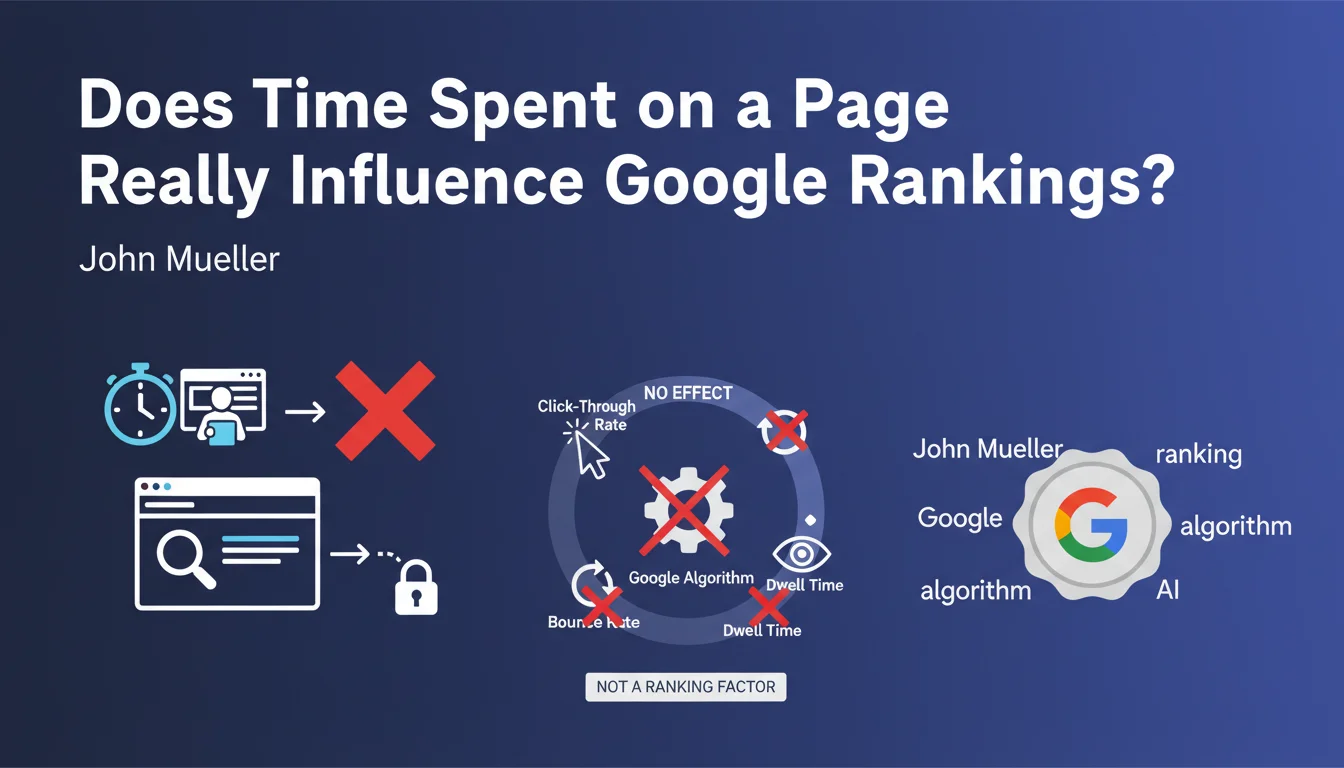
John Mueller, Google's official spokesperson, reaffirms a consistent position: time spent on a page is not a ranking factor. This behavioral metric, also called "dwell time," is not part of the criteria used by the algorithm to evaluate the relevance of content.
Google even extends this clarification to all direct behavioral signals such as bounce rate, click-through rate, or session duration. These Analytics data are therefore not transmitted to the ranking algorithms.
Why can't Google use these metrics?
The main reason is the contextual variability of these signals. A user may spend 10 seconds on a page because they immediately found the information they were looking for (excellent experience), or conversely spend 5 minutes because the content is confusing and difficult to understand (poor experience).
Moreover, these metrics are easily manipulable and vary considerably depending on the type of content: a recipe requires more time than a currency conversion, without this reflecting the respective quality of these pages.
What are the real factors that Google takes into account?
Google focuses on objective and measurable criteria: content quality, semantic relevance, domain authority, technical structure, Core Web Vitals, and overall user experience.
- Content should not be optimized to artificially retain visitors, but to effectively respond to their query
- Behavioral metrics remain useful for your own analysis, but are not ranking signals
- Correlation is not causation: well-ranked pages may have good engagement, but that's not what causes their ranking
- Google uses indirect satisfaction signals such as repeated searches or query modifications
SEO Expert opinion
Is this statement consistent with what we observe in the field?
After 15 years of SEO practice, I confirm that this position from Google is perfectly consistent with observed results. Sites that rank in first position are not necessarily those with the best "dwell time," but those that respond most precisely to search intent.
I have personally tested deliberately streamlined pages, offering an immediate and concise answer, which outperformed longer content supposed to "retain" the user. Speed of satisfaction trumps duration of engagement.
What nuances should we bring to this statement?
Be careful though: while Google doesn't directly use these metrics as ranking factors, it probably uses indirect signals of user satisfaction. For example, if a user systematically returns to search results after visiting your page ("pogo-sticking" phenomenon), this may indicate a problem.
Additionally, Core Web Vitals include interaction metrics like FID and INP that indirectly measure engagement. Google also evaluates whether your page causes refinement searches or reformulations, which are signals of dissatisfaction.
In what cases could this rule evolve?
With the emergence of AI and machine learning systems, Google could theoretically refine its understanding of complex satisfaction signals. However, the easy manipulation of these metrics makes their direct use always problematic.
The current direction is rather toward measurable and objective experience signals (speed, visual stability, responsiveness) rather than subjective and contextual behavioral metrics.
Practical impact and recommendations
What should you concretely do to optimize your SEO?
Forget attempts to artificially increase time spent on your pages. Focus instead on the immediate satisfaction of search intent. Your content must answer the question asked quickly and effectively.
Prioritize a clear information architecture: clickable table of contents, direct answer at the beginning of content, then progressive deepening for those who wish. Users must be able to scan and find what they're looking for in seconds.
What critical mistakes should you absolutely avoid?
Don't fall into the trap of manipulative techniques aimed at artificially retaining users: excessive pagination, essential information hidden at the bottom of the page, walls of text without structure, or intrusive popups. These practices harm user experience.
Also avoid removing your Analytics tools on the pretext that Google doesn't use them. This data remains essential for your own optimization: it reveals UX problems, content to improve, and conversion opportunities.
- Structure your content with clear H2/H3 headings allowing quick scanning
- Place essential information at the beginning of the page (inverted pyramid principle)
- Optimize your internal linking so users can easily find complementary content if they wish
- Improve your Core Web Vitals which are confirmed ranking factors
- Test the clarity of your titles and meta descriptions to avoid disappointments and immediate returns to SERPs
- Analyze your behavioral data in Analytics to detect problematic pages (high bounce rate + low conversion)
- Create content adapted to search intent: concise for simple informational queries, comprehensive for in-depth guides
- Monitor indirect signals such as branded search rate or natural links obtained
How can you verify that your strategy aligns with best practices?
Conduct an audit combining technical and behavioral data. Identify pages where users immediately leave to search elsewhere: this often indicates a problem with relevance or quality rather than a "time spent" problem.
Measure the success of your pages by their ability to completely satisfy search intent, whether in 30 seconds or 5 minutes. The goal is satisfaction, not artificial retention.
💬 Comments (0)
Be the first to comment.