
Official statement
What you need to understand
What is Google's official position on donations for reviews?
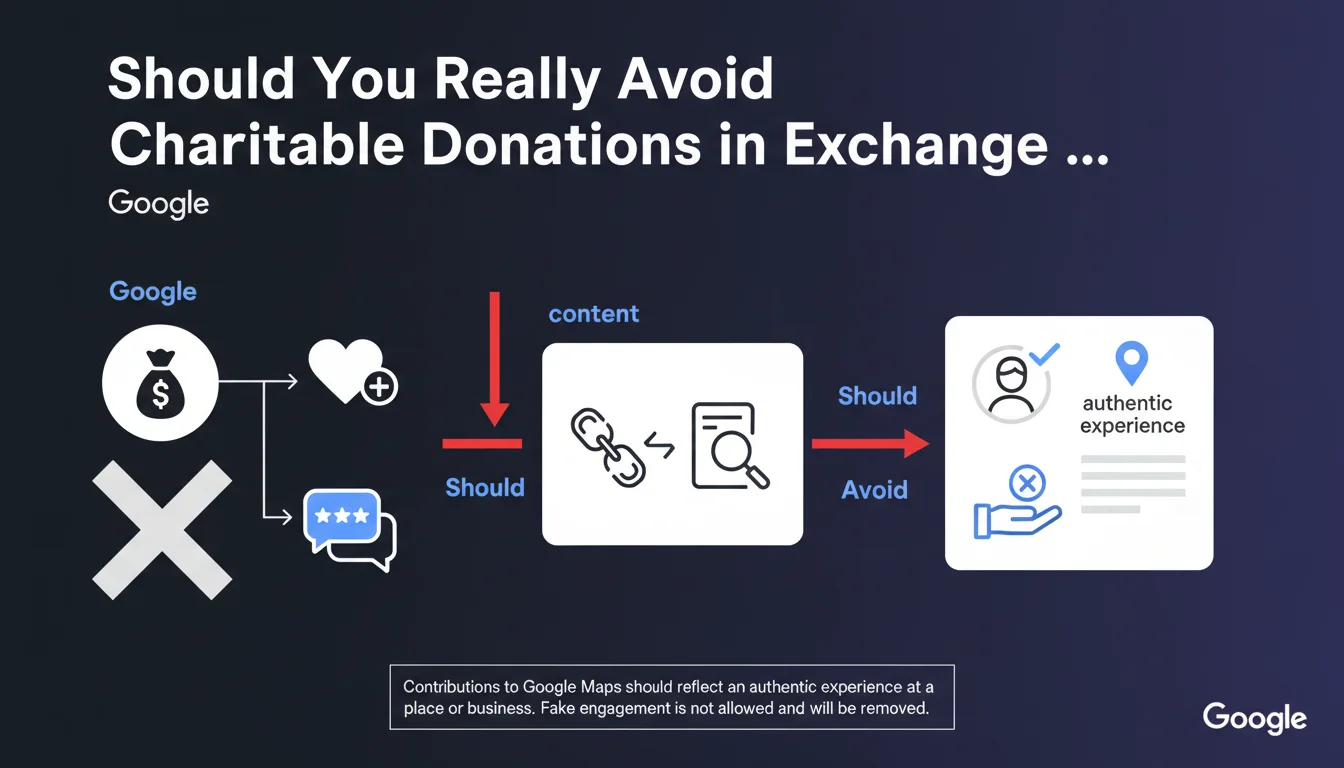
Google clarified its position following a question from Joy Hawkins: making a donation to a charitable organization in exchange for a customer review is strictly contrary to the guidelines of the platform. This practice is considered a form of incentivization, even if the money does not go directly to the review writer.
The rule applies without distinction: whether the review is positive, negative or neutral, as soon as there is a financial consideration (even charitable), it no longer reflects an authentic experience. Google considers these reviews as fake engagement likely to be removed.
Why does Google prohibit this practice?
Google's objective is to preserve the integrity of its reviews and user trust. A review must reflect a real and spontaneous experience, without any form of pressure or incentivization, even indirect.
By allowing charitable donations for reviews, a systematic bias would be created: customers would be more motivated to leave a review to trigger the donation, rather than to authentically share their experience. This would distort the overall ratings of establishments.
What exactly does Google's policy say on this subject?
Google Maps guidelines clearly state: "Contributions must reflect an authentic experience at a place or business. Fake engagement is not allowed and will be removed."
This policy explicitly includes: "Paying, incentivizing, or encouraging the publication of content that does not represent an authentic experience." The term "incentivizing" covers all forms of consideration, including charitable donations.
- Formal prohibition of any form of financial incentive to obtain reviews
- Charitable donations fall into this category of incentives
- The authenticity of the customer experience must take precedence over any other consideration
- Reviews obtained through these methods risk removal
- The rule applies even if the review can be negative
SEO Expert opinion
Is this prohibition consistent with practices observed in the field?
Yes, this position is perfectly consistent with Google's actions in recent years. The search engine has considerably toughened its policy against manipulated reviews, with massive deletions of suspicious reviews and penalties for offending establishments.
In my practice, I observe that Google uses increasingly sophisticated detection algorithms: unusual temporal patterns, similar wording, suspicious author profiles. Establishments that attempt to manipulate their reviews often suffer temporary deindexing or decreases in visibility.
Can Google really detect these charitable donation practices?
This is indeed the main grey area of this directive. Algorithmically detecting that a donation was made in exchange for a review is technically complex, especially if the establishment does not publicly communicate about this practice.
However, several warning signals can betray this strategy: sudden influx of reviews, mentions of the donation in the reviews themselves, visible marketing communications, or reports by competitors. The reputational and legal risk remains significant, even if detection is not systematic.
What nuances should be added to this strict rule?
It is important to distinguish donations conditioned on reviews (prohibited) from authentic charitable actions by the company (acceptable). You can perfectly communicate about your charitable commitments without creating a direct link with customer reviews.
Similarly, offering an exceptional customer experience that naturally encourages positive reviews remains the best strategy. Satisfied customers spontaneously share their experience, without any incentive being necessary. It is this authenticity that Google values in its local ranking algorithm.
Practical impact and recommendations
How can you adapt your review acquisition strategy while respecting these rules?
The absolute priority is to immediately stop any practice of donation conditioned on reviews if you have implemented it. The risk of sanction far exceeds the potential benefits in terms of reputation.
Focus on legitimate strategies: asking for reviews after a purchase or visit (without consideration), simplifying the review submission process, sending personalized follow-up emails, or training your teams to naturally solicit customer feedback.
What critical mistakes must absolutely be avoided?
Never publicly display a link between your charitable actions and customer reviews, even indirectly. Avoid communications like "For each review, we donate $X to a charity" on your marketing materials, social networks or in-store.
Also beware of overly aggressive automated campaigns that systematically solicit all customers. Google detects abnormal spikes in reviews and may consider this as manipulation, even without direct financial incentive.
What should you do if you have already implemented this type of program?
Immediately stop all communication associating donations and reviews. Remove in-store displays, mentions on your website and cease any email campaign making this link.
Document the authentic reviews obtained before and after this practice. If Google contacts you or removes reviews, you can demonstrate your change in strategy and good faith.
- Audit your current communications to identify any mention of donations for reviews
- Immediately remove any marketing material creating this link
- Train your teams on compliant review solicitation practices
- Implement a post-purchase review request process without incentive
- Create personalized and non-intrusive email templates
- Regularly monitor your reviews to detect suspicious patterns
- Develop a true culture of customer service excellence
- Respond systematically and professionally to all reviews
- Document your processes to prove their compliance in case of audit
💬 Comments (0)
Be the first to comment.