
Official statement
What you need to understand
Why does Google advise against using third-party tools to disavow links?
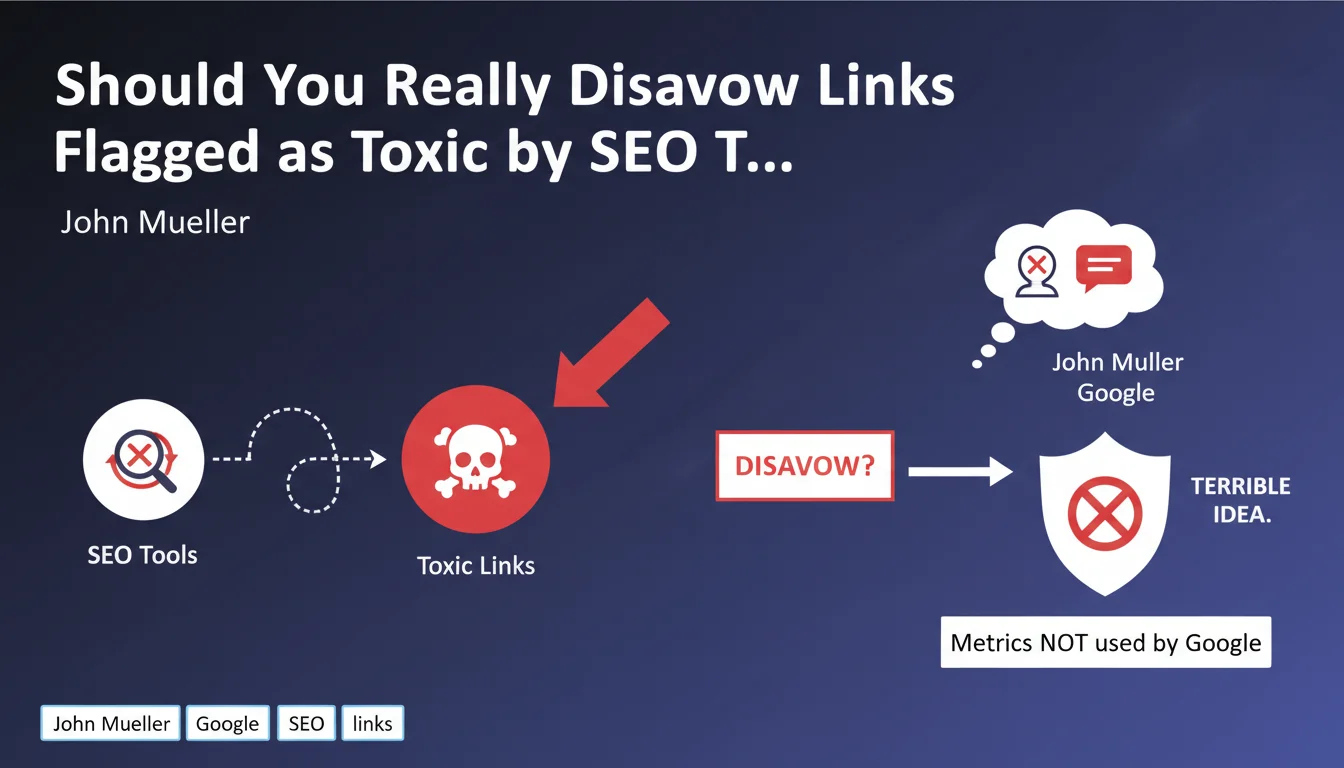
Google clearly states that disavowing links based solely on third-party tool metrics constitutes a strategic mistake. John Mueller emphasizes that the "toxicity" indicators offered by these tools do not correspond to the actual criteria used by Google's algorithm.
These external tools calculate their own link quality scores, often based on proprietary metrics that have no direct correlation with Google's evaluation. Using these scores to massively disavow backlinks can therefore lead to rejecting perfectly legitimate links.
How does Google actually handle low-quality links?
Google's algorithm has evolved considerably since the days of Penguin penalties. Today, the search engine is capable of automatically detecting and ignoring unnatural links without any webmaster intervention.
Rather than penalizing a site for questionable links it didn't necessarily solicit, Google simply chooses to not take these links into account in PageRank calculations. This approach makes the disavow tool largely obsolete for the majority of sites.
In what cases does the disavow tool remain relevant?
The disavow tool was initially created for sites that have suffered explicit manual penalties related to artificial links. It therefore retains usefulness in very specific situations.
- Confirmed manual action in Search Console for unnatural links
- Aggressive and documented negative SEO campaign with massive influx of spam links
- History of black hat link building practices before a migration or redesign
- Need to clean up a link profile before a reconsideration request following a penalty
SEO Expert opinion
Is this statement consistent with practices observed in the field?
After 15 years of observation, I confirm that this position from Google does indeed reflect current reality. Cases where link disavowal has genuinely improved rankings are extremely rare in the absence of a confirmed manual penalty.
I've analyzed dozens of sites that massively disavowed "toxic" links according to third-party tools. In the vast majority of cases, no measurable positive impact was observed. Even worse, some sites lost rankings after disavowing links that, while coming from modest sites, provided real thematic value.
What important nuances should be added to this recommendation?
While Google does indeed handle low-quality links well, there are nevertheless borderline situations that warrant particular vigilance. Massive and coordinated negative SEO attacks can sometimes overwhelm automatic detection capabilities.
Additionally, certain ultra-competitive sectors (casino, loans, health) are subject to stricter manual monitoring. In these areas, an abnormally suspicious link profile can trigger human review, even without a prior complaint.
Why do third-party tools create this confusion about link toxicity?
SEO tools have an obvious commercial interest in dramatizing the issue of toxic links. The more their users perceive a danger, the more they value the audit and monitoring features offered.
These tools calculate their scores according to their own criteria (over-optimized anchor text, exotic TLD, lack of traffic, etc.) that don't necessarily correspond to the signals actually used by Google. A link from a site with a low "authority score" can be perfectly relevant and contextual, therefore valued by Google.
Practical impact and recommendations
What should you actually do with toxic link audits?
When your SEO tool alerts you to thousands of toxic links, resist the urge to disavow everything immediately. Start by checking in Search Console whether you have an active manual action concerning links.
If no penalty is reported and your rankings are stable or growing, these links are probably already ignored by Google without negative impact. Focus your energy on acquiring new quality links rather than preventive cleanup.
What critical mistakes must be absolutely avoided?
The most frequent error consists of massively disavowing links based solely on an automated score. This approach can lead you to reject relevant contextual links that genuinely contribute to your thematic authority.
Also avoid disavowing entire domains without detailed analysis. A site can host both spam content and legitimate pages that naturally reference your business. Page-level disavowal is often more appropriate.
- Never disavow links without verifying the absence of manual action in Search Console
- Manually analyze at least a representative sample of links flagged as toxic
- Favor URL-level disavowal rather than complete domain when appropriate
- Systematically document the reasons for each disavowal for traceability
- Monitor ranking evolution for 4-6 weeks after massive disavowal
- Focus 80% of your efforts on acquiring new quality links
How do you build a healthy and sustainable link strategy?
Rather than spending time on preventive disavowal, invest in a strategy for acquiring natural editorial links. Create reference content in your field, develop thematic partnerships, and cultivate your presence in industry media.
Regularly monitor your link profile via Search Console to detect any flagrant anomalies (sudden spike in spam links, mass over-optimized anchors). Monthly monitoring is more than sufficient to identify real problems.
💬 Comments (0)
Be the first to comment.