
Official statement
Other statements from this video 3 ▾
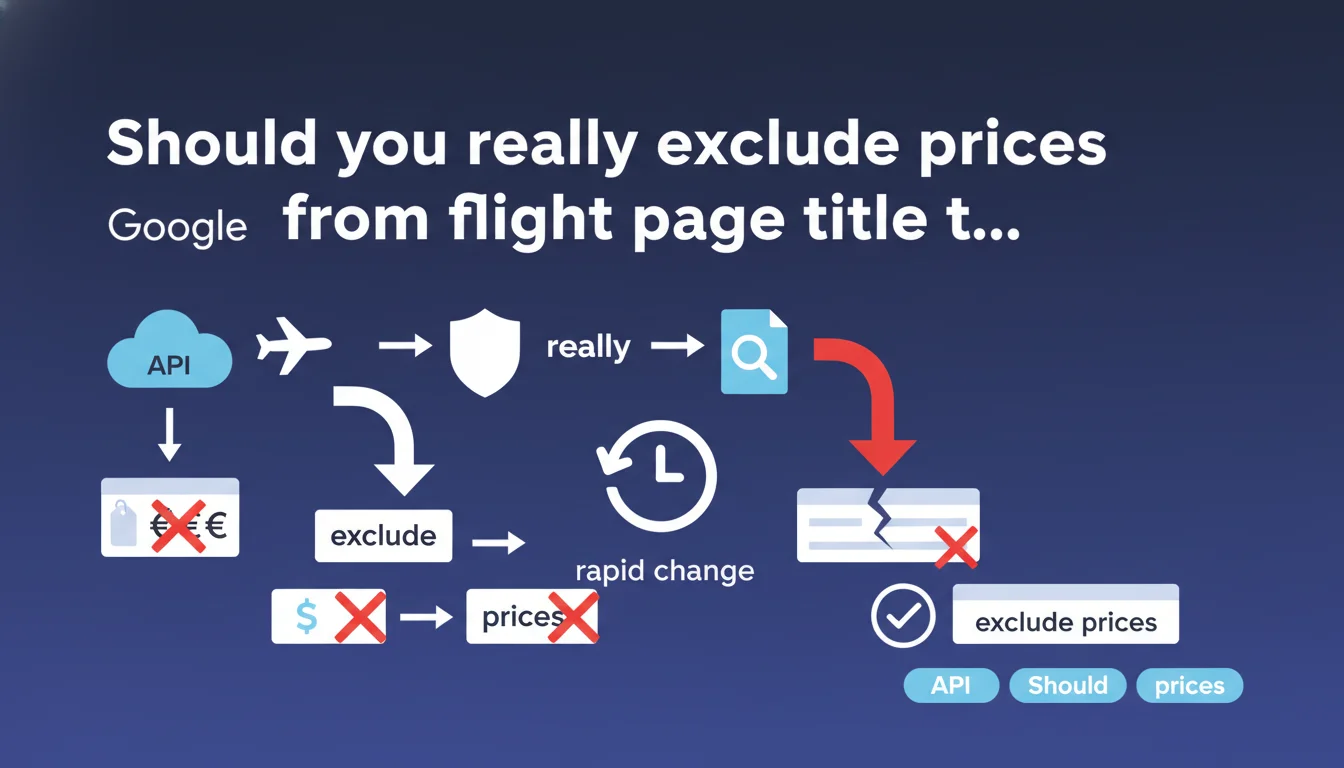
Google recommends never including prices in flight page title tags. The reason given: prices fluctuate too rapidly, which makes the title become outdated and creates a gap between what's promised in the SERP and reality on the page. A simple directive but one that raises questions about its practical implementation.
What you need to understand
Why does Google explicitly discourage prices in flight title tags?
The logic is straightforward: a title tag remains displayed in search results as long as Google doesn't recrawl the page. Yet in the aviation sector, fares change several times a day — sometimes every hour depending on demand.
If your title displays "Paris to New York Flight from €350" but the price has climbed to €480 when the user clicks, you're creating a frustrating experience. Google hates that. Worse: you risk an explosive bounce rate and negative brand perception.
Does this recommendation apply only to flights or to other sectors?
Google only mentions flights here, but the logic naturally extends to any product with volatile pricing. Hotels, car rentals, event tickets — all these sectors share the same issue.
On the other hand, for standard physical products (electronics, clothing) where prices evolve less frenetically, the question is different. The risk of mismatch exists, but it's less critical.
What makes this directive difficult to apply in practice?
The devil is in the technical details. Many travel sites generate their titles dynamically based on search results. Removing the price means overhauling your entire templating logic — and sometimes sacrificing a powerful sales argument.
Because let's be honest: an attractive price in a title tag is a formidable CTR lever. Google tells you not to do it, but gives you no alternative to compensate for this loss of appeal.
- Price-free titles must remain distinctive and compelling — difficult without mentioning the price argument
- Crawl timing works against you: even if you update the title, Google may display the old version for hours
- Structured rich snippets (offers, prices) can display outdated data despite your title efforts
- Aggregators and metasearch engines often scrape your titles: obsolescence spreads beyond Google
SEO Expert opinion
Is this directive consistent with practices observed in the field?
Paradoxically, no. If you examine the SERPs for flight queries, you'll still see dozens of sites displaying prices in their titles. Some major players completely ignore this recommendation — and don't seem to suffer for it.
Why? Because immediate CTR often trumps the risk of delayed dissatisfaction. A title with a price catches the eye, generates clicks, and as long as the landing page remains competitive, the bounce rate stays manageable. Google knows this, but continues to hammer this guideline.
What nuances should be applied to this general rule?
It all depends on your update frequency and your ability to sync titles with real data. If you have a system that recrawls and reindexes your pages every 2 hours with real-time updates, the risk of mismatch becomes marginal.
But realistically? Very few sites have this infrastructure. Most generate titles at initial indexing time, and Google keeps them cached for days. [To verify]: Google has never published data on average recrawl frequency for flight pages based on their authority.
In which cases does this rule absolutely not apply?
If you're working on editorial content about flights (guides, comparisons, fare trend analysis), the question doesn't even arise. A title like "Analysis: Why Paris-Bangkok Flights Have Dropped 30%" poses no problem — the price is contextual, not transactional.
Similarly, on broad category pages ("European Flights", "Long-haul Budget Flights"), the absence of a specific price is natural. The problem concerns almost exclusively individual product pages or highly targeted search result pages.
Practical impact and recommendations
What should you do concretely on your flight pages?
First step: audit your current templates. Identify all title variations that include dynamic prices. Many sites have multiple templates depending on query type — some display the price, others don't.
Next, rethink your titles to maximize CTR without the price. Remaining levers: urgency ("Last Seats"), benefit ("Direct Flight"), differentiation ("Non-stop", "Flexible"). Test multiple formulations — CTR remains your key metric.
What mistakes should you absolutely avoid in this overhaul?
Don't fall into the trap of bland generic titles. "Paris to New York Flight" alone is SEO suicide. You must compensate for the absence of price with something else tangible.
Also avoid mentioning "from" or "starting at" without the price — it sounds hollow and adds no value. If you can't be specific, stick to qualitative attributes.
How do you verify that your implementation is compliant and performant?
Set up monitoring of your titles in the SERP using a tool like OnCrawl, Botify or even a custom scraper. Verify that Google displays what you've defined — not a surprise rewrite including obsolete data.
Monitor your bounce rate and organic CTR in parallel. If you notice a sharp drop after removing prices, it's either a problem with alternative formulation, or proof that your audience is explicitly seeking price-checking — in which case, you may have a search intent problem.
- Identify all title templates including dynamic prices
- Design alternatives focused on benefits, urgency or differentiation
- Test multiple variants via A/B testing if possible
- Update structured data in line with new titles
- Monitor CTR, bounce rate and recrawl frequency post-modification
- Document performance before/after to measure real impact
❓ Frequently Asked Questions
Puis-je afficher un prix dans la meta description si je l'enlève du title ?
Les données structurées Offer avec prix posent-elles le même problème ?
Cette règle s'applique-t-elle aussi aux annonces Google Ads sur les vols ?
Si mes concurrents affichent des prix dans leurs titles, dois-je faire pareil pour rester compétitif ?
Google peut-il pénaliser un site qui continue d'afficher des prix dans les titles de vols ?
🎥 From the same video 3
Other SEO insights extracted from this same Google Search Central video · published on 19/12/2023
🎥 Watch the full video on YouTube →
💬 Comments (0)
Be the first to comment.