
Official statement
What you need to understand
What does this Google statement about directories really mean?
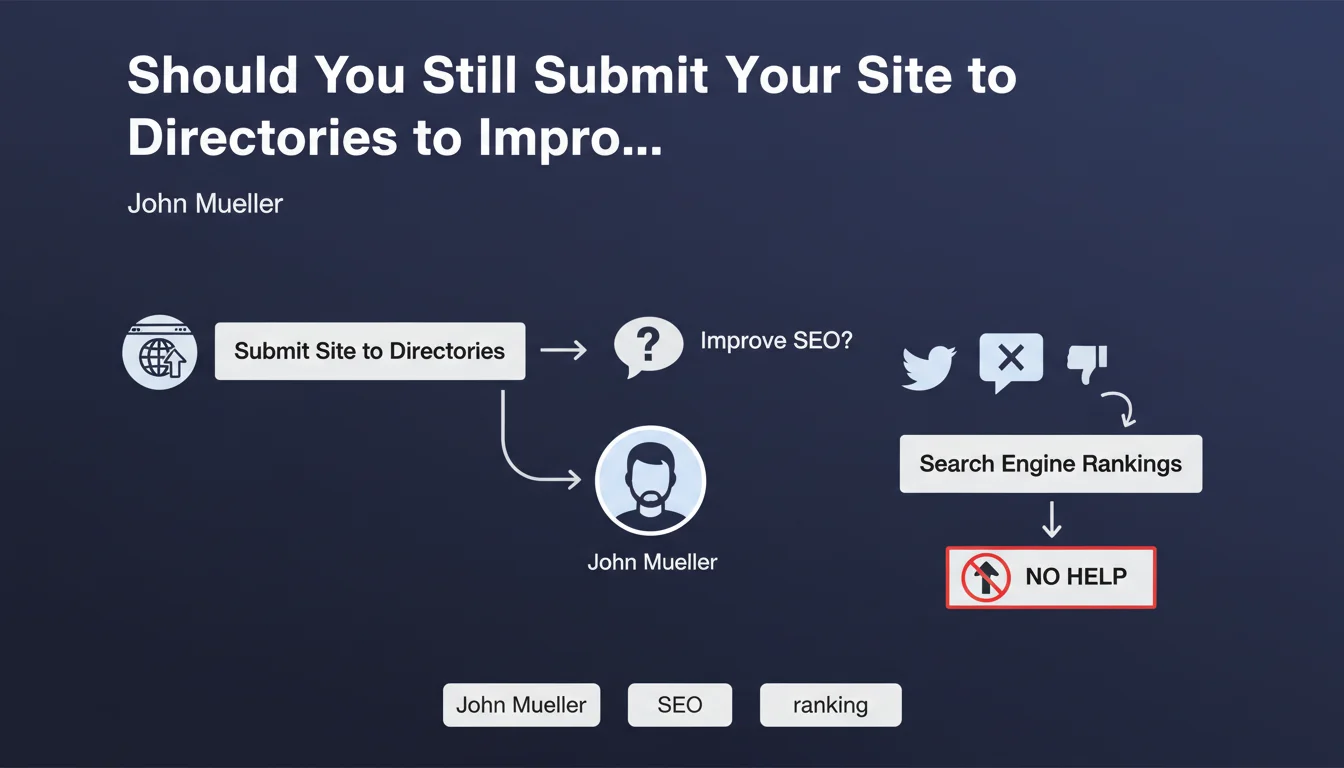
John Mueller clarified Google's position regarding directory submissions. According to him, this practice "generally" provides no benefit for ranking in search results.
This statement specifically targets directories created primarily for SEO purposes, meaning to generate artificial backlinks. Google considers these links as having little to no value in its ranking algorithm.
Why are SEO directories no longer effective?
SEO directories belong to a bygone era of search engine optimization, before Google perfected its algorithms for detecting artificial link patterns. The modern algorithm favors natural, contextual links from relevant content.
Google has developed sophisticated capabilities to identify link farms and low-quality directories. These platforms rarely offer real added value to users, making them natural candidates for devaluation.
Are there exceptions to this general rule?
The term "generally" used by Mueller suggests that not all directories are equal. Some legitimate, specialized directories in specific sectors may still provide some value.
Directories that genuinely serve users in finding services, that are editorially curated and selective, may retain relevance. However, these are exceptions rather than the norm.
- Generic SEO directories generally provide no benefit
- Google effectively detects artificial link patterns
- Some legitimate professional directories may be exceptions
- A directory's value depends on its actual usefulness to users
SEO Expert opinion
Is this position consistent with practices observed in the field?
After 15 years of observation, this statement confirms what SEO professionals have been noticing for several years. Massive campaigns submitting to hundreds of directories no longer produce measurable results, and may even trigger algorithmic penalties.
Sites that continue investing time in these obsolete practices are missing out on much more effective strategies. The return on investment from submitting to generic directories is close to zero in the majority of cases.
What important nuances should be added to this statement?
The crucial nuance lies in distinguishing between SEO directories and professional platforms. A listing on Google Business Profile, Yelp in certain countries, or recognized industry directories like Yellow Pages maintains its relevance.
These platforms generate real traffic, strengthen local citation consistency (NAP) and genuinely serve users. Their value doesn't reside solely in the link, but in the complete ecosystem they create.
In what contexts might this strategy still have minimal interest?
For a newly created site, a few selective listings on quality directories can help accelerate indexing and create an initial online presence. The goal isn't the link, but initial discoverability.
In certain very specific niche sectors, specialized directories with selection committees can provide targeted visibility. However, this represents less than 5% of cases and requires case-by-case analysis.
Practical impact and recommendations
What should you actually do with this information?
Immediately, stop all campaigns of massive submission to generic SEO directories. These efforts should be reallocated toward modern link building strategies: quality content creation, digital press relations, editorial partnerships.
Focus on essential local citations if your business has a geographical dimension. Verify the consistency of your NAP information on platforms that actually generate traffic.
How do you audit your existing directory backlinks?
Conduct a link profile audit to identify low-quality directories pointing to your site. Use tools like Google Search Console, Ahrefs or Semrush for this analysis.
If you identify links from suspicious directories or link farms, consider disavowing them via Google Search Console. However, Google generally ignores these links automatically, so the priority remains low.
What alternatives should you prioritize for your link strategy?
Invest in content marketing: create quality resources that naturally attract editorial links. Comprehensive guides, case studies, infographics and original data generate authentic backlinks.
Develop strategic partnerships with complementary players in your sector. Collaborations, guest posting on recognized media outlets and influencer relations offer significantly higher ROI.
- Immediately stop all submission to generic SEO directories
- Maintain only citations on legitimate and industry-specific platforms
- Audit your backlink profile to identify toxic links
- Redirect your budget toward content marketing and digital press relations
- Prioritize quality and contextual relevance of links
- Verify consistency of your local citations (NAP) on major platforms
- Develop a link building strategy based on value creation
💬 Comments (0)
Be the first to comment.