
Official statement
What you need to understand
What is Google's practice regarding date display in SERPs?
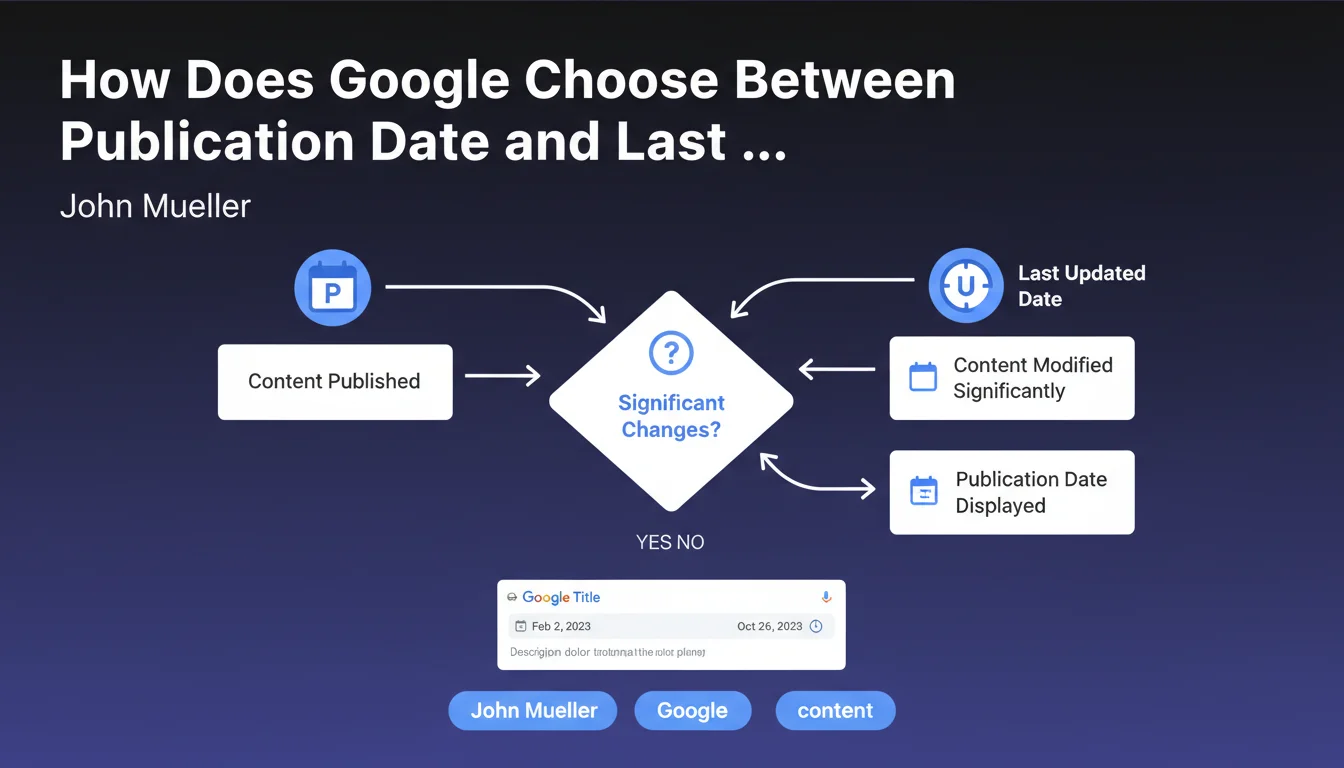
Google displays a date to the left of the snippet in its search results. This date can be either the original publication date or the last modification date of the content.
The choice between these two options depends on the context and the extent of modifications made to the content. If the changes are substantial, Google will favor the updated date rather than the initial publication date.
Why does this distinction matter for SEO?
This information directly impacts the perceived freshness of your content by users. A recent date can improve the click-through rate for queries sensitive to current events.
Understanding this mechanism allows you to optimize your content update strategy and avoid misleading dates that could harm your credibility.
What signals does Google use to make this decision?
Google analyzes the degree of content modification to determine which date to display. Minor changes (typographical corrections) generally don't trigger a date change.
On the other hand, substantial modifications such as adding important sections, updating data, or rewriting arguments can lead Google to favor the update date.
- Google chooses between publication date and modification date based on context
- Substantial modifications trigger the display of the update date
- The precise criteria remain unclear but are related to the extent of changes
- This date influences the perceived freshness of the content
- The impact on CTR can be significant for certain queries
SEO Expert opinion
Is this statement consistent with field observations?
This revelation from Google confirms what many SEO practitioners have been observing empirically for years. Tests indeed show that certain pages see their date evolve after major updates.
However, the gray area persists regarding the exact criteria. I've observed cases where significant modifications (30-40% of the content) didn't trigger a date change, while other more modest updates did.
What nuances should be added to this statement?
The notion of "significant modification" remains subjective and is probably calculated algorithmically. Google likely uses semantic signals to evaluate whether the meaning or value of the content has truly changed.
Simply modifying 50% of the text isn't enough to guarantee a date update. Google seems to differentiate between cosmetic changes and genuine content enrichments.
In what cases doesn't this rule apply systematically?
For evergreen content or institutional pages, Google often favors the original publication date even after updates. The nature of the content therefore influences the algorithm's behavior.
Pages without structured date markup (schema.org) leave Google to extract dates from visible content, which can create inconsistencies. The presence of multiple dates on a page also complicates Google's decision.
Practical impact and recommendations
How can you optimize date markup to maximize your chances?
Systematically implement schema.org markup with the datePublished and dateModified properties. This structuring helps Google clearly identify your dates.
Ensure consistency across all dates displayed on your page: meta tag, schema.org, visible date in the content. Inconsistencies create confusion for Google.
What update strategies should you adopt to leverage this mechanism?
Favor substantial updates rather than frequent cosmetic tweaks. Add new sections, update data, enrich the analysis rather than simply rephrasing.
For time-sensitive content, plan in-depth revision cycles that legitimately justify a date change. Document these changes in a visible history if relevant.
What should you absolutely check and avoid?
Never manually modify dates without actual content changes. This practice is detectable and counterproductive in the long term.
Monitor in Search Console how Google indexes your dates. Regularly verify that the date displayed in SERPs matches your editorial strategy.
- Implement schema.org markup with datePublished and dateModified on all content pages
- Verify date consistency between schema, meta tags, and visible display
- Plan substantial updates rather than frequent superficial modifications
- Document major changes with a revision history if relevant
- Test the impact of updates on date display in SERPs via Search Console
- Avoid any artificial manipulation of dates without actual content modification
- Adapt the strategy according to content type (news vs evergreen)
- Monitor CTR before/after date changes to measure impact
Managing dates in SERPs requires a strategic approach combining rigorous technical markup and coherent editorial policy. The challenge is twofold: satisfying Google's algorithmic criteria while providing transparent information to users.
These technical and editorial optimizations require specialized expertise and continuous monitoring. Between implementing structured markup, auditing date consistency, defining an update policy, and monitoring results, the complexity can quickly become significant. For businesses wanting to fully leverage this tool without mobilizing substantial internal resources, support from a specialized SEO agency provides a personalized strategy and professional implementation, ensuring both technical compliance and editorial coherence.
💬 Comments (0)
Be the first to comment.