
Official statement
What you need to understand
Why Can't Google Accept Cookies During Crawling?
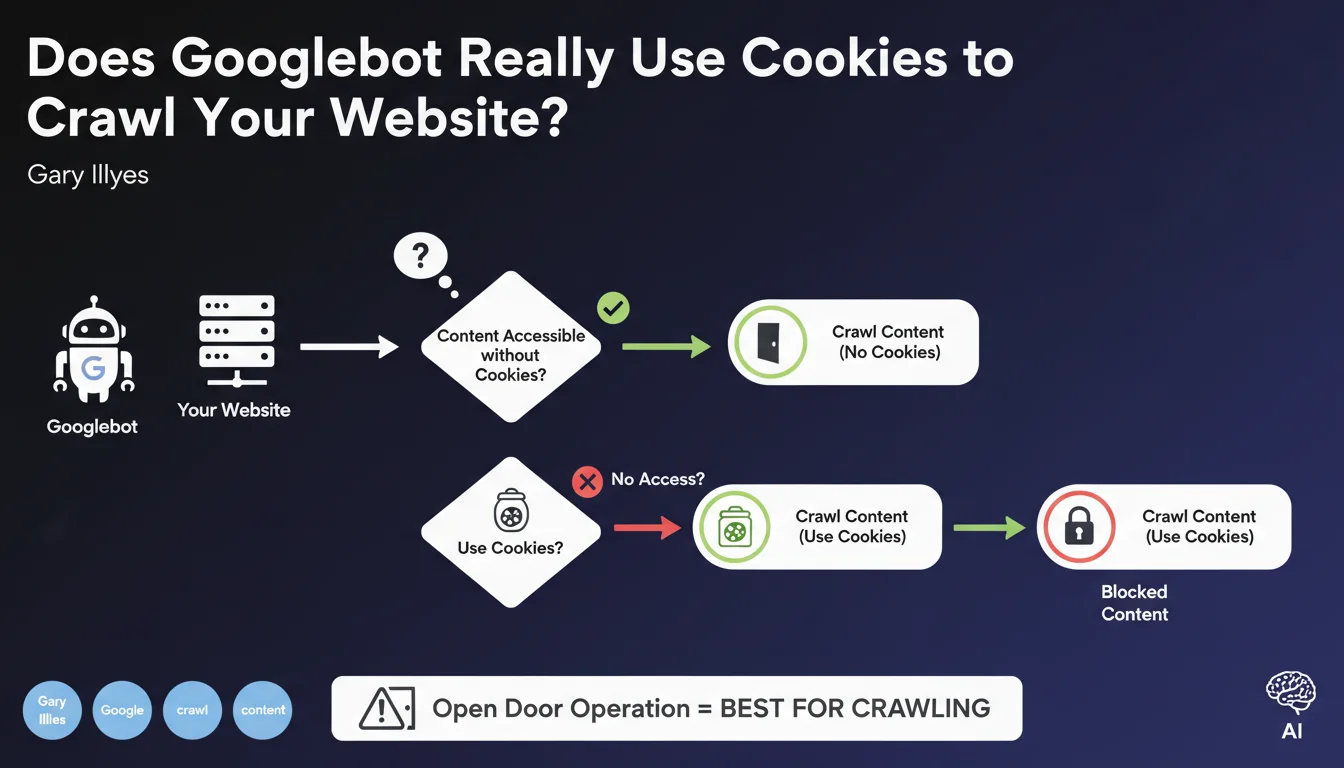
Google's crawling robots (Googlebot) cannot interact with JavaScript elements that require user action such as clicking a button. They browse the web in an automated manner and do not have the capability to consent to accepting cookies.
When a page displays a cookie banner that blocks access to the main content until the user has made their choice, Googlebot faces an insurmountable wall. It then only sees an empty or partially accessible page, which seriously compromises indexation.
What Are the Concrete Consequences for Indexation?
If your content is hidden behind a blocking cookie banner, Google will not be able to analyze it, understand it, or rank it in its search results. This is equivalent to making your pages invisible to the search engine.
This situation particularly affects sites that use poorly configured consent management solutions, where the main content is inaccessible without prior interaction. The risk is a drastic drop in organic traffic.
How Does This Issue Fit Within the GDPR Framework?
The GDPR requires explicit consent from users before placing non-essential cookies. This legal constraint sometimes conflicts with the technical needs of SEO if poorly implemented.
The solution lies in an intelligent implementation that respects both legislation and natural search engine requirements. It is possible to be GDPR compliant while remaining crawlable.
- Googlebot cannot click on cookie banners or accept conditions
- Content blocked by a consent banner becomes invisible to Google
- This situation can lead to a progressive de-indexation of affected pages
- GDPR and SEO can coexist with appropriate configuration
- Cookies essential to the site's functioning can be exempted from consent
SEO Expert opinion
Does This Statement Align with Real-World Observations?
Absolutely. In the field, we regularly observe significant visibility losses after installing poorly configured consent management solutions. Tools like Google Search Console often reveal rendering errors on these pages.
Tests with the URL Inspection tool in Search Console clearly show that when content is conditional on accepting cookies, Googlebot receives an impoverished version of the page. This technical reality is confirmed by the regular audits we conduct.
What Essential Nuances Should Be Added to This Rule?
There is a fundamental distinction between banners that block content display (modal overlay) and those that simply overlay without preventing access. Only the former actually pose a problem for crawling.
Moreover, certain cookies called "technical" or "essential" to the site's operation do not require consent under GDPR. These cookies can be placed automatically without compromising either legal compliance or natural search engine optimization.
In Which Specific Cases Does This Rule Require Particular Attention?
E-commerce sites are particularly vulnerable because they often use numerous cookies for tracking, shopping carts, and personalized recommendations. Poor configuration can make product pages invisible to Google.
Media and editorial sites that monetize through programmatic advertising are also affected. Their dependence on third-party cookies sometimes pushes them to implement very restrictive banners that negatively impact crawling and indexation.
Practical impact and recommendations
What Should You Check Immediately on Your Site?
Use the URL Inspection tool in Google Search Console on your main pages to visualize exactly what Googlebot perceives. Compare this view with that of a standard browser to identify any differences.
Also test your pages in private browsing mode without accepting cookies. If the main content is not visible or accessible, you've identified a critical problem to fix immediately.
What Implementation Best Practices Should You Follow?
Configure your cookie banner in non-blocking mode: it should display as an overlay but allow access to content without requiring prior action. The user can scroll and read even if the banner is present.
Use a bot detector in your CMP to automatically serve crawling robots a version without a blocking banner. Most professional solutions offer this functionality natively.
Ensure that strictly necessary cookies for the site's technical operation (session, security, load balancing) are exempted from consent and placed automatically. This respects GDPR while preserving SEO.
- Test the rendering of your pages with Google Search Console's URL Inspection tool
- Verify that main content is accessible without accepting cookies
- Configure your CMP in non-blocking mode or with robot detection
- Clearly distinguish essential cookies (exempted) from non-essential cookies
- Regularly audit strategic pages to detect any indexation issues
- Document your consent management solution configuration
- Train technical teams on SEO issues related to GDPR
- Implement automatic monitoring of crawl errors related to cookies
Cookie consent management represents a complex technical challenge that requires cross-expertise in web development, GDPR compliance, and natural search engine optimization. Poor configuration can have disastrous consequences on your organic visibility.
The balance between legal compliance and SEO performance requires a methodical approach and rigorous testing. Given the complexity of these optimizations and the associated risks, support from a specialized SEO agency can prove valuable to secure your approach and guarantee optimal implementation that preserves both your compliance and your search engine rankings.
💬 Comments (0)
Be the first to comment.