
Official statement
What you need to understand
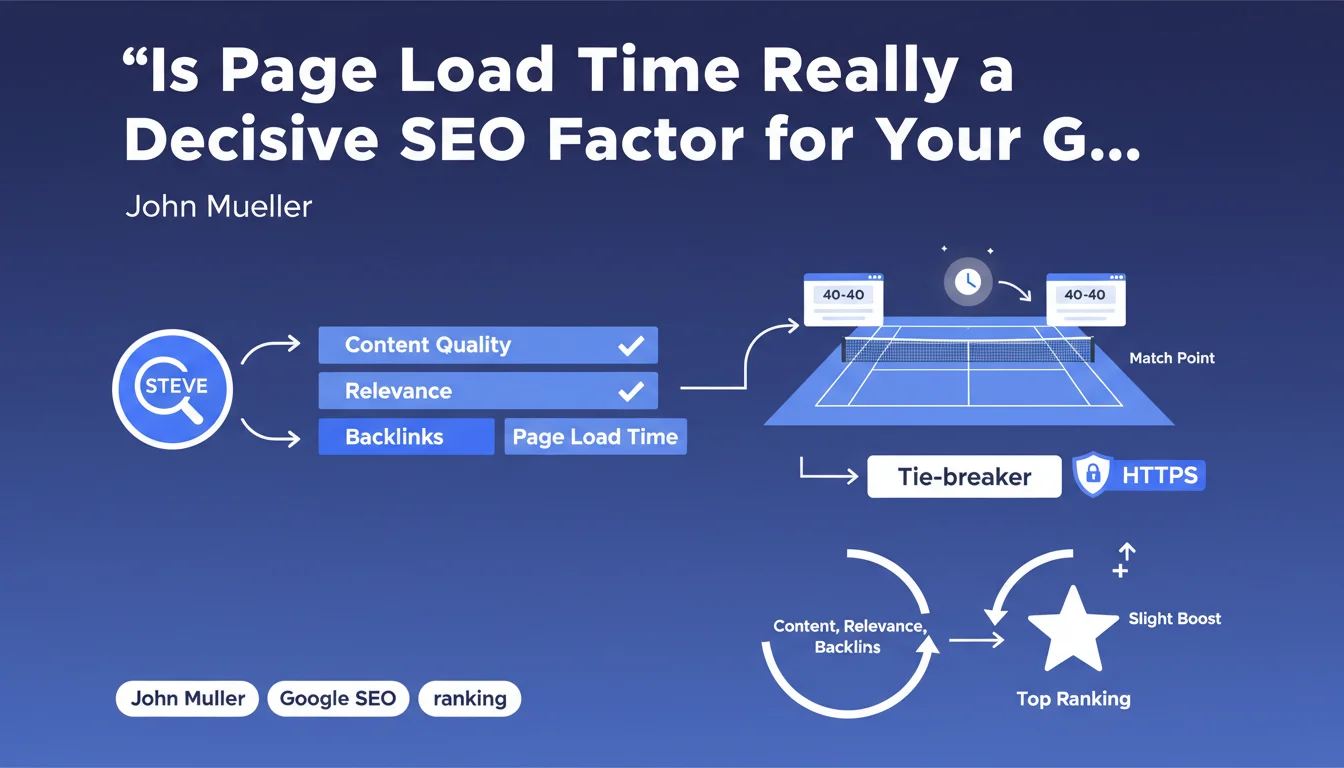
Google has officially confirmed that page load time functions as a tiebreaker criterion, similar to a tie-break in tennis. This signal only comes into play when several pages are judged equivalent in quality and relevance.
The Google Zurich team used the metaphor of a fictional search engine named "Steve" to explain their philosophy. In this model, speed is not a primary ranking factor, but rather a secondary element to decide between content of equal value.
This revelation fits into the context of the Page Experience and Core Web Vitals update. Google has multiplied communications to temper expectations and clarify that this update would not radically disrupt search results.
- Page load time acts as a tie-breaker, not as a primary criterion
- HTTPS follows the same logic and has even seen its weight decrease since its introduction
- Google needs more tie-breakers than before to separate content
- The Core Web Vitals update should not cause major changes in SERPs
- Content relevance and quality remain the dominant factors
SEO Expert opinion
This statement is perfectly consistent with field observations from recent years. Since the rollout of Core Web Vitals in 2021, we indeed observe that slow sites with excellent content continue to rank well against fast sites with less relevant content.
However, this point must be nuanced according to competitive contexts. In ultra-competitive niches where ten sites offer nearly identical content, speed can tip the positions. Conversely, on queries where you have unique expertise, a few tenths of a second won't change anything.
The evolution of HTTPS is also revealing: Google tests the impact of its new criteria with an initially high weight, then gradually adjusts according to observed results. This pragmatic approach suggests that Core Web Vitals could follow a similar trajectory.
Practical impact and recommendations
- Don't panic if your Core Web Vitals aren't perfect: focus first on creating unique and relevant content
- Audit your direct competitors: if you're equal in quality with them, then speed becomes a differentiating lever to activate
- Set reasonable thresholds: aim for "green" on Core Web Vitals without investing fortunes to gain 0.2 seconds on an already performing site
- Beware of alarmist discourse: an agency that presents Core Web Vitals as a major revolution is probably manipulating reality to sell services
- Invest intelligently: if your content is mediocre, an ultra-fast site won't change anything; improve your content first
- Monitor user experience: behavioral metrics (bounce rate, time on site, pages per session) have an indirect but real impact on SEO
- Prioritize mobile: Google indexes mobile-first, so performance on smartphones is more critical than on desktop
- Document your performance: track the evolution of your speed metrics in correlation with your rankings to identify real levers
These technical optimizations often require specialized expertise in web performance, server architecture and data analysis. The interactions between content, technical aspects and speed form a complex ecosystem where each site presents specific challenges. For businesses that want to structure a comprehensive approach and avoid false priorities, support from an experienced SEO agency allows them to build a balanced strategy and allocate resources to levers that actually generate results.
💬 Comments (0)
Be the first to comment.