
Official statement
What you need to understand
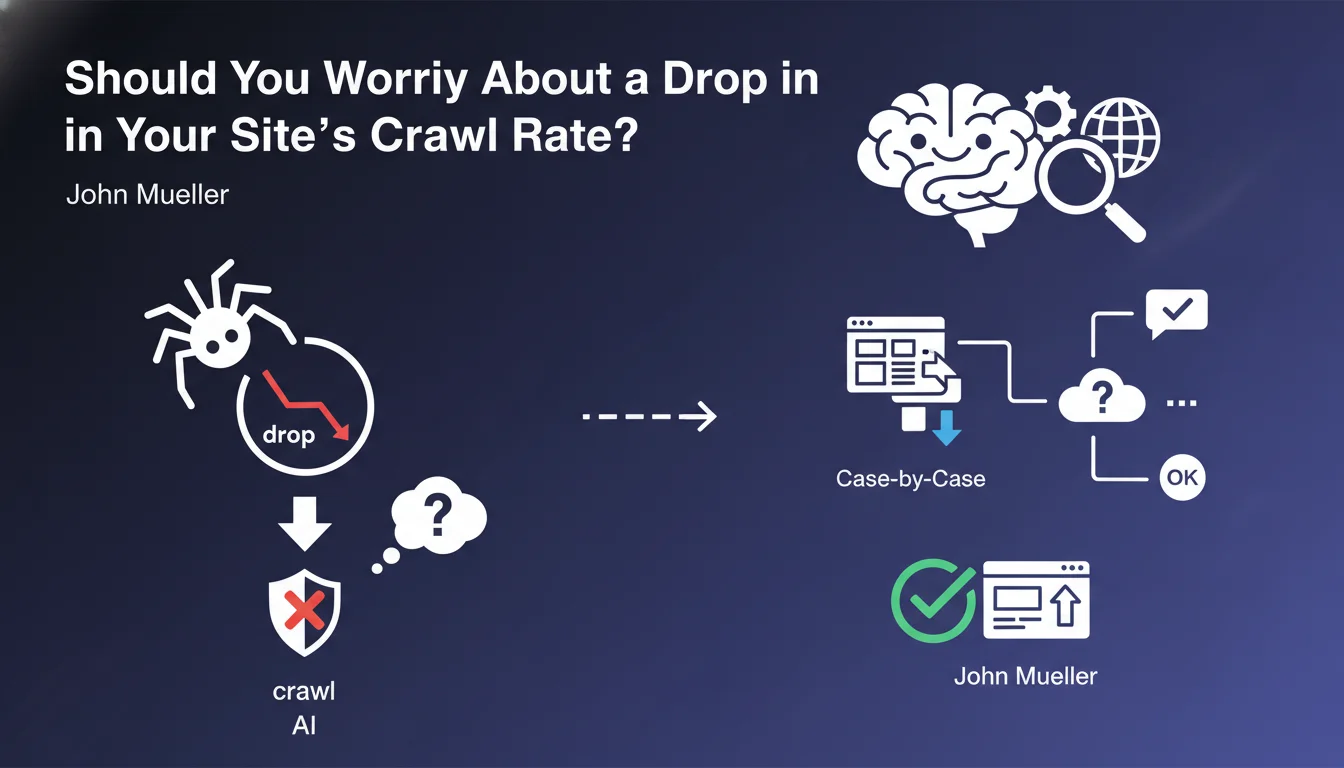
The crawl rate represents the frequency and intensity with which Googlebot explores the pages of your site. In Search Console, Google offers a parameter to limit this rate, but this functionality is often misunderstood and misused.
John Mueller emphasizes that for very large sites, this manual modification is not recommended. Googlebot uses sophisticated algorithms to automatically determine the optimal exploration pace, taking into account server health, content freshness, and many other signals.
Key points to remember:
- Googlebot automatically adjusts its crawl rate based on your server's capabilities
- The engine detects slowdowns and adapts to avoid overloading your infrastructure
- Manually limiting the crawl can slow down the indexing of important new pages
- This parameter only serves to limit the crawl, never to increase it
- Google naturally prioritizes sites with quality content and sound technical architecture
The editorial recommendation goes even further by suggesting to never touch this setting, regardless of site size, except in exceptional cases of major server problems.
SEO Expert opinion
This position from Google is completely consistent with field observations. In 99% of cases, sites that limit their crawl rate do so out of ignorance or unfounded fear of server overload. However, Googlebot is particularly respectful of server resources: it automatically slows down as soon as it detects degraded response times or 5xx errors.
However, there are a few legitimate cases where temporary limitation may be justified: during a major technical migration with undersized servers, during a complete redesign with a fragile production environment, or on e-commerce sites with extreme load peaks during critical commercial events. Even in these situations, it's better to solve the infrastructure problem than to throttle Googlebot.
Practical impact and recommendations
- TO DO: Check your server's technical health (response time, availability) in Search Console
- TO DO: Optimize server performance to naturally support intensive crawling (cache, CDN, database optimization)
- TO DO: Work on your internal linking architecture to effectively guide Googlebot to your priority pages
- TO DO: Use the robots.txt file and noindex tags to avoid crawling pages without SEO value (useless facets, internal search pages)
- TO DO: Monitor crawl statistics in Search Console to detect any anomalies
- NOT TO DO: Modify the crawl rate in Search Console without major and temporary technical reasons
- NOT TO DO: Believe that artificially increasing the crawl will improve your SEO (this parameter only allows limitation)
- NOT TO DO: Confuse crawl budget and crawl rate: work on quality and structure rather than arbitrary limitations
- SPECIAL CASE: If you really must temporarily limit (critical migration), document the reason and plan rapid reactivation of automatic mode
💬 Comments (0)
Be the first to comment.